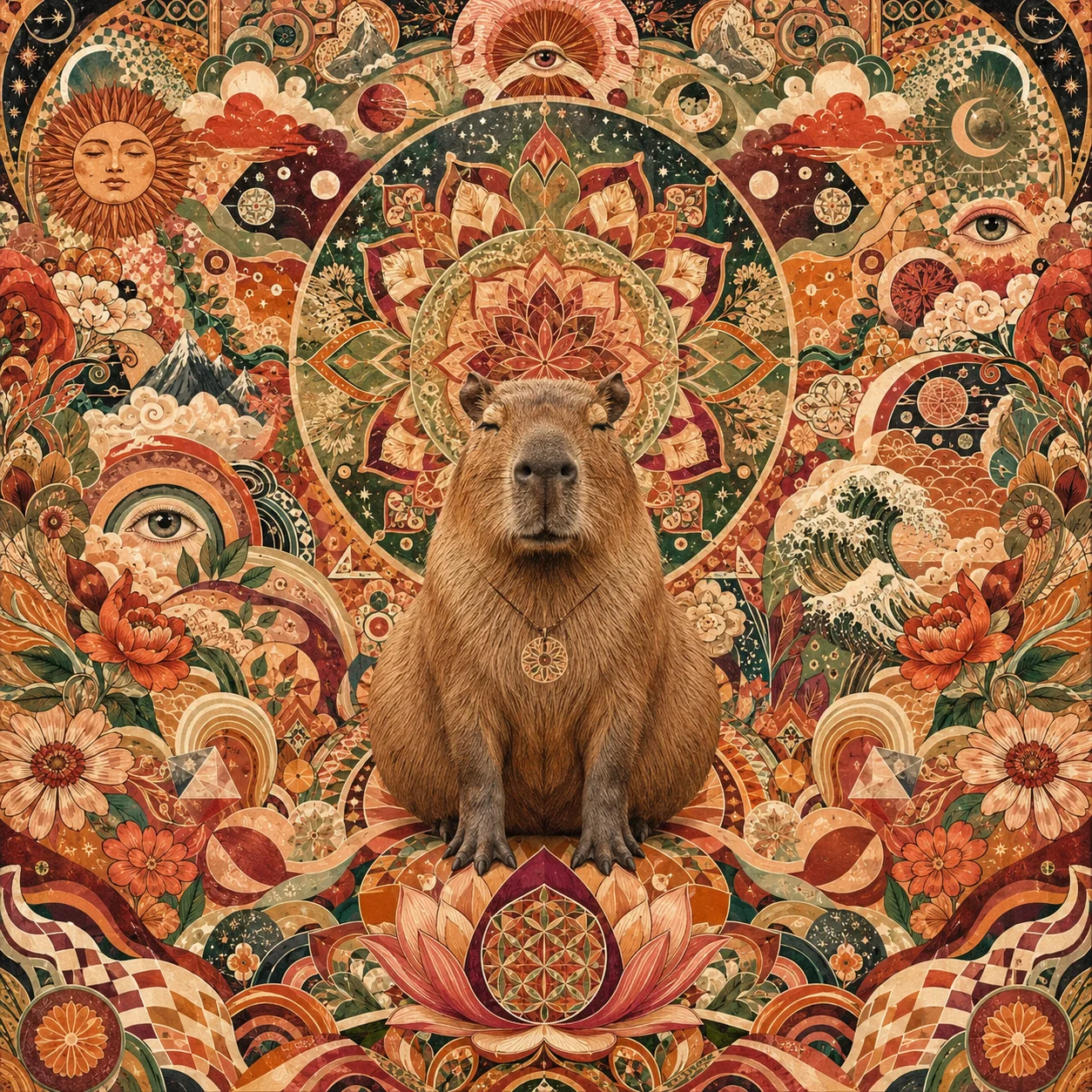
sat still long enough that the cosmos arranged a whole mandala around it. the capy neither confirms nor denies enlightenment.
about the image
the capybara is seated dead-center in a massive ornate mandala — lotus throne, gold medallion around its neck, expression unchanged. radiating out from it: a sun deity with closed eyes, Hokusai’s Great Wave, all-seeing eyes, mountain peaks, crescent moons, symmetrical floral patterns stacked in every direction. the color palette is warm terracotta, deep reds, forest greens, gold.
the gold necklace is the bit. the universe clearly gave it a whole spiritual coronation, complete with a medallion, and the capy is just sitting there wearing it like it showed up in the mail and seemed fine to keep.
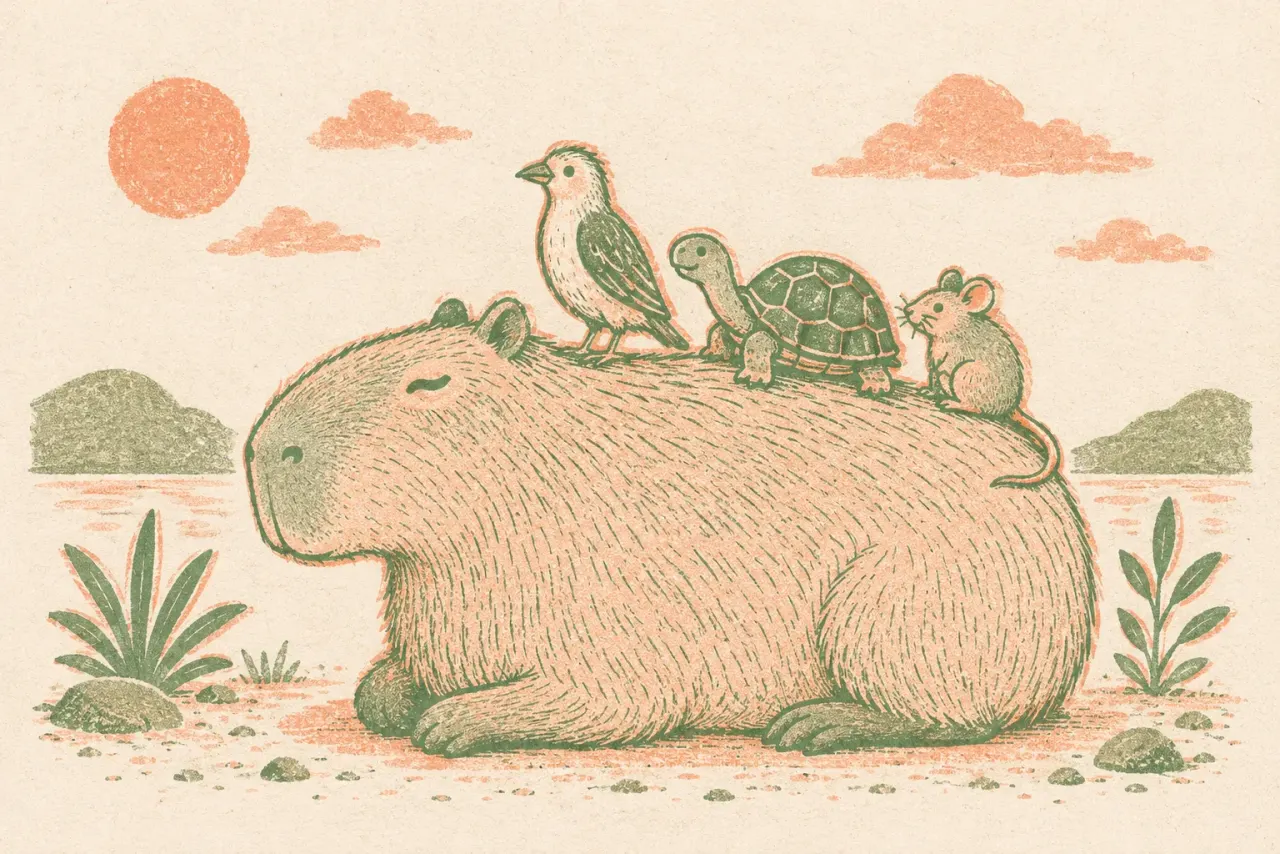
the meme format here is “unbothered entity as cosmic center” — a long internet tradition. what makes the capybara version work better than most is that capybaras genuinely are like this. they sit still while birds land on them, while other animals eat directly next to them, while full environmental chaos unfolds at close range. the mandala isn’t a stretch. it’s practically a nature documentary.
some actual facts about mandalas
the word comes from Sanskrit and means roughly “circle” or “disc.” mandalas appear in Hindu and Buddhist traditions as visual tools for meditation and ritual — the idea being that the symmetrical structure gives the mind something to settle into.
Carl Jung brought mandalas into Western psychology in the early 20th century. he believed that when people spontaneously drew circles and radial patterns, it reflected a kind of psychological centering — the self trying to organize itself. he drew his own every morning for years. this is either profound or a very elaborate journaling habit, depending on how you look at it.
in Tibetan Buddhism there’s a specific tradition of sand mandalas: monks spend days or weeks building one grain by grain, using colored sand and metal funnels, reaching levels of detail that take your breath away. then, when it’s complete, they sweep it away. the destruction is part of the practice — impermanence, not preservation. the capy would probably be fine with this.
mandala-like structures show up independently across cultures: Native American medicine wheels, the rose windows in Gothic cathedrals, Celtic knotwork, Islamic geometric tilework. the human brain seems drawn to radial symmetry as a container for meaning. the capybara, apparently, just sits inside one.
caption variations
- achieved enlightenment by refusing to check notifications.
- the universe arranged itself. the capy did not help.
- inner peace, outer loaf.
- unlocked cosmic stillness. declined the webinar.
- when the mandala forms around you but you are still thinking about grass.
- no thoughts, just wetland divinity.
useful capybara fact under the joke
Capybaras often look meditative because their body language is subtle and their resting face is extremely low-drama. That does not mean they are blank inside. They are vocal, social animals that keep track of group members, respond to alarm calls, groom, graze, and use water as shelter. The meme turns stillness into enlightenment; the real animal is quietly monitoring a whole wetland situation.