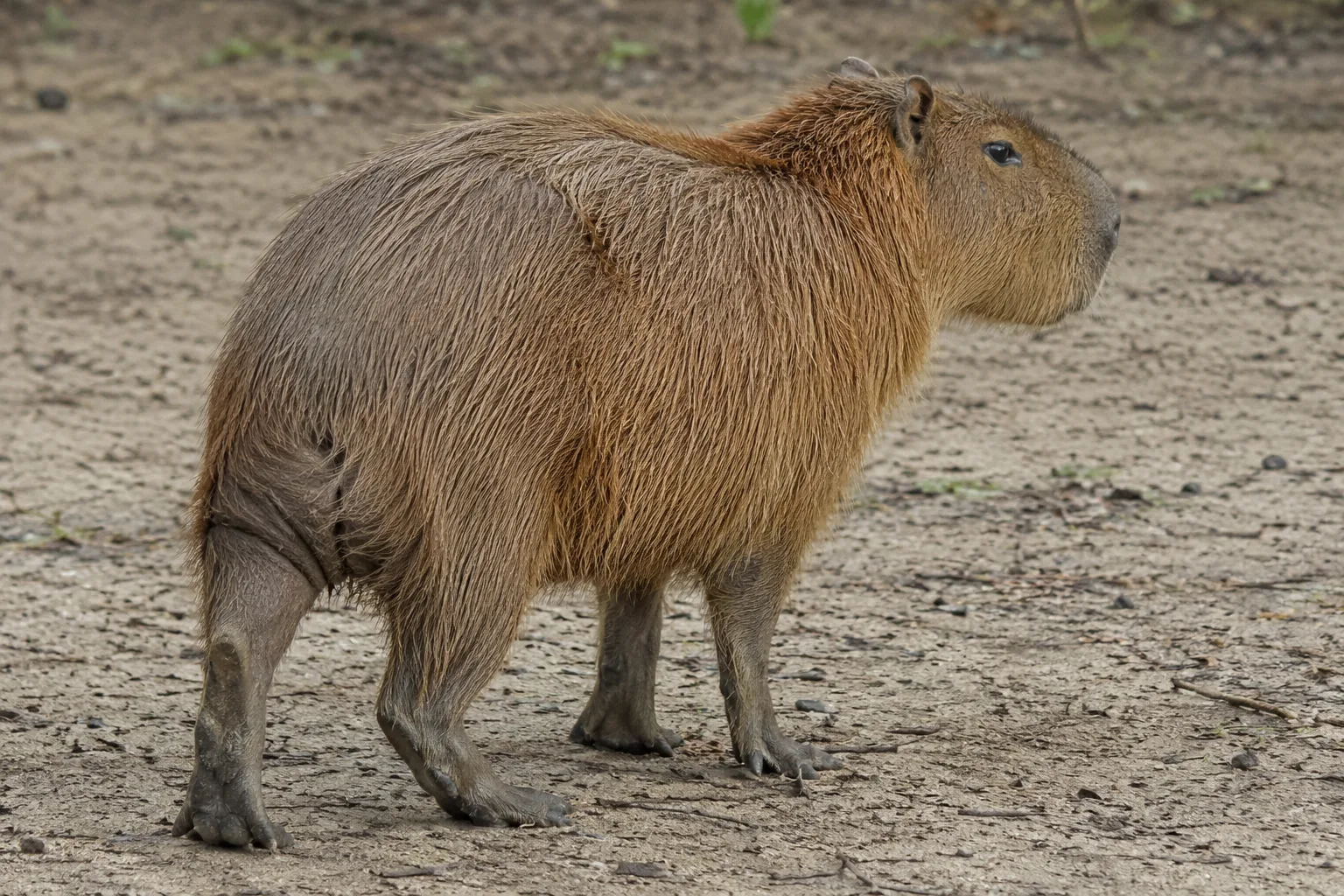

Capybaras do not hunt, stalk, chase, or defend a kill. Nothing in the animal is built for hurting you on purpose. The risk is entirely defensive, it is rare, and it is decided almost completely by the situation you meet the animal in rather than by the animal itself.
Every short answer stops there, which is why the question keeps getting asked. The part that gets left off: a capybara bite is a real emergency-department problem, with a wound that has to be irrigated and closed and a week of antibiotics behind it. Both things are true at the same time, and the second one is the one worth knowing.
Low risk, serious consequence, and the setting decides which one you get
A wild capybara hears you and leaves. A capybara that has been hand-fed, cornered, or kept privately as an adult is a different proposition, because the equipment is the same in both animals. Twenty teeth, four of them massive chisel-like incisors, on a body that can pass 170 lb.
How Much Damage a Capybara Bite Actually Does
Animal Diversity Web describes capybara incisors in three words that do most of the work here: massive and chisel-like. They are shears. The dental formula is 1/1, 0/0, 1/1, 3/3, which means there is nothing between the cutting teeth at the front and the grinding plates at the back. No canines, no puncture geometry. A capybara bite is not a stab. It is a cut.
That is why the injury pattern is lacerations rather than punctures, and it is also why it does not take an angry animal to produce one. The San Diego Zoo Wildlife Alliance notes that capybaras chew side to side, like a camel, and that the front teeth grow continuously because a life of grass wears them down. Hardware built to shear tough wetland vegetation all day does not become gentle when it closes on a thigh.
The most detailed human case in the medical literature is worth reading slowly. In The Journal of Emergency Medicine in 2015, de Oliveira Vieira, Bernardes Filho, and Azulay-Abulafia reported a 54-year-old man who arrived at an emergency department after being bitten by a capybara. The bites were on his right thigh. The wounds were lacerating, with abrasions around them. Treatment was irrigation, closure with a sterile dressing, rabies prophylaxis, and oral amoxicillin/clavulanate for seven days. The authors’ point was not that capybaras are dangerous; it was that wild-animal bites need prompt wound care and infection prevention if the patient is going to recover well, aesthetically and functionally.
Notice what is missing from that account. No charge, no mauling, no repeat attack. One defensive animal, one leg, and a wound serious enough that closing it properly was part of the write-up. That is the realistic shape of this, and it is also why treating a capybara bite as a funny anecdote is the actual mistake people make.
Where the Chill Is Real, and Where It Stops
The reputation is not fake. Capybaras genuinely are among the least confrontational large animals you will ever stand near, and the reason is boring: they are prey. Animal Diversity Web lists jaguars, green anacondas, and spectacled caimans among their predators. An animal on that menu invests in noticing and leaving, not in fighting. Water is the escape route, and San Diego Zoo Wildlife Alliance notes a capybara can stay under for up to five minutes.
So the honest framing is that capybaras are safe in the same way a horse is safe. Enormous, calm, not interested in you, and capable of hurting you by accident or by objection.
Risk by setting, lowest first
-
Accredited zoo, across a barrier
Effectively zero. The only way to change that is to reach over, through, or around the barrier.
-
Wild capybara, undisturbed
Very low. It hears you first and goes to water. What raises it is cornering the animal, or standing between it and the water.
-
Staffed encounter or capybara cafe
Low, but venue-dependent rather than species-dependent. Session length, group size, and whether the animal has somewhere to retreat to decide it.
-
Any capybara that is ill, in pain, or overheated
Elevated in every setting, and nothing you can fix from the fence. Tell staff and step back.
-
Fed park or urban capybara
The highest everyday risk, because the animal now approaches instead of leaving. Hand-feeding does it: once people mean food, the distance the animal would normally keep is gone.
-
Privately owned adult capybara
The highest sustained exposure of any setting, with no keeper protocol behind it. Sexual maturity, no pool, no second capybara, and an owner reading calm as consent.
The pattern in that ladder is not about temperament. It is about distance. Every high-risk row is a row where a human removed the animal’s option to simply walk away, and every low-risk row is one where that option is intact.

If you want the behavioral machinery underneath all of this, what capybara aggression actually looks like covers the signals and the social rules that produce them. This page is about consequences.
Are Capybaras Safe Around Kids?
In a staffed encounter, with a barrier or a keeper managing the contact and an adult standing beside the child: usually yes, and thousands of families do it every year without incident. As a household animal around a child: no, and the reasons are geometric before they are behavioral.
A capybara’s head sits at roughly toddler-face height. Adults meet capybaras at knee level and children meet them eye to eye, which is a completely different encounter for both parties. Add that a child’s instinct when an animal moves away is to follow, and that the single most reliable safety rule with capybaras is to let the animal choose the distance, and you have a conflict built into the setup.
Children cannot reliably read the moment an animal has had enough, and capybara faces are famously uninformative. The signal is in posture and direction of travel, not expression. A capybara that has stopped eating to look at your kid has changed the subject.
There is also the boring hygiene layer, which matters more with kids than with adults because kids put hands near faces. Wash after any animal contact, before food, every time. It is the least interesting rule on this page and the one that prevents the most actual problems.
The rest of the family-setting question, including what a good venue looks like, is in the capybaras and kids guide.

Are Capybaras Dangerous to Dogs?
This is the question people search at 11pm after seeing a video, and it deserves a straighter answer than it usually gets. The risk runs in both directions, and the more likely casualty is the capybara.
A dog sees a large rodent moving away from it and a very old piece of software starts running. Chase, corner, grip. The capybara’s entire defensive plan is to reach water; deny it that and it is left with the only other option it has. Neither animal is misbehaving. They are solving different problems with incompatible instincts, at speed, usually in a garden with a fence around it.
What lowers the risk
- An open route to water the capybara can always take
- A dog with a reliable recall and no chase history
- Separate space by default, shared space only when supervised
- Feeding the two animals apart, always
What raises it
- Fenced yards with dead ends and no pool
- Terriers and other high-prey-drive breeds
- Food, toys, or a resting spot in play
- Assuming a calm first meeting settled the question
One honest opinion, since this article should have one: the viral videos of capybaras lounging with dogs are real, and they are also selected from an enormous pile of footage nobody uploads. A capybara that tolerates a dog is telling you about that specific pair on that specific afternoon. It is not a species-level guarantee, and treating it as one is how the bad afternoon happens. The detail is in how capybaras and dogs actually get along.

The Disease Question Is Not the One You Expect
Almost everyone asks about rabies. It is the wrong first question, and the reason is genuinely useful to know.
The World Health Organization’s rabies fact sheet is blunt about it: bites from rodents are not known to transmit rabies. Dogs account for up to 99% of human rabies cases worldwide. Capybaras are rodents, the largest of them, and nothing in the global picture puts them in the transmission story. That does not mean a bite gets ignored. Rabies exposure is assessed by a clinician or public health authority against local circumstances, and the man in the 2015 case report received rabies prophylaxis anyway. Prophylaxis after an unclear exposure is normal caution, not evidence the animal was infected. Our full rabies breakdown goes through how that assessment works.
The disease actually associated with capybaras is one almost nobody searching this page has heard of, and it has nothing to do with being bitten.
In Brazil, capybaras are the major amplifying host for Rickettsia rickettsii, the bacterium behind Brazilian spotted fever, which is carried by the ticks Amblyomma sculptum and Amblyomma dubitatum that live on them. The 2019 PLOS Neglected Tropical Diseases review of capybara-associated Brazilian spotted fever records 978 confirmed cases in São Paulo state between 2001 and 2018, of which 489 were fatal. The capybara does not transmit it to you. The tick does, and the capybara is what keeps the infected tick population going in areas where people and capybaras now share the same parks.
For a US reader that is context, not a warning. It is relevant if you are walking in capybara habitat in southeastern Brazil, and it is a good argument for checking yourself for ticks afterwards. It is not a reason to worry about the animal at your local zoo.
What to Do If a Capybara Bites You
Not medical advice, and nothing here replaces a clinician. This is the sequence the published guidance points to, in the order it matters.
-
Wash it, for longer than feels reasonable
MedlinePlus says mild soap and warm running water, rinsing the bite for three to five minutes. WHO post-exposure guidance goes further and calls for extensive washing with soap and water for at least 15 minutes. Err toward the longer number; it is free.
-
Look at where it landed
MedlinePlus flags bites to the head, face, neck, hands, or feet for immediate contact with a provider. Those areas have less tissue between skin and structures that matter.
-
If skin broke, get seen within 24 hours
That is the stated window for any bite that breaks the skin, and it is about infection, not drama. The published capybara case ended in a week of amoxicillin/clavulanate for exactly this reason.
-
Check your tetanus date
MedlinePlus advises contacting your provider if it has been more than five years. Most people have no idea and guess wrong.
-
Report it, and let someone else make the rabies call
Tell the facility, and tell the clinician what animal it was and what it was doing. Exposure assessment is a public-health judgment, not a thing to settle from a forum thread.
Watch the wound afterwards for swelling, spreading redness, pus, or red streaks running away from the bite. Those are the signs that turn a wound-care problem into an urgent one.

What People Get Wrong, and the Rule That Covers All of It
| What people believe | What is actually true |
|---|---|
| ”The friendliest animal on earth would never bite” | The tolerance is aimed at other species. The one detailed human case is a thigh full of lacerations that needed irrigation and antibiotics. |
| ”It’s a rodent, so it’s a hamster bite” | Twenty teeth on an animal that can reach 174 lb, with incisors built to shear tough wetland plants. |
| ”A capybara could kill you” | What the medical literature actually documents is lacerations and infection risk. The kill question has its own answer. |
| ”The bite is the disease risk” | WHO says rodent bites are not known to transmit rabies. The capybara-linked disease that actually kills people is spread by ticks. |
| ”Wild ones are the dangerous ones” | Fed ones are. Wild capybaras leave; habituated ones approach, and that is a human-made change. |
| ”A hand-raised capybara is a safe capybara” | Familiarity changes the distance the animal keeps. It does not change the dentition. |
Every safe capybara encounter in the world runs on the same rule, and it is short enough to remember at the fence: let the animal decide the distance.
That is it. Do not follow a capybara that moves away. Do not reach across a barrier because it looked fine. Do not hand-feed unless staff hands you the food and tells you how. Do not put a child’s face at capybara height without an adult in arm’s reach. If you want the encounter to be the good version, pick the venue carefully and let the capybara run the meeting.
The animal is peaceful and the animal is powerful. Both, at the same time, forever. The whole safety question is just whether you left it a way out.