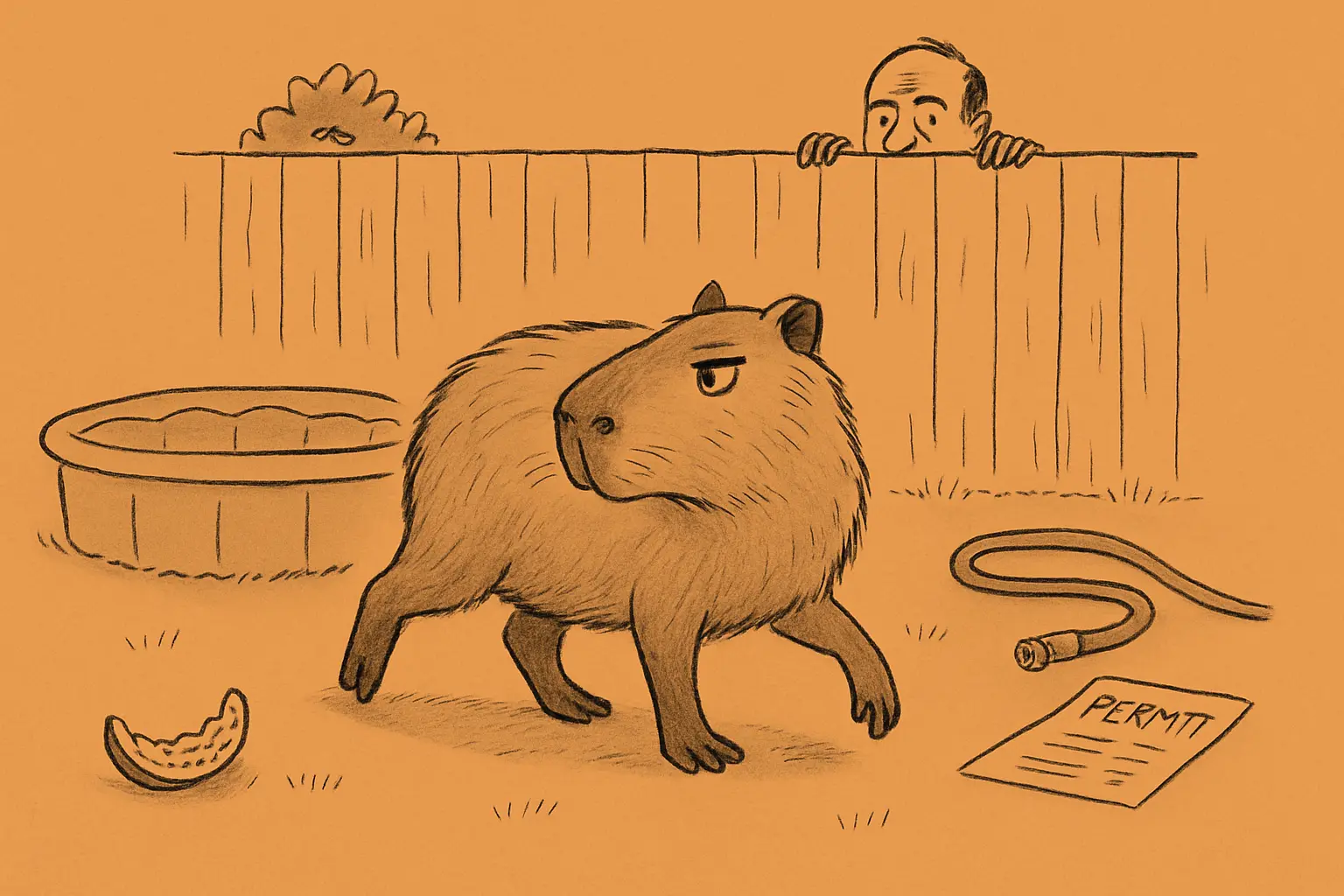
The permit patchwork nobody warned you about
The United States has no federal law governing private capybara ownership, which means the question of legality gets answered fifty different ways depending on where you live. According to AOL’s state-by-state breakdown, ten states currently allow it in some form, ranging from a handshake-and-done arrangement in Texas to a multi-step permit process with on-site inspections in Florida. The variation is not random. It reflects each state’s broader philosophy on exotic animals, its history with invasive species, and, occasionally, one very bad incident that changed everything.
Before getting into the specifics, it is worth correcting a common assumption: that capybaras, because of their viral reputation as gentle, universally beloved animals, occupy some kind of legal grey area everywhere. They do not. California has them on an explicit prohibited species list. New York City health regulations have resulted in violations for far less unusual animals. The legal landscape is genuinely fragmented, and assuming your state is fine without checking is how you end up with a 140-pound rodent and a cease-and-desist letter.
The no-permit states and why they are no-permit states
Texas and New Jersey sit at the permissive end of the spectrum, and they got there by very different roads. Texas has broadly relaxed exotic animal laws, and AOL’s report notes that the warm climate genuinely works in a capybara’s favour. These animals are semi-aquatic, native to South American wetlands and grasslands, and they need regular water access and temperatures that do not regularly plunge below freezing. Texas delivers on both counts more reliably than most states.
New Jersey is the one that surprises people, and it earns that reputation. A densely populated Northeastern state with stringent regulations on most things has simply never moved to restrict capybara ownership. No permit required. This is either an oversight or a considered position, and the state has not been especially forthcoming about which.
Permit-required states and what they actually require
Florida, Pennsylvania, Nevada, North Carolina, and Ohio all require permits, but the friction involved varies considerably. Florida’s process includes inspections and checks on housing conditions. This makes sense: capybaras need large outdoor enclosures and reliable water access, and Florida’s wildlife regulators are already managing the consequences of escaped exotic animals. The state’s python problem is well documented, and officials are not eager to add another chapter.
Pennsylvania’s bigger obstacle is often local zoning rather than state permits. Suburban municipalities rarely account for a large rodent in their land-use codes, and neighbours tend to have opinions. Ohio’s current rules stem directly from a 2011 incident in which privately held wildlife was released, prompting a legislative overhaul. Capybaras remained legal, but enclosure and care standards tightened considerably.
Nevada’s path to stricter permits came from early permit applications that revealed a pattern: buyers consistently underestimated what capybara ownership actually requires. Rural properties outside Las Vegas can meet the space and water requirements more easily than suburban lots.
The states that said no, and why Arizona is complicated
California’s prohibition is the clearest in the country. The state’s environmental agencies list capybaras alongside a wide range of non-native species, citing ecological risk from escapes or releases. Given California’s ongoing battles with invasive fish, reptiles, and plants, the logic is consistent even if it disappoints prospective owners.
Arizona is a more interesting case. The desert climate is genuinely hostile to a semi-aquatic animal, yet the state has maintained a permissive stance toward unusual pets for years. Owners there build shaded enclosures and large water features to compensate. It works, apparently, though it requires more infrastructure investment than ownership in, say, North Carolina, where humid summers and farmland create conditions that are a reasonable approximation of a capybara’s natural habitat.
Here is the real biology behind why climate matters so much: capybaras are the largest rodents on earth, with adults regularly reaching 140 pounds and occasionally exceeding that. An animal that size loses and gains heat at a scale that makes thermoregulation a genuine daily concern. They submerge themselves in water to cool down and to escape predators, and they do this multiple times a day in warm conditions. A state that cannot provide that infrastructure through either climate or owner-built facilities is a state where capybara ownership becomes an expensive welfare problem.
The Grumpy Capy take
The framing of “surprise states” in capybara ownership coverage tends to treat New Jersey as a punchline. It is not. It is a data point about how inconsistently the U.S. regulates exotic animal ownership, and the inconsistency is the actual story. A patchwork of fifty different legal frameworks means an animal can be a legal pet one state over and a confiscatable invasive species the next.
The welfare angle also gets underplayed in most of this coverage. The recurring theme across Nevada, Florida, and Pennsylvania is that buyers underestimate what capybaras need. That is not a minor footnote. It is the reason permit requirements exist in the first place, and it is probably the reason more states should have them.
Transparency note: the secondary source listed in this story’s siblings did not contain usable reporting on U.S. ownership laws and was not drawn upon here.
Sourcing note: this rests on a single syndicated roundup. State-by-state legal summaries in that format are frequently out of date — treat it as a starting point and check the state guides or the state agency itself before acting on any of it.