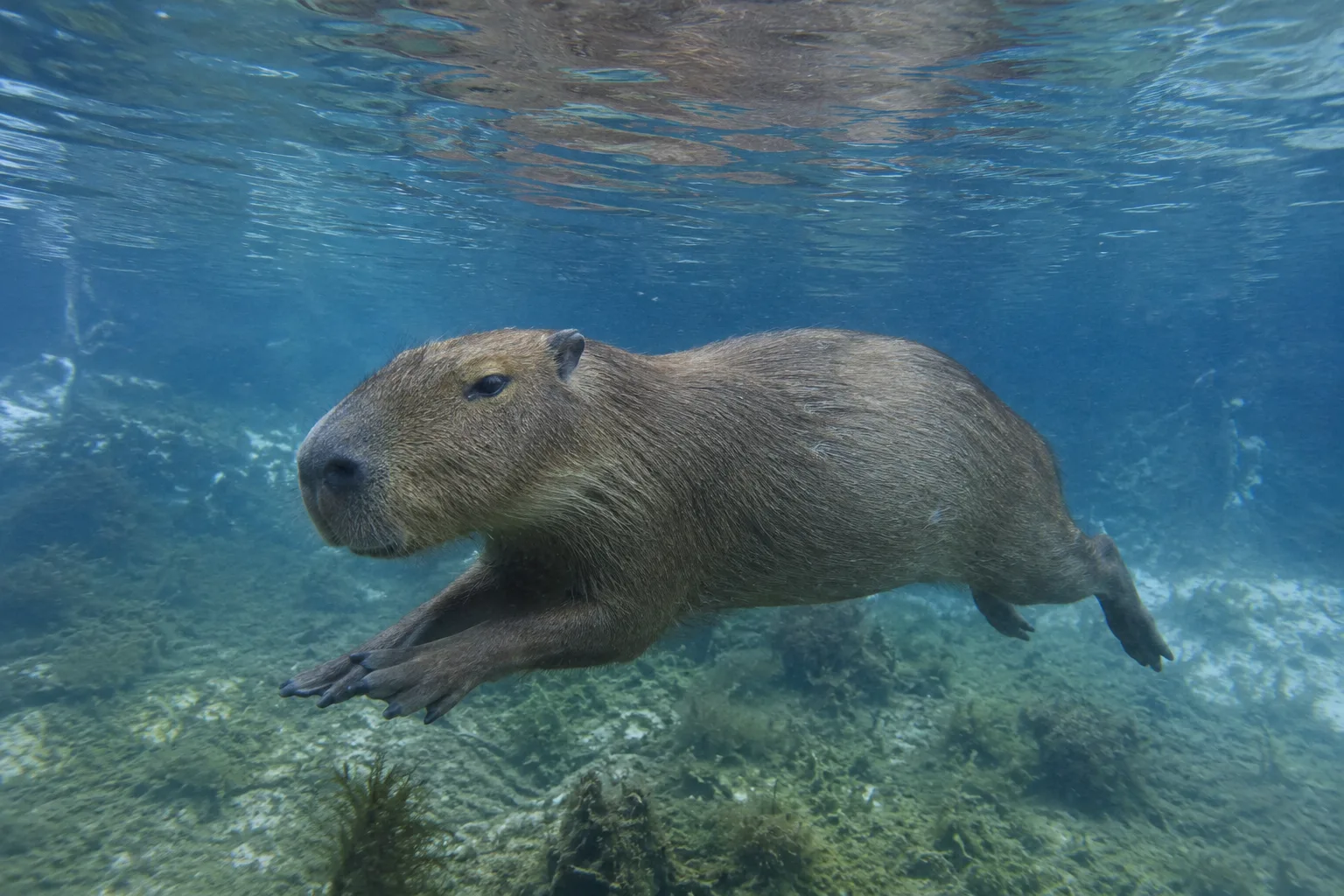
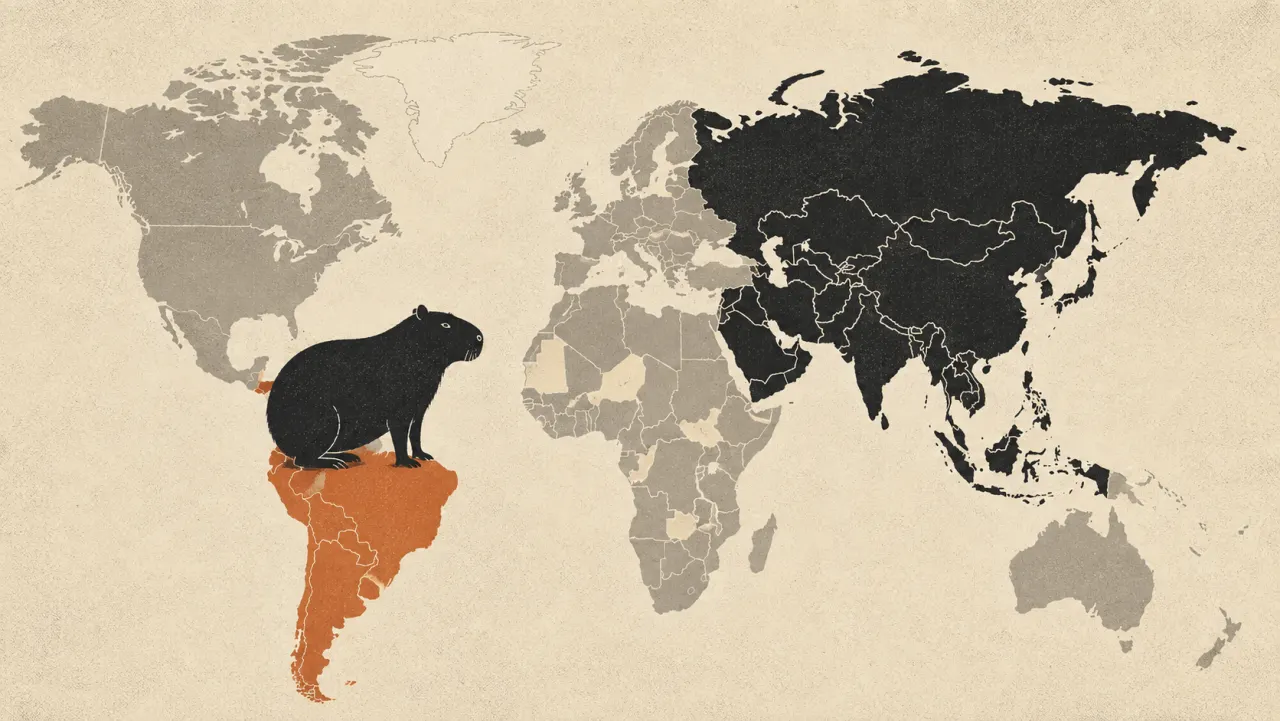
No treaty decides this one. The AZA Capybara Care Manual records the species in its permit section as IUCN Least Concern, CITES Not Listed, USFWS Not Listed, which means there is no international instrument to check and no global answer to give. Every country writes its rule alone, and almost none of them name the capybara. They regulate a category instead, and which category your country reaches for is the entire answer.
Decided nationally, usually by a list the capybara was never considered for
No CITES appendix covers Hydrochoerus hydrochaeris, so nothing sits above national law. Countries answer through five recurring mechanisms, and the same silence in the rulebook means allowed in one country and prohibited in the next.
Seven countries below carry a label taken from a rule we read at source. Everything else is a screening prompt with an agency attached.
The Five Rulebooks That Decide the Answer Anywhere
Learn the mechanisms and you can read a country you have never looked up before.
1. A positive pet list. The government publishes what may be kept, and everything else is out. RVO runs the Dutch version: a huis- en hobbydierenlijst of 30 approved mammals, in force since 1 July 2024, with the blunt companion sentence that a mammal species not on the list may not be kept.
2. A dangerous-wild-animal licence. The government publishes what is dangerous, and keeping it requires a licence from a local authority. The UK’s Dangerous Wild Animals Act 1976 works this way, with the licensable species set out in a schedule.
3. A live-import list. Nothing about pets, everything about the border. Australia’s List of Specimens Taken to be Suitable for Live Import is a legislative instrument on the Federal Register, made under the Environment Protection and Biodiversity Conservation Act 1999. The list is the gate.
4. A keeper permit or competence requirement. France’s arrêté of 8 October 2018 obliges anyone keeping a non-domestic animal to provide suitable housing, hold skills appropriate to the species and number of animals, prevent risk to third parties, and prevent escape and disease transmission. Japan runs registration and permission through prefectural governors under the Act on Welfare and Management of Animals.
5. The welfare standard the paperwork gets judged against. This is the one people skip, and it is the one that ends most applications. Nobody refuses you because of the animal. They refuse you because of the enclosure.

Positive List or Negative List: The Split That Sorts Most Countries
Before you look up your country, work out which of these two it is. It changes what an absence means.
Positive list: only the named is allowed
- The Netherlands publishes 30 approved mammals
- Singapore's Wildlife Act requires written approval to keep any wildlife
- Australia's import list is a positive list at the border
- Not named means no
Negative list: only the named is banned
- The UK schedules dangerous species for licensing
- Many US states name dangerous or restricted species
- Absence removes one layer, not all of them
- Not named means keep reading
The distinction matters more than any single country row, because the internet reports both the same way. “Capybaras aren’t mentioned in the law” is good news in London and terrible news in Rotterdam, and the sentence looks identical either time.
The positive-list design is the more defensible of the two, for what that opinion is worth. It forces a government to decide in advance whether an animal can actually be kept well, rather than waiting for a rescue centre to find out. It also means the capybara loses, every time, because a species that wants a pond, a herd and year-round outdoor access is never going to score well on a suitability assessment written for flats.
Capybara Legality by Country: What We Could and Could Not Source
Two tables, deliberately. The first holds countries where we opened the governing rule ourselves. The second holds countries where we did not, and says so. Both are also in the capybara legality checker, which puts them next to the 50 US states and the Canadian provinces.
Source-checked at the rule. Each row below is drawn from the official page or instrument named in the third column.
| Country | Legal position | What actually governs it | Verify with |
|---|---|---|---|
| Netherlands | Not permitted as a pet | Huis- en hobbydierenlijst, 30 approved mammals since 1 July 2024; unlisted mammals may not be kept | RVO and NVWA |
| Singapore | Not an approved pet species | Wildlife Act: keeping any wildlife needs the Director-General’s written approval; approved small mammals are rabbits, mice, hamsters, guinea pigs, gerbils, chinchillas | NParks AVS |
| Australia | Import controlled by legislative list; no capybara entry confirmed | List of Specimens Taken to be Suitable for Live Import, made under the EPBC Act 1999 | DCCEEW |
| France | Regulated keeping, not free keeping | Arrêté of 8 October 2018: housing, competence, third-party safety, escape and disease duties | Your prefecture and the DDPP |
| Japan | Regulated through registration and permission | Act on Welfare and Management of Animals, Articles 10 and 26, administered by prefectural governors | Prefectural animal welfare office |
| Mexico | Possible with authorisation, confinement only | SEMARNAT-08-056: proof of legal origin, veterinary documentation, form FF-SEMARNAT-107 | SEMARNAT regional office |
| Brazil | Only from an authorised facility | IBAMA regime of criadouros and mantenedouros, with CTF registration and Sisfauna enrolment | IBAMA |
Not source-checked here. These are screening prompts, not answers. The framework column is what to ask about, not what we verified.
| Country | Status here | Likely framework to ask about | Verify with |
|---|---|---|---|
| Germany | Not source-checked | State-level exotic animal rules and competence requirements | Your Land’s Veterinäramt |
| Spain | Not source-checked | National invasive-species rules plus autonomous community rules | Your comunidad autónoma |
| Italy | Not source-checked | National rules on keeping wild species, with local authorisation | Your ASL and the Ministry of Health |
| New Zealand | Not source-checked | Biosecurity import health standards | MPI |
| UAE | Not source-checked | Federal rules on keeping dangerous and exotic animals | Ministry of Climate Change and Environment |
| India | Not source-checked | Wildlife Protection Act and live-animal import restrictions | Your state chief wildlife warden |
Three big ones are handled elsewhere. The United States is a state-by-state and city-by-city problem with three states naming the capybara directly, and it has its own page: the capybara legal states map. Canada is province and municipality, and gets the same treatment at are capybaras legal in Canada. For the UK, the Dangerous Wild Animals Act 1976 schedule is the licensing trigger and capybaras are not on it, so no DWA licence applies, which removes one layer and settles nothing about welfare duties, planning, or what your council thinks of a pond.
The 50-state screening map, with a search box
Three states name the capybara by species. A dozen more have no statewide position at all, which reads like permission and is not. Type your state and see which agency you need to call.
A note on how the tables were built, because it explains the gaps. Australian government sites and legislation.gov.uk both refused automated requests during this pass, which is routine and says nothing about the pages themselves. The Australian instrument came through the Federal Register of Legislation instead, confirming the list exists and which Act it sits under, but not whether a capybara entry appears on it. So Australia sits in the first table for its mechanism and carries an unconfirmed species position, which is uncomfortable to publish and correct to publish. The six countries in the second table got the same treatment for the same reason.
Europe Is Where the Welfare Bar Does the Banning
The paperwork in Europe is rarely the obstacle. The enclosure is.
An unpublished 2014 survey of AZA-accredited institutions holding capybaras, reported in the AZA Capybara Care Manual, put the smallest recorded exhibit at 95 m² (1,023 ft²) for a single non-breeding pair. The median came in at 523 m² (5,630 ft²). Those are zoo numbers rather than legal minimums, but they are the numbers a European inspector reaches for when someone submits a plan, and very few private applicants have that.
That third figure is the one nobody plans for. The AZA manual notes that most pools in capybara enclosures are the type requiring draining, cleaning and daily refilling, with disinfection at least once a week using a 5% bleach dilution. A garden pond is a feature. A capybara pool is a chore with a schedule, and it is the line item that turns an enthusiastic application into a withdrawn one. Our pool requirements guide goes further into what that actually involves.
France shows the softer version of the same logic. The 2018 arrêté bans nothing by species. It requires housing that ensures welfare, skills appropriate to the species and number of animals held, prevention of risk to third parties, and prevention of escape and disease transmission. Read as a checklist for one capybara in a suburban garden, it is a polite no. The Netherlands skipped the conversation and wrote the 30-mammal list, covered in are capybaras legal in the Netherlands.

The Americas: Native Range Is Not a Free Pass
Being local does not make it casual. Brazil, where capybaras are genuinely native, is stricter about origin than several countries where they are exotic.
IBAMA authorises wildlife-using enterprises by category, including commercial breeding facilities, conservation breeders, scientific breeders, exotic fauna keepers, zoological gardens and licensed traders. Operators register in the CTF and enrol in the Sisfauna system before authorisation, and the paper trail runs through prior, installation and management authorisations. The practical effect is that a legal Brazilian capybara is a documented captive-bred animal from an authorised facility, not an animal from a riverbank. More at are capybaras legal in Brazil.
Mexico treats the capybara as exotic and routes it through SEMARNAT. Procedure SEMARNAT-08-056 authorises exotic specimens as pets, and the requirements are specific: proof of legal origin such as invoices or import permits, veterinary documentation, proof of the address where the animal will be kept, a signed commitment covering care and reporting the animal’s death, and form FF-SEMARNAT-107. The stated condition is confinement. It costs nothing and is quoted at 15 business days, which is a fair reminder that the application is the cheap part. Detail in are capybaras legal in Mexico.
Argentina is the country most people picture when they picture wild capybaras near houses, and it is also the country where the carpinchos on the golf course are wild fauna rather than available animals. That distinction is the whole subject of the Nordelta story.

Colombia: native, protected, and periodically rumoured otherwise
Colombia is a useful reminder that native range and legal access are unrelated. Commercial capybara hunting is banned, and in July 2026 the environment minister, Lena Estrada, publicly confirmed the ban and denied reports that the government intended to legalise hunting — a denial prompted by a campaign led by Senator Padilla against any such move.
The pattern is worth recognising because it recurs across the capybara’s native range: a periodic rumour that a country is about to open commercial hunting, an official denial, and a great deal of confusion in between. Poaching and habitat loss remain the real pressures on Colombian populations regardless of what the hunting rules say on paper.
Asia-Pacific: A Cafe Tradition and a Closed List
Japan is where you have seen the pictures, and the pictures are almost all commercial premises rather than homes.
The Act on Welfare and Management of Animals sets two separate gates. Article 10 requires anyone running a business that handles mammals, birds or reptiles, including selling, keeping, lending, training or exhibiting them, to be registered with the prefectural governor, who must refuse registration where facility standards set by the Ministry of the Environment are not met. Article 26 requires the governor’s permission to keep an animal a Cabinet Order categorises as carrying a risk of harm to people or property. Both gates are prefectural, which is why answers from Tokyo and Shizuoka are not interchangeable. We go through it in are capybaras legal in Japan.

Singapore is the clearest no we could source. The Wildlife Act requires the Director-General of Wildlife Management’s written approval to keep any wildlife, and the AVS list of approved small mammals is short and specific: rabbits, mice, hamsters, guinea pigs, gerbils and chinchillas. The capybara does not appear anywhere on it. Approval is the mechanism, and nobody has given it for a household capybara.
Australia is the border case. Its live-import instrument sits under the EPBC Act 1999, and the practical question is not whether a capybara may be owned but whether it may arrive. We could confirm the instrument and its authority. We could not confirm a capybara entry on it, and DCCEEW is the office that can.
Malaysia: authorised institutions only, and the collar gives it away
Keeping a capybara in Malaysia requires authorisation from the Department of Wildlife and National Parks, and in practice that authorisation goes to zoos and licensed sanctuaries rather than to households.
The enforcement reality showed up in July 2026, when a capybara wearing a collar was filmed wandering a car wash forecourt in Selayang. No permit surfaced, and authorities opened an investigation into how the animal was being kept.
The collar is the detail that matters, and it generalises well beyond Malaysia. An animal that escapes an institution wears an ear tag or a microchip, not a collar. A collar means somebody was walking it. In a positive-list jurisdiction, that single accessory converts “loose exotic animal” into “evidence of unlicensed private keeping,” which is a different offence with a different investigation attached.
Legal to Keep Is Not the Same as Legal to Move
Two approvals, two agencies, two ways to lose a deposit.
Ownership cleared in the destination country, transport booked, and then the import approval turns out to be a separate application to a different agency with its own timeline. Clear the border first. It is the one that cannot be appealed at the airport.
Even inside the EU, where movement is meant to be simple, capybaras fall outside the simple part. Regulation (EU) No 576/2013 puts dogs, cats and ferrets in Annex I Part A and everything else, rodents included, in Part B. For Part B species, Articles 9 and 14 leave national rules in charge for movement between member states and from outside the EU alike, pending harmonised requirements that have not arrived. The EU pet passport most people picture does not apply here.
Then the ordinary layers: a veterinary health certificate, an import permit where one is required, and whatever quarantine or testing the receiving country sets. None of it is CITES, because CITES does not reach this species. It is national biosecurity, and biosecurity agencies are the least flexible offices in the whole process.
Misconceptions That Cost International Buyers Money
| What people believe | What is actually true |
|---|---|
| ”Capybaras aren’t mentioned in my country’s law, so they’re legal” | Depends entirely on list type. Under a positive list like the Dutch one, an unmentioned mammal may not be kept at all. |
| ”It’s legal next door, so I’ll import” | Ownership and import are separate approvals. In the EU, Regulation 576/2013 leaves rodent movement to national rules on both sides. |
| ”CITES will tell me if it’s restricted” | It will not. The AZA care manual records the species as CITES Not Listed, so the treaty says nothing either way. |
| ”The positive list will add capybaras eventually” | Positive lists are built around whether an animal can be kept well in a home. Pond access, herd housing and outdoor space all count against it. |
| ”Zoos here keep them, so I can” | Zoo exemptions exist precisely because zoo standards do. The median AZA exhibit in the 2014 survey was 523 m². |
| ”I’ll register it as an emotional support animal” | ESA-style frameworks do not override exotic animal or import law anywhere we have looked, and they are not a travel document. |
What This Means in Practice
Find which of the five rulebooks your country uses, then ask one written question of one named agency. That sequence costs an email and saves everything else.
-
Work out which of the five rulebooks you are under
Positive pet list, dangerous-animal schedule, live-import list, keeper permit, or a bare welfare standard. Everything after this depends on getting it right.
-
Under a positive list, check the list and stop
If the species is not named, it may not be kept. There is no second question, and no appeal that turns a silence into a yes.
-
Under a dangerous-animal schedule, absence settles one thing only
It removes the licence question. Welfare duties, planning rules and whatever your local authority thinks of a pond are all still standing.
-
Ask about the enclosure standard before anything else
Where permits or competence certificates exist, this is where the decision is actually made. Nobody refuses you because of the animal.
-
If it has to cross a border, clear the import first
Import is a separate approval from a separate agency with its own timeline. It is also the one that cannot be argued with at the airport.
One detail reframes the whole housing argument. Capybaras are known to swim as early as the day they are born, so facilities lower pool levels for neonates and grate the culverts to stop the young swimming through them. That is the animal these rules are written around. Not a large guinea pig with a paddling pool.
This guide is current as of September 1, 2026. National, regional and municipal rules change, positive lists are revised, and import instruments are amended without fanfare. Treat every row above as a starting point rather than a determination, confirm in writing with the agency named, and talk to a qualified local advisor before any money moves. If you are still costing this out, the capybara cost guide covers the part the permit form leaves out.