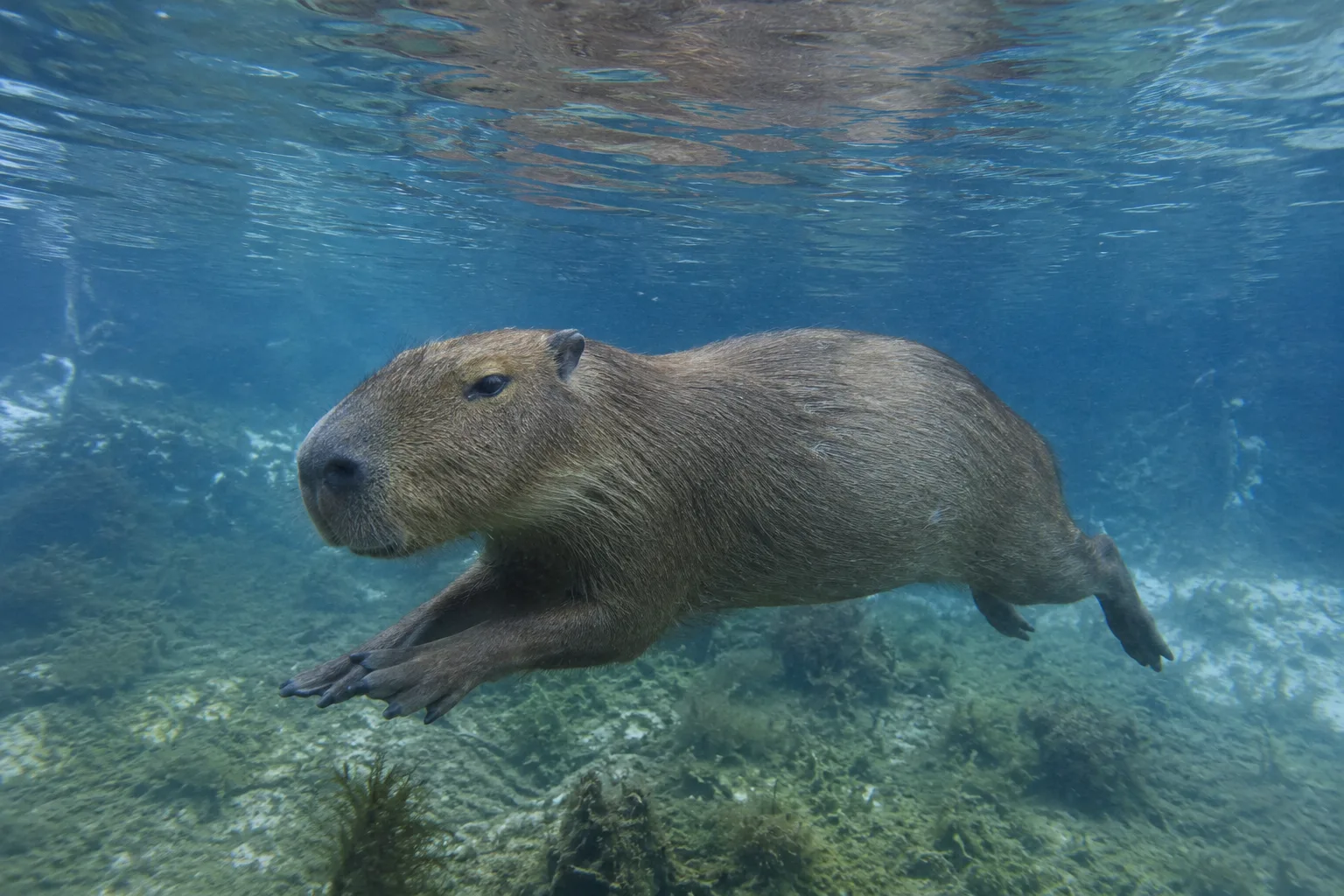

You already know capybaras are giant rodents. Excellent. That is fact one, and it is doing a lot of public-relations work.
Here are 21 capybara facts for students that go a little further: body, water, food, babies, social life, sounds, teeth, digestion, and why the animal is more interesting than “big guinea pig” repeated until the teacher gives up.
Capybara Basics That Actually Matter
-
Capybaras are the world’s largest living rodents. San Diego Zoo Wildlife Alliance lists adult weight at 60 to 174 pounds.
-
They are native to Central and South America, especially places with rivers, ponds, marshes, and grasslands.
-
They are related to cavies, the rodent group that includes guinea pigs. They are not pigs, beavers, or tiny hippos in witness protection.
-
Their scientific name is commonly given as Hydrochoerus hydrochaeris.
-
They are herbivores, meaning they eat plants.
| Report topic | Strong fact to use |
|---|---|
| Size | Largest living rodent, up to 174 pounds in San Diego Zoo’s range |
| Habitat | Water-edge grasslands, marshes, rivers, ponds, and wetlands |
| Diet | Mostly grasses and aquatic plants |
| Social life | Groups often include multiple adults and young |
| Adaptation | Eyes, ears, and nostrils sit high on the head for water life |
Weird Body Facts
-
Capybaras have partly webbed feet, which help them swim and move in muddy wetland areas.
-
Their eyes, ears, and nostrils sit high on the head, so they can keep most of the body underwater while still sensing the world.
-
Their front teeth keep growing, like other rodents’ incisors. Chewing tough plants is part of the maintenance plan.
-
Their fur is coarse and thin, not fluffy. This is disappointing only if you believed the plush toy lobby.
-
Adult capybaras stand around 1.6 to 2 feet at the shoulder, depending on the source and animal.

Family And Social Facts
-
Capybaras live in social groups. Animal Diversity Web describes groups of around 10 adults, with larger gatherings forming around water during dry periods.
-
Group life helps with watching for predators. More eyes, fewer surprises.
-
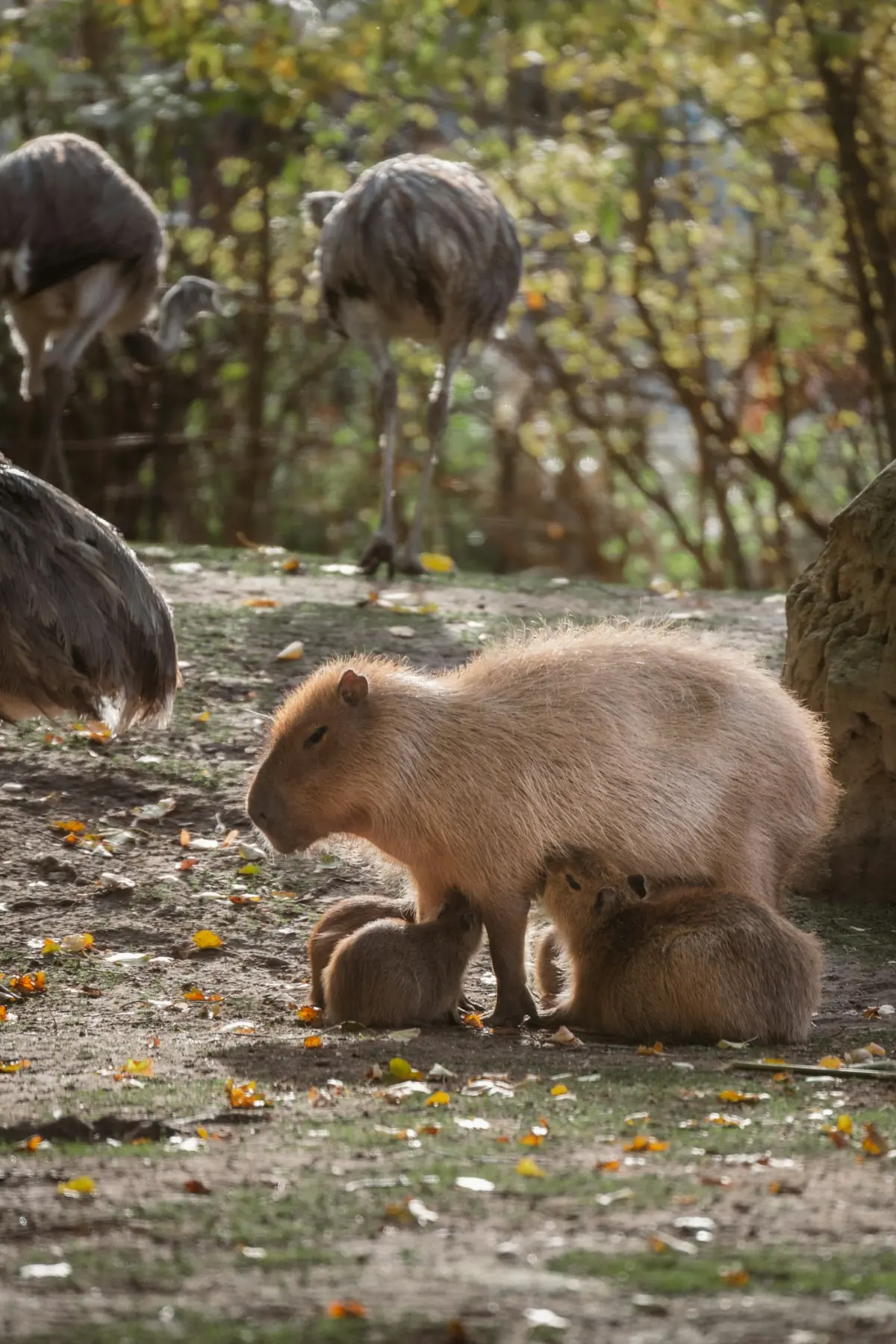
Baby capybaras are precocial, which means they are born relatively developed and can move around soon after birth.
-
Animal Diversity Web says young capybaras can graze within a week of being born.
-
Capybara pups may nurse from females other than their own mother within the group. Group projects, but somehow less annoying.
Water Facts Students Remember
-
Capybaras are strong swimmers.
-
San Diego Zoo Wildlife Alliance says they can stay underwater for up to five minutes to hide from predators.
-
They use water to cool off during hot parts of the day.
-
They eat water plants as well as grasses.
-
Water is part of safety. A startled capybara often heads for water, which is basically its emergency exit with ripples.
Capybara Facts That Make Great Reports
- Capybaras eat some of their own poop. This sounds like playground chaos, but it helps them recover nutrients and bacteria needed to digest tough plant fiber. San Diego Zoo Wildlife Alliance and Animal Diversity Web both note this behavior.
If you want your report to stand out, do not stop at “big rodent.” Explain the system: capybaras are large social grazers built for water-edge habitats. Their teeth, feet, head shape, diet, group life, and digestion all point to that same lifestyle.
Facts People Get Wrong
A lot of capybara “facts” circulate online that are close enough to feel true and wrong enough to cost you marks. If your report repeats one of these, a teacher who has read a single fact sheet will notice. Here is what to correct.
| Common claim | Better answer |
|---|---|
| Capybaras are a kind of pig | They are rodents, family Caviidae, closer to guinea pigs and maras than to anything with a curly tail. |
| They are basically giant guinea pigs | Related, yes, but a different genus and a semi-aquatic lifestyle a guinea pig does not have. |
| They can hold their breath forever | San Diego Zoo Wildlife Alliance says up to about five minutes underwater, not indefinitely. |
| They are fine living alone as a single pet | They are herd animals. Keeping one alone is a known welfare stress, which is one reason care manuals push for groups. |
| Capybaras are friends with every animal | The famous “everyone rides the capybara” photos are calm tolerance plus a lot of selective posting, not a documented universal truce. |
That solitary-pet point is worth stating plainly, because it is the one most likely to show up in a slideshow with a heart emoji. A capybara on its own is not a low-maintenance starter pet. It is a social grazer separated from its group, and the AZA Capybara Care Manual treats group housing as the baseline, not a nice-to-have. If a fact about capybaras makes them sound like a convenient single companion animal, be suspicious of it.
Numbers Worth Memorizing
Reports get stronger when a couple of specific figures are correct and the rest stays qualitative. Memorize a small, defensible set instead of inventing precise-sounding numbers you cannot source.
| Detail | What to say | Where it comes from |
|---|---|---|
| Weight | Adults commonly reach dog-sized, roughly 35 to 66 kg | Established range; San Diego Zoo lists 60 to 174 lb |
| Breath underwater | Up to about five minutes | San Diego Zoo Wildlife Alliance |
| Group size | Often around 10 adults, larger near water in dry season | Animal Diversity Web |
| Lifespan | Roughly 8 to 10 years or more in human care | Established captive range |
| First grazing | Young can graze within about a week | Animal Diversity Web |
Two of those facts are worth understanding rather than memorizing, because they explain the whole animal. The first is digestion. Capybaras are hindgut fermenters, which means the heavy work of breaking down grass happens late in the gut where nutrients are hard to absorb. So they re-ingest soft morning droppings, run the food through a second time, and recover what the first pass missed. It looks like the worst habit in the wetland and it is actually efficient plumbing.
The second is vitamin C. Like guinea pigs, capybaras cannot make their own, so they have to get it from food. In the wild a varied diet of grasses and aquatic plants covers it. In captivity it becomes something keepers track on purpose, because a grazer that cannot synthesize a vitamin will quietly run short if the menu is careless. It is a small fact that connects capybaras straight back to the rest of family Caviidae.
How To Actually Write The Report
If you only take one structural idea from this page, take this one: pick a lens and make every fact serve it. The strongest capybara reports are not lists. They are short arguments where each fact earns its place.
- Lead with the lens, not the size. “Capybaras are large rodents built for life beside water” beats “capybaras are big” because it tells the reader where the report is going.
- Group facts by body system. Teeth and digestion go together. Feet and head shape and swimming go together. Group life and babies go together. Three tidy clusters read better than 21 loose bullets.
- Keep one weird fact for the end. Coprophagy is the one classmates remember. Used as a closer that explains hindgut fermentation, it lands. Dropped in the middle for shock value, it just sits there.
- Cite two real sources. San Diego Zoo Wildlife Alliance and Animal Diversity Web are enough for a school report and both are checkable.
That is the better capybara fact: the animal looks like a calm loaf because the whole body is designed to survive beside water while quietly deleting grass.