
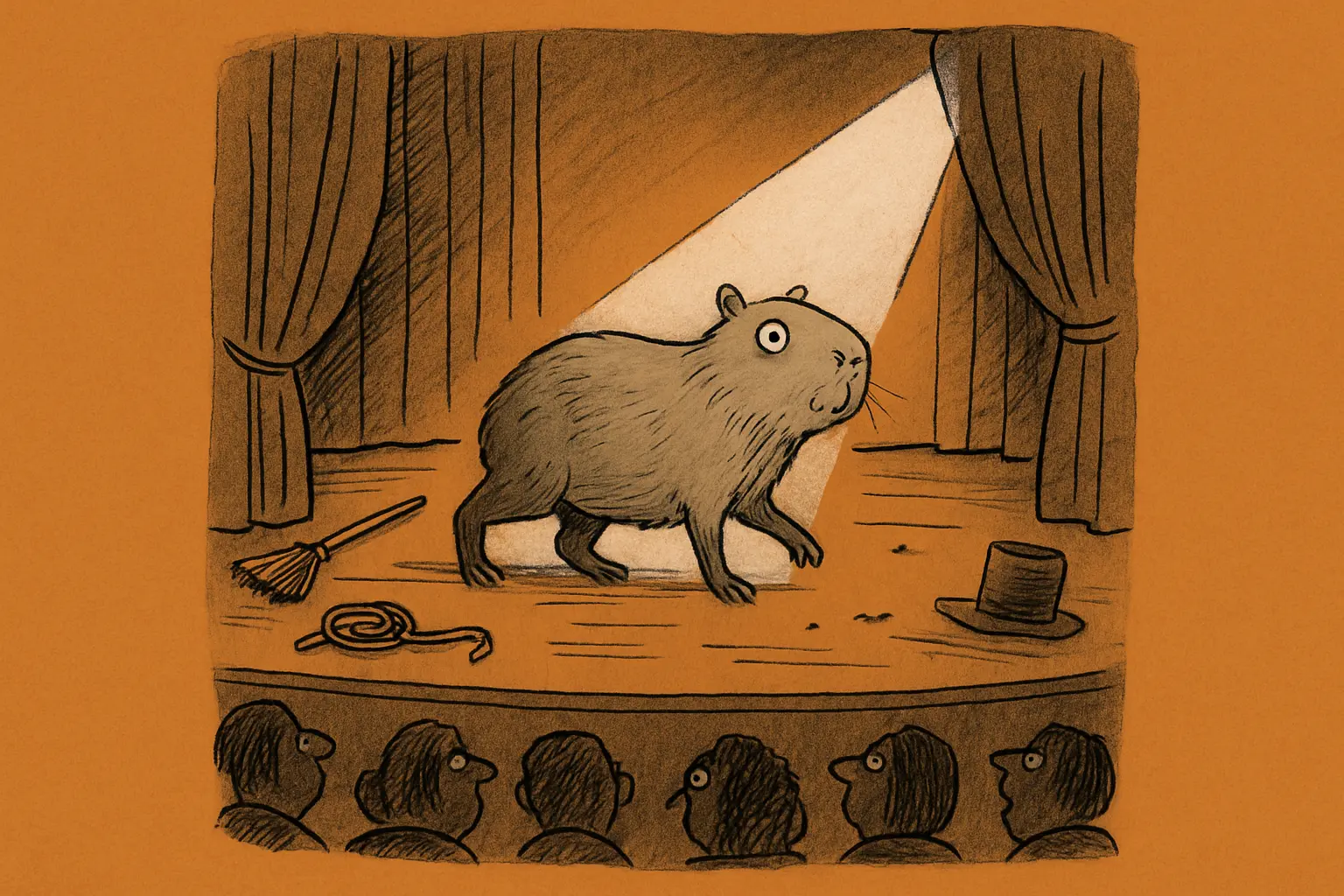
The theatre disruption
In a peculiar turn of events, a capybara reportedly found itself amidst a theatre performance, leading to quite an unexpected scene. The Financial Times has covered the incident, but details are unfortunately hidden behind their paywall. The headline itself is tantalizing enough: “Exit, pursued by a capybara,” referencing the famous stage direction from Shakespeare’s “The Winter’s Tale.” However, without access to the full text, we’re left to speculate on the finer details of this capybara cameo.
The exact circumstances of the capybara’s entrance and its effect on the performance remain largely shrouded in mystery. Did the animal wander in from a nearby habitat, or was this part of an avant-garde performance piece that took an unexpected turn? These questions hang in the air with the same uncertainty as a curtain call awaiting applause.
Capybara basics
For the uninitiated, capybaras are the world’s largest rodents, often compared to giant guinea pigs owing to their close genetic relationship. These semi-aquatic mammals are native to South America, but have found fans worldwide thanks to their amiable nature. Despite their size and appearance, capybaras are excellent swimmers and can remain submerged for up to five minutes, a fact that often surprises those who assume their hefty bodies would sink rather than swim.
Capybaras are social creatures, typically found in groups ranging from 10 to 20 individuals. This social nature might explain why a lone capybara would venture into a crowded theatre—it could have been seeking company or simply curious about the sounds and lights.
Unpacking common misconceptions
While capybaras are indeed friendly, there are misconceptions about their swimming abilities. Many assume that because they are rodents, capybaras might not be adept in water. However, this couldn’t be further from the truth. Their webbed feet and streamlined bodies make them agile swimmers, quite the opposite of the bumbling land-dwellers some imagine them to be.
Another common mistake is believing capybaras are solitary animals. In reality, they thrive in social settings, often seen lounging in large groups by riverbanks or grazing together in fields. Their social behavior is essential for their survival in the wild, providing protection and companionship.
The allure of the capybara
It’s not just their peculiar aquatic abilities that make capybaras fascinating. Their teeth never stop growing, a trait shared with other rodents like beavers. This continuous growth means capybaras must constantly gnaw on vegetation to keep their teeth at a manageable length, which makes them quite the busy grazers.
Their diet primarily consists of grasses and aquatic plants, which they efficiently digest thanks to their complex stomachs. Despite their herbivorous diet, they have a surprisingly high nutritional requirement, often consuming up to eight pounds of grass a day.
The grumpy capy take
While the details of the capybara’s theatrical escapade remain elusive, the incident serves as a reminder of the unpredictable nature of live performances—and the need for more accessible journalism. The Financial Times might want to consider offering a preview of such delightful stories before locking them behind a subscription wall.
In the end, whether the capybara was a planned part of the production or an unexpected guest, it certainly adds an element of intrigue to an otherwise ordinary evening at the theatre. And for those of us who appreciate a good capybara tale, this one’s a keeper—even if we have to imagine most of it.