
Capybara reproduction is inseparable from the social structure it happens within. The dominant male in a group has access to females; subordinate males are excluded or minimized during mating attempts. Females exert significant control over whether mating proceeds. And the precocial young that result are born far more developed than most rodents, which is unusual and worth understanding.
Mating In Water: How It Works
Animal Diversity Web’s account of capybara reproduction documents the characteristic water-based mating behavior. The sequence, as described in behavioral studies:
- The female enters the water (often shallow water, not deep)
- The dominant male follows and pursues in the water
- The female surfaces, then submerges, then surfaces again — a repeated motion that controls pacing
- Mounting occurs in the water when the female allows
- The sequence repeats multiple times in a single mating event
The female’s role in this sequence is active, not passive. She controls whether the water entry proceeds, how quickly the male can approach, and when she surfaces (which ends or pauses each mounting attempt). This is not a detail; it means the female exercises meaningful reproductive agency.
Subordinate males in the group may attempt to mate but are typically interrupted by the dominant male. The dominant male’s access to females is maintained through behavioral competition — chasing, pursuing, and physically displacing subordinate males during female contact. This is where much of the intragroup male aggression originates.
Dominant Male Access And Reproductive Control
The social structure of a capybara group — one dominant male, subordinate males, females, and young — is a polygynous system where one male has preferential reproductive access. Animal Diversity Web and the AZA Capybara Care Manual both describe this structure.
The dominant male’s reproductive dominance is not absolute. Subordinate males do achieve matings, particularly in larger groups where the dominant male cannot monitor all females simultaneously. Paternity is therefore not always from the dominant male, but he maintains the plurality of matings under normal social conditions.
Dominant male status changes over time as younger, larger males challenge and displace older ones. This creates a turnover in reproductive access that distributes genetic contribution across the group’s history. Male morrillo gland size — the scent gland on the top of the snout — is correlated with dominance and provides a visual indicator of reproductive status in the group.
Mating Season: Or Year-Round
The seasonality of capybara reproduction depends on the habitat. In the Venezuelan llanos and Colombian wetlands, where there is a pronounced dry season (November-March) and wet season (April-October), reproductive peaks occur during the wet season when resources are abundant. The AZA Capybara Care Manual notes that mating and birth peaks in seasonal habitats follow the wet season pattern.
In the Brazilian Pantanal and more stable resource environments, capybaras can reproduce year-round. IUCN Red List documentation confirms year-round reproduction in portions of the range where resource availability does not fluctuate dramatically by season.
In captive settings, reproduction occurs year-round when animals are healthy, housed appropriately, and have stable nutrition. The seasonal trigger is resource availability, not an internally programmed calendar.
Gestation And Birth
Capybara gestation is approximately 150 days — about five months. This is notably long for a rodent. Most small rodents have gestation periods of 18-30 days. The extended gestation in capybaras is consistent with their large body size and with the precocial developmental strategy — the young are essentially fully formed at birth because development that other rodents complete after birth is completed in the uterus.
Birth occurs on land, typically in a secluded area of the home range. The female may leave the main group area briefly for the birth, then return with the young. Capybara mothers do not build nests — the precocial young do not require a nest environment.
Litter size averages 4 pups (range 1-8). San Diego Zoo Wildlife Alliance notes the typical litter size as 4, which is consistent across multiple references. Larger litters are reported but are less common.
Precocial Young: Born Ready
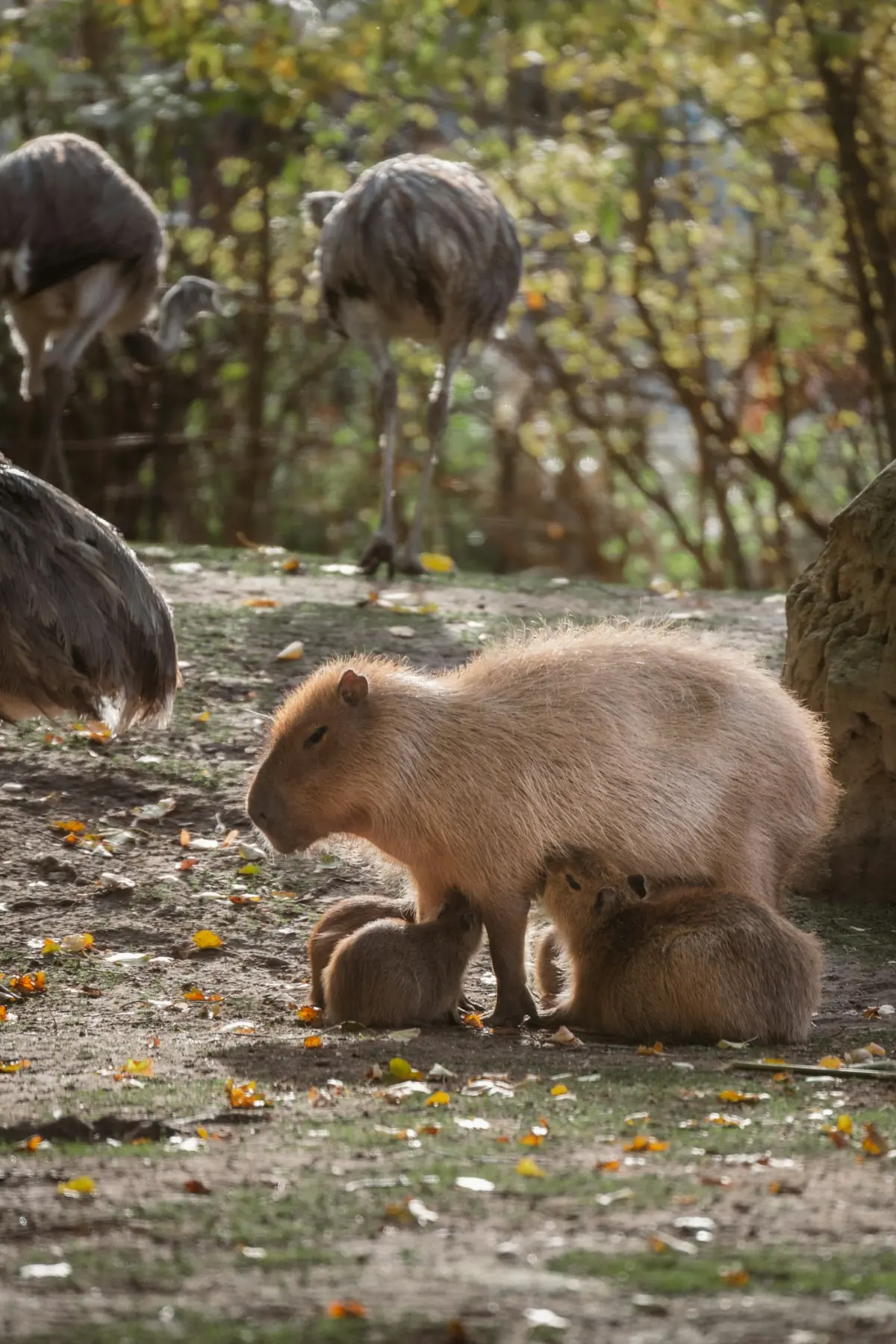
Capybara pups are born with:
- Eyes fully open
- Complete fur coat
- Ability to walk and run within hours
- Capacity to begin grazing (eating soft plant material) within the first few days
This is the precocial developmental strategy — opposite of altricial species like rats, mice, and rabbits, which are born blind, naked, and helpless. The precocial strategy requires more parental investment during pregnancy (longer gestation, larger energy expenditure) in exchange for young that are immediately functional.
The advantage is survival. A group of capybara pups that can walk and follow the group within hours is far more capable of predator avoidance than a litter of helpless pups in a nest. In a habitat with jaguars, caimans, and anacondas, born-ready is not a luxury.
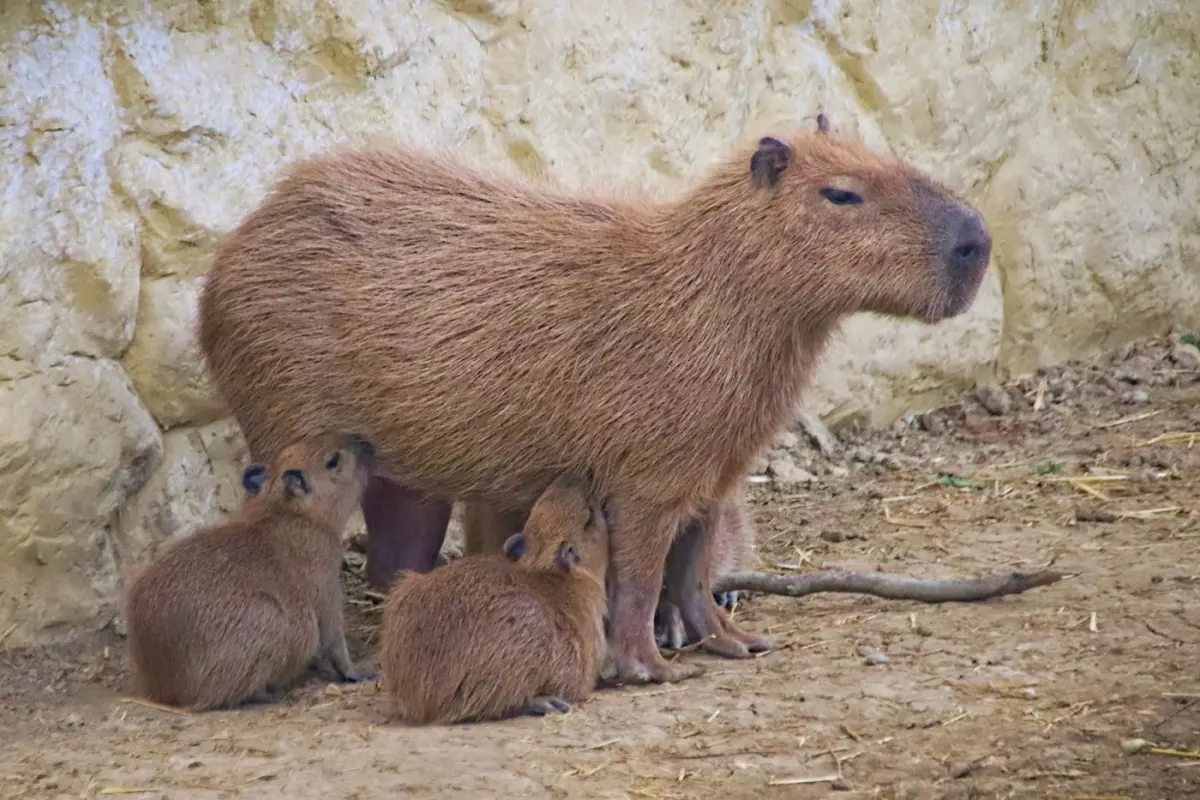
The group’s communal nursing behavior is also notable: multiple females in the group will nurse each other’s young. This alloparental care distributes the nursing load and creates resilience — if a mother is lost, the young are not automatically orphaned. Smithsonian’s National Zoo notes communal nursing as a characteristic behavior of capybara social groups.
Misconceptions About Capybara Reproduction
“Capybara pups are helpless at birth like mice.” Wrong order of magnitude. Capybara pups are among the most precocial rodents, walking and grazing within hours of birth.
“Only the dominant male can breed.” Subordinate males do achieve matings, particularly in larger groups. The dominant male has preferential access, not exclusive access.
“Capybaras breed once a year.” In stable resource environments, they breed year-round. The once-a-year framing applies to the seasonal peak in habitats with pronounced dry/wet seasons, not to the species-wide biology.
“The mother raises the young alone.” Communal nursing by group females is the documented pattern. Capybara young care is a group activity.