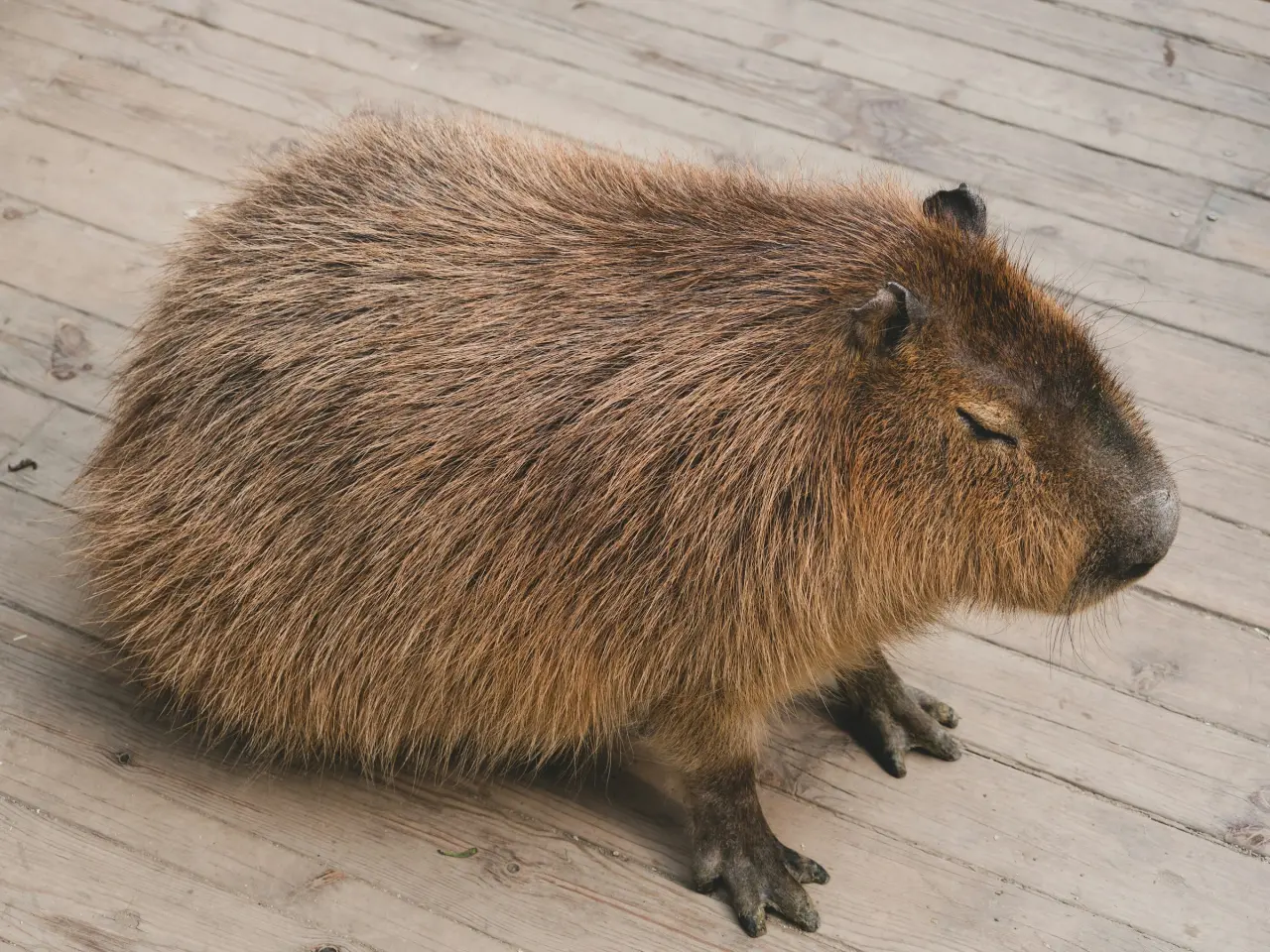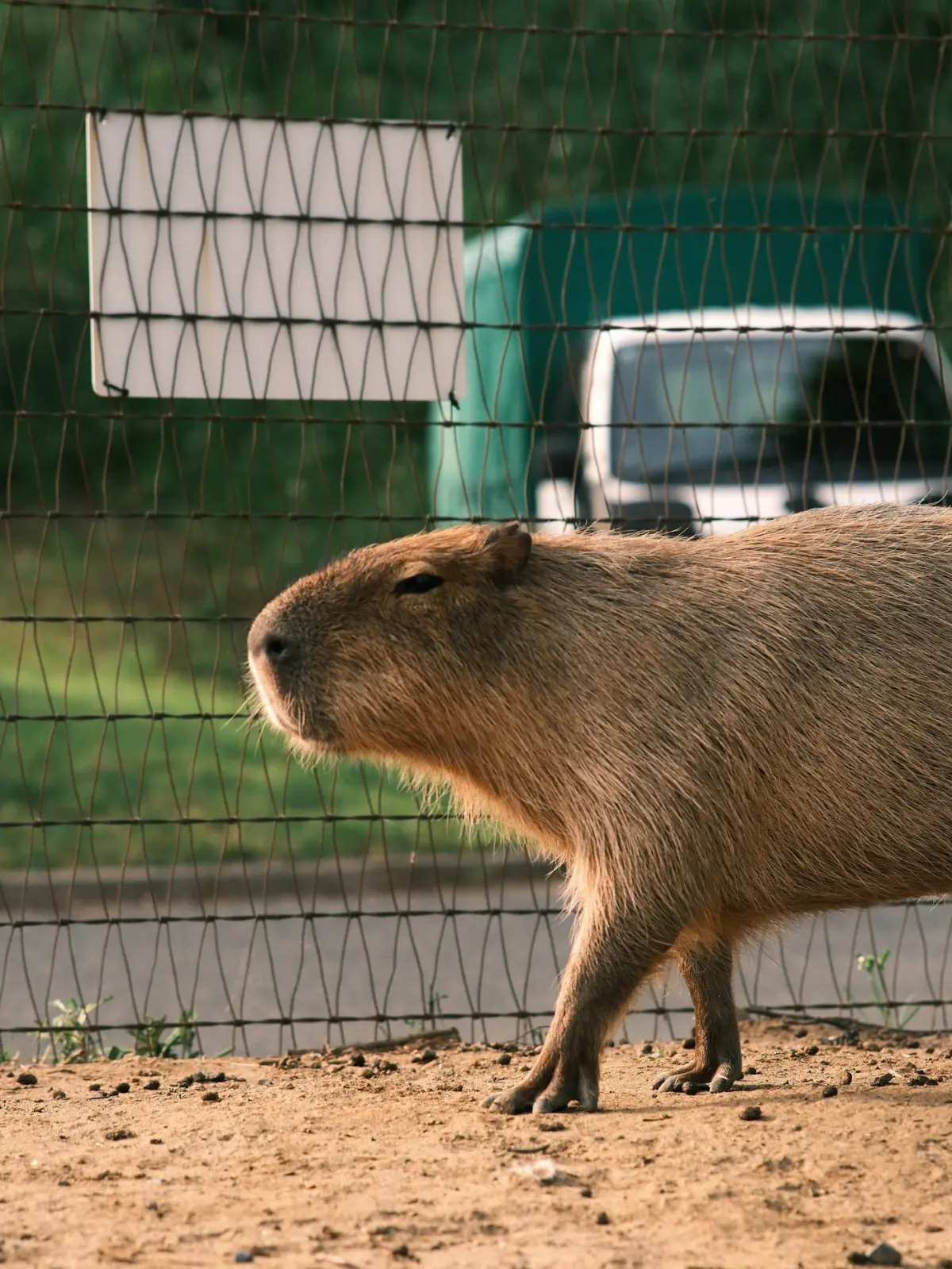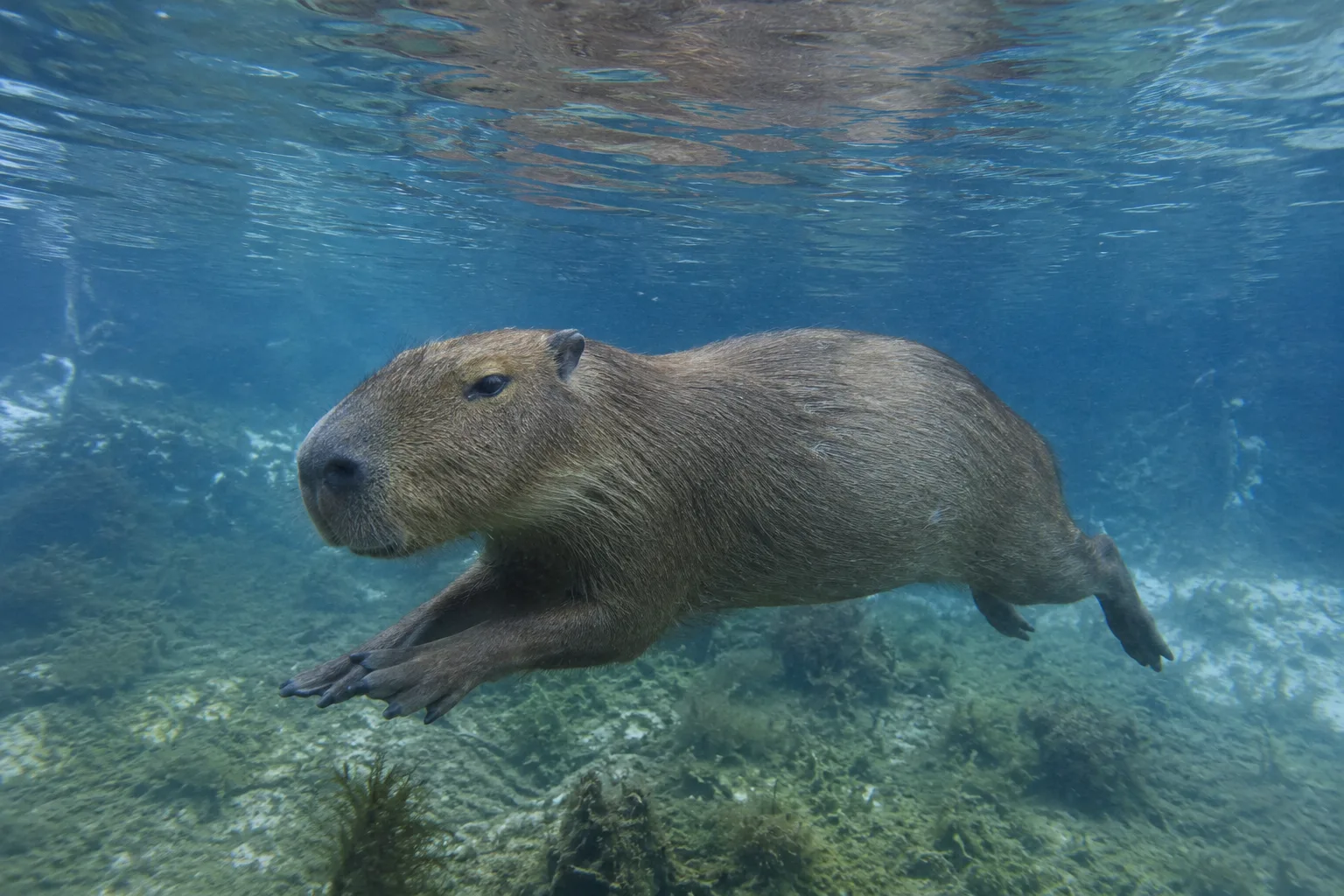
A capybara has four toes on each front foot and three on each back foot, all partially webbed, tipped with nails the San Diego Zoo Wildlife Alliance describes as strong and hoof-like. The toes sit in a radial arrangement rather than pointing forward in a row, which is why a capybara track in wet ground comes out shaped like a star rather than like a paw.
That is the whole answer, and it is a stranger set of facts than most people expect from an animal best known for lying down.
Four toes front, three toes back, partial webbing on both, hoof-like nails
The AZA Capybara Care Manual describes the digits as "arranged in a radial pattern," partially webbed, and "armed with short, strong claws, making capybaras very strong swimmers." Hindfoot length in the greater capybara runs 220 to 250 mm. Nothing about this foot is a paw, and nothing about it is a flipper.
Four Toes Front, Three Toes Back, and Why That Matters
An uneven toe count is genuinely unusual and it is the detail that makes people go back through their camera roll. Most mammals people are familiar with run the same number of digits front and back, or at least something close to it. Capybaras do not.
Front foot: four toes
- Four digits, radially arranged
- Partially webbed
- Short, strong, blunt nails
- On shorter front legs, which sit lower than the rear
- The wider of the two prints
Back foot: three toes
- Three digits, same radial arrangement
- Partially webbed
- Same blunt hoof-like nails
- Longer leg, 220 to 250 mm of foot
- The propulsion end, in water and on land
Animal Diversity Web notes that the front legs are slightly shorter than the hind legs, which gives a standing capybara that faintly uphill posture people read as sulking. It is not attitude. It is gearing.
| Feature | What it looks like | What it is for |
|---|---|---|
| Radial toe arrangement | Toes fanned outward from the foot rather than aimed forward | Spreads load across soft ground and prints a star instead of a pad |
| Partial webbing | Skin between the digits, usually hidden by mud or water | Adds surface area in water without penalising the animal on land |
| Hoof-like nails | Short, thick, blunt, one per digit | Grip and ground contact, not grasping, digging, or climbing |
| Unequal leg length | Front legs shorter than hind legs | Rear-driven movement, and a slight forward lean at rest |
| Large hindfoot | Roughly the length of an adult human hand | Flotation on saturated ground and thrust when swimming |
The Nails Are Closer to Hooves Than Claws
This is the part the word “claw” gets wrong. The San Diego Zoo Wildlife Alliance fact sheet describes capybara nails in three words: “strong, hoof like.” The AZA manual calls them short, strong claws. Both descriptions point at the same object, and neither one is a cat claw.
A capybara nail is not retractable, not hooked, and not built for holding anything. It is a blunt ground-contact tool at the end of a toe that is already doing most of the work. Capybaras do not climb, do not dig burrows, and do not manipulate food with their feet. They stand, walk, wade, and paddle. The hardware matches the job list exactly, which is more than most animals can claim.
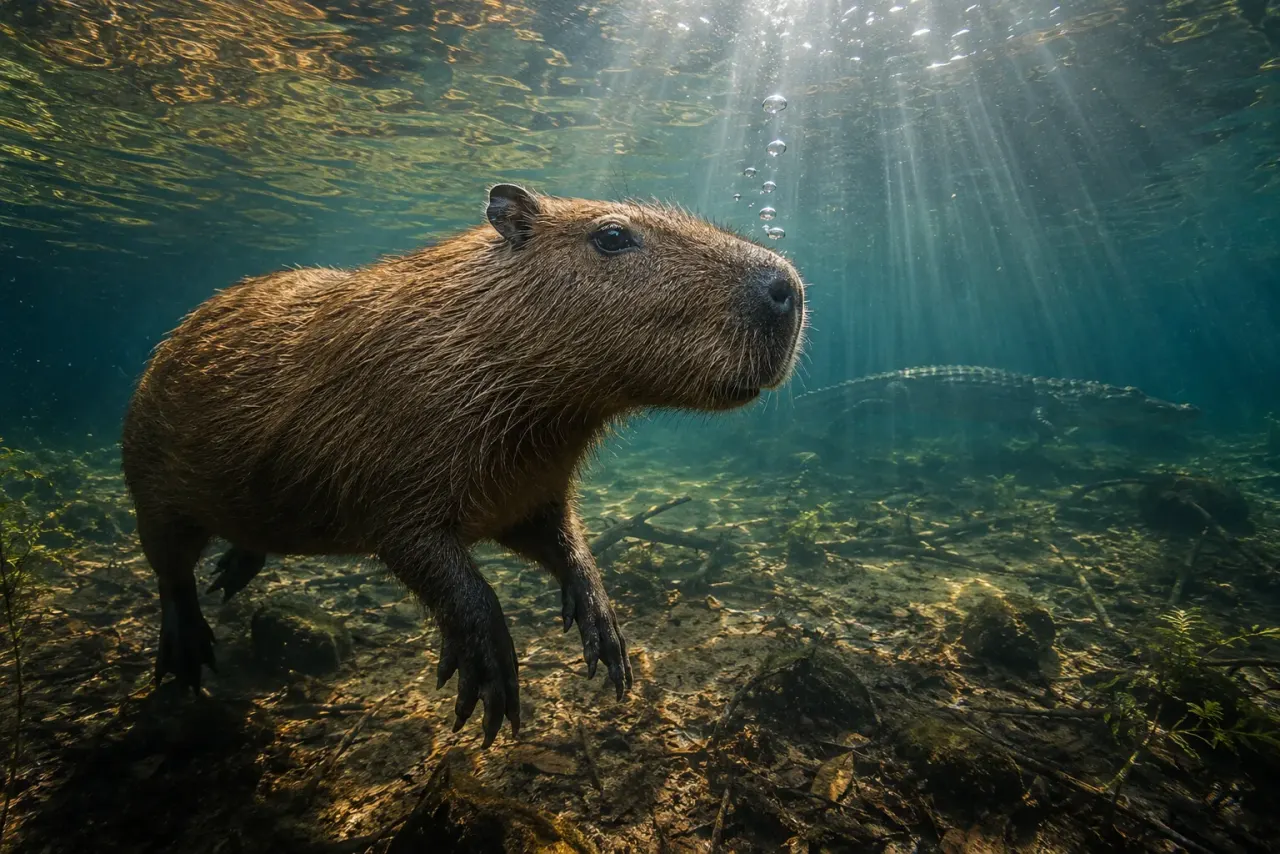
The webbing question gets asked so often it has its own guide. The short version stays the same wherever you ask it: partial, functional, and not the duck situation people picture.
How a 140-Pound Rodent Stays on Top of a Marsh
Here is where the anatomy stops being trivia. Animal Diversity Web puts adult capybaras at 35 to 66 kg, up to roughly 145 pounds. That is a large animal standing on ground that is, by design of its habitat, frequently waterlogged.
Narrow feet punch through saturated soil. Broad, splayed feet with the toes fanned apart do not, or at least they do it more slowly. A capybara foot is essentially a load-spreading plate that also happens to paddle. It is the same physics as a snowshoe, applied to mud, by an animal that never had the option of avoiding mud.
The San Diego Zoo Wildlife Alliance fact sheet records capybaras walking and grazing around 700 metres in a typical day. That is not a long journey, but it is 700 metres of riverbank, wallow edge, and soft grass, repeated daily for years. Feet that failed at that would be a species-level problem.
My honest read: the feet are the clearest argument against keeping a capybara indoors. They are wetland tools. Smooth flooring is not a surface they were ever designed to work against, and a wetland is not something you assemble out of a rug and a kiddie pool.
Capybara Tracks Print a Star
The radial toe arrangement produces something specific in the ground, and the San Diego Zoo Wildlife Alliance calls it directly: star-shaped footprints.
Think about why. If toes point forward in a row, the print reads as a blob with a front edge. If the toes radiate outward from a centre, each one leaves its own line running away from the middle, and the whole impression looks like a rough asterisk. Add the asymmetry between four toes in front and three behind and you get a trail where the two prints are visibly different shapes, which is unusual and therefore useful.
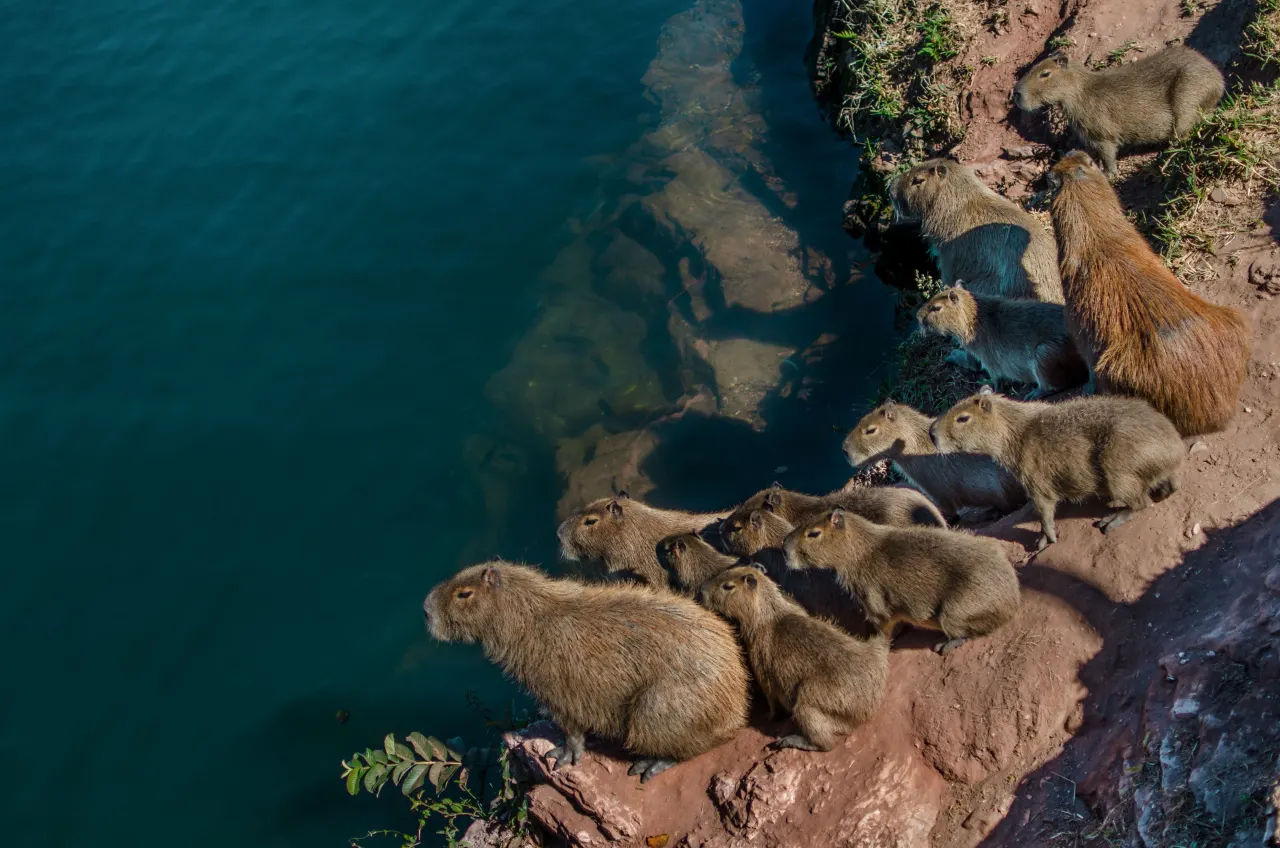
Every few months the same message goes around: somebody in Florida or Louisiana photographs a big rodent print in soft ground and the internet decides it is a capybara. The photo is usually good. The ground is usually right. The animal almost never is. Nutria are established across a lot of the American South, they use the same wet margins, they leave prints in the same silt, and they are the correct answer roughly every time. The tell is the hind print, and it is a simple one: count the toes. Three is a capybara foot. Five, with the outer one sitting apart from the webbed group, is a nutria. It takes two seconds, and it is the difference between a genuinely interesting sighting and a very ordinary one. Florida does have a small wild capybara presence, which is exactly what makes the misidentifications so persistent.
Wild capybaras are a South American animal. A large rodent track in a North American wetland is overwhelmingly more likely to belong to a nutria, a beaver, or a muskrat. Count the toes on the hind print first: three means the capybara case is at least open, and five means it is closed.
Telling Capybara Feet from a Nutria
Nutria are the animal capybaras get confused with most often in the United States, and the feet are one of the cleaner ways to separate them. Animal Diversity Web describes the nutria forefoot as having “four long, flexible, unwebbed digits and a vestigial thumb,” and the hind foot as containing “five digits; the first four are connected by webbing, and the fifth is free.”
That is a different machine entirely.
| Feature | Capybara | Nutria |
|---|---|---|
| Front foot | Four toes, radially arranged | Four long flexible digits plus a vestigial thumb |
| Back foot | Three toes | Five digits, the first four webbed, the fifth free |
| Webbing | Partial, on front and back | Hind feet only, and only four of the five digits |
| Nails | Short, blunt, described as hoof-like | Clawed, on flexible manipulating digits |
| Adult weight | 35–66 kg (77–145 lb) | 5–10 kg (11–22 lb) |
The weight row is doing more work than the toe rows, honestly. A nutria is a fifth the size of an adult capybara, and once you have seen both in person the confusion largely stops. Tails settle it even faster, which is why the nutria, beaver, and guinea pig field guide starts there rather than at the feet.
Foot Myths Worth Dropping
| What people believe | What is actually true |
|---|---|
| Capybaras have fully webbed, duck-like feet | The webbing is partial on both feet. It helps in water and costs nothing on land |
| Front and back feet match | Four toes in front, three in back. The prints are different shapes |
| Webbed feet mean they live mostly in water | Semi-aquatic. They graze on land and use water for cooling, safety, and travel |
| Those are soft paw pads | The nails are described as strong and hoof-like, on a foot built for wet ground |
| Webbing makes them clumsy on land | They walk, graze, and cover around 700 m a day on exactly these feet |
| A capybara would be fine on apartment floors | The foot needs soft, uneven, often wet ground to work against |
What the Feet Say About the Rest of the Animal
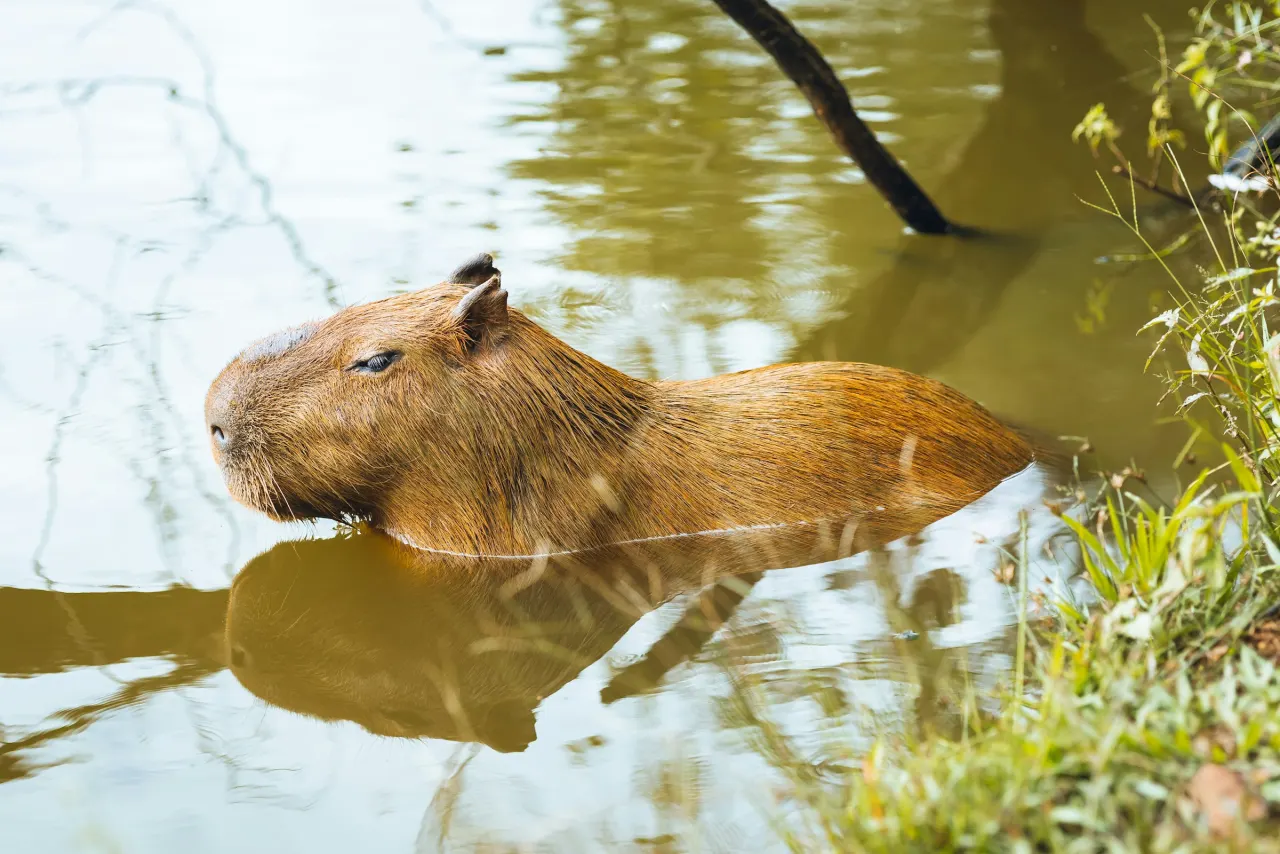
Anatomy tends to agree with itself, and capybara anatomy is unusually consistent about where this animal lives. Continuously growing teeth are the equipment for a lifetime of abrasive grass. Eyes, ears, and nostrils set high on the skull are the equipment for sitting in water with the important instruments above the surface. Feet that spread load on mud and paddle in the shallows are the equipment for getting between those two situations several times a day.
Nothing in that list is showing off. The feet do not look like a pet’s paws and they do not look like flippers, because they were never solving either problem. They were solving grass, mud, bank, and water in one package, and they handle all four without complaint.
That is the quiet thing about capybara feet. The face gets the memes. The feet are why the animal is standing in the shallows swimming better than it has any right to, looking like it has nowhere to be.