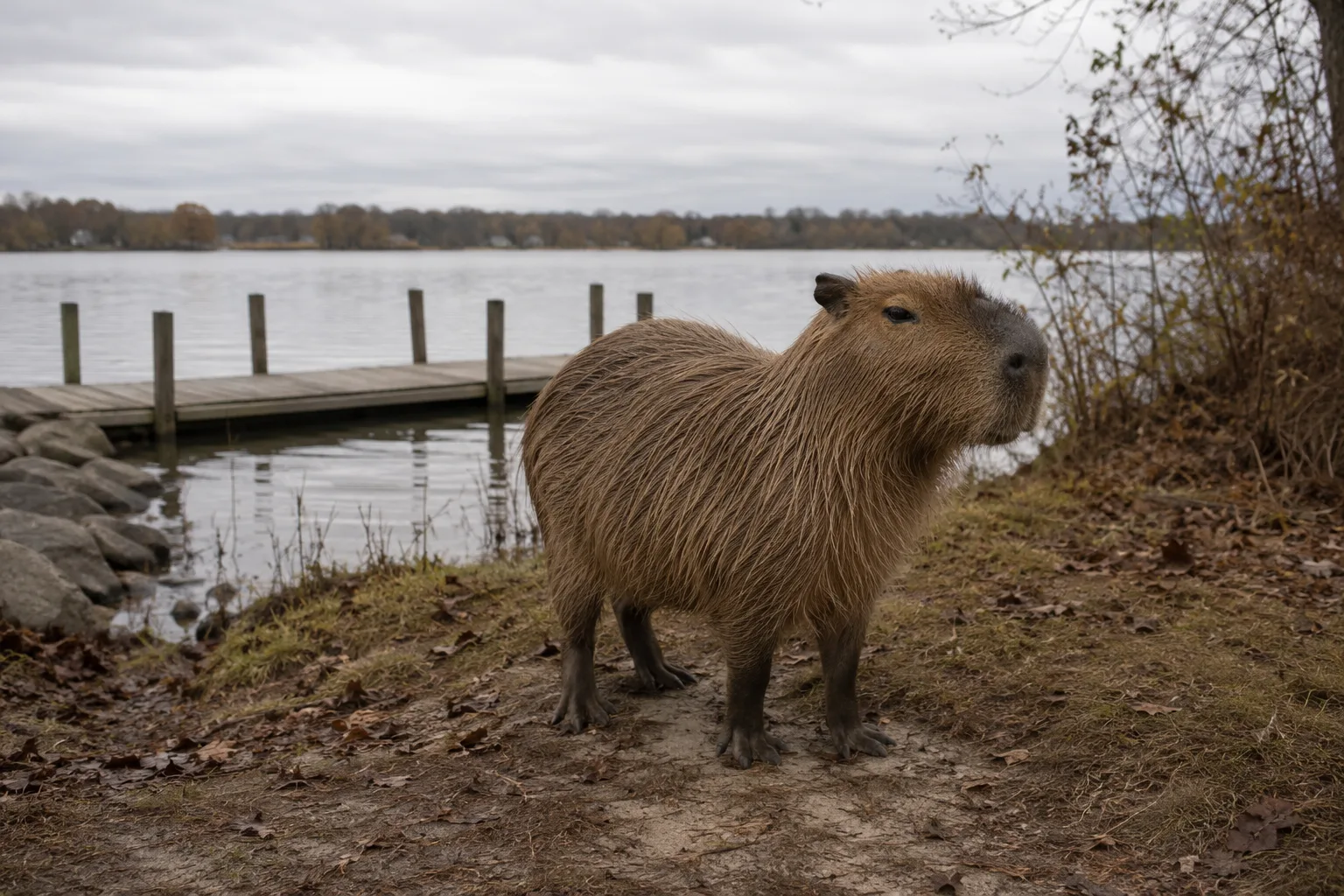
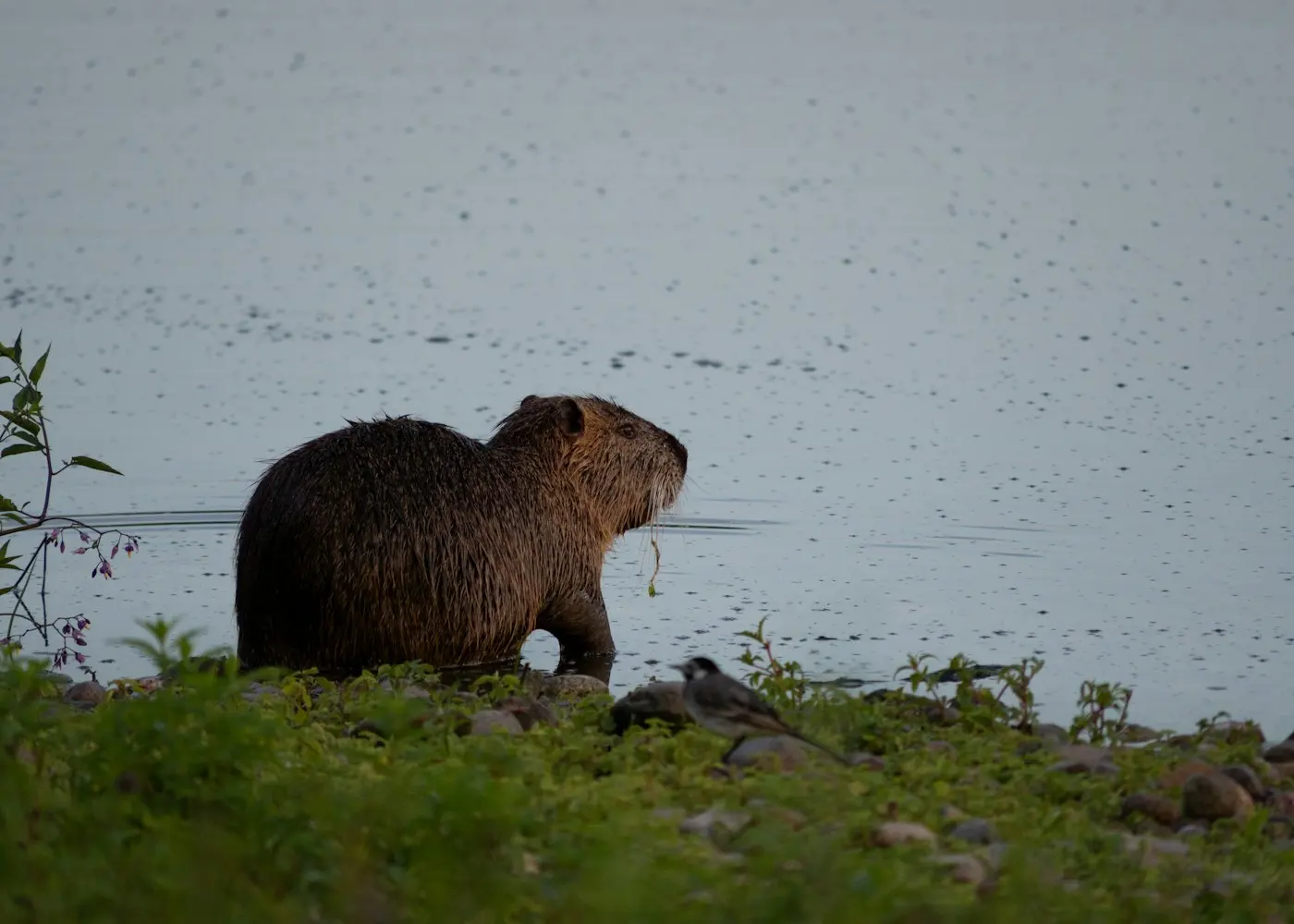
Yes, capybaras swim, and they are very good at it. They are semi-aquatic mammals with partly webbed feet, eyes and nostrils sitting high on the head, and a body plan built for rivers, marshes, ponds, and wet grasslands. Water is not spa content for them. It is infrastructure.
San Diego Zoo Wildlife Alliance reports capybaras can stay submerged for up to about five minutes. That is not party trivia. That is the predator-defense feature that lets a 100-pound rodent become an animal that disappeared.
If you have only seen the bath videos, the real animal can be a shock. It is not “relaxing in water” the way a person relaxes in a hotel pool. It is constantly keeping the bank, the group, the depth, and the escape route in the same mental tab. The capybara is calm because the exits are good.
Built For Water, Not Just Bathing
Open any reputable capybara reference and the language is the same. San Diego Zoo Wildlife Alliance and Smithsonian’s National Zoo both describe them as semi-aquatic. Animal Diversity Web is explicit: excellent swimmers, tied to water bodies in their home range. Britannica calls out their amphibious habits. When four serious sources line up, we can stop hedging.
The anatomy is consistent with what the references say. The feet have webbing between the toes (the front feet have four toes, the back feet three, all partly webbed). The eyes, ears, and nostrils all sit near the top of the head, which lets the animal stay almost entirely submerged with only sensory hardware above the water line. The body is dense, broad, and stable. None of this is decorative.
| Feature | What it does | Why it matters |
|---|---|---|
| Partly webbed feet | Propulsion, mud stability | Faster water movement, less slipping on soft banks |
| High-set eyes and nostrils | Stay submerged while watching and breathing | Hidden mass, exposed sensors |
| Dense, water-resistant fur | Insulation, faster drying | Repeated water entry without chill |
| Large stable body | Steady float, easy submersion | Calm posture in current and stress |
| Group living | Coordinated water use, shared vigilance | More eyes near the bank, faster group escape |
Why They Swim In The Wild
Swimming is not a recreational choice for wild capybaras. It is part of how they stay alive. Their home range overlaps with jaguar and puma territory and large constrictors like the green anaconda. Animal Diversity Web’s jaguar account flags capybaras as a common prey species in some regions, and predator presence shapes capybara behavior heavily.
A capybara near water has options. A capybara far from water has a motivational problem. The pattern you see in field photos — animals grazing close to the bank, drifting back into shallows at the first sign of stress, sleeping near reeds — is not laziness. It is positioning. The animal is keeping the exit door close.
this is the part of capybara biology that lands hardest in person. They look chill because they have chosen a safer seat than most animals in the wetland. The “calm vibe” is a survival posture.
The “Up To Five Minutes” Trick
The famous San Diego Zoo number is worth slowing down on. Five minutes is a meaningful chunk of time for a predator-evasion behavior. A jaguar that runs to the bank and watches the surface ripple for a couple of minutes is a jaguar that often gives up before the capybara has to surface.
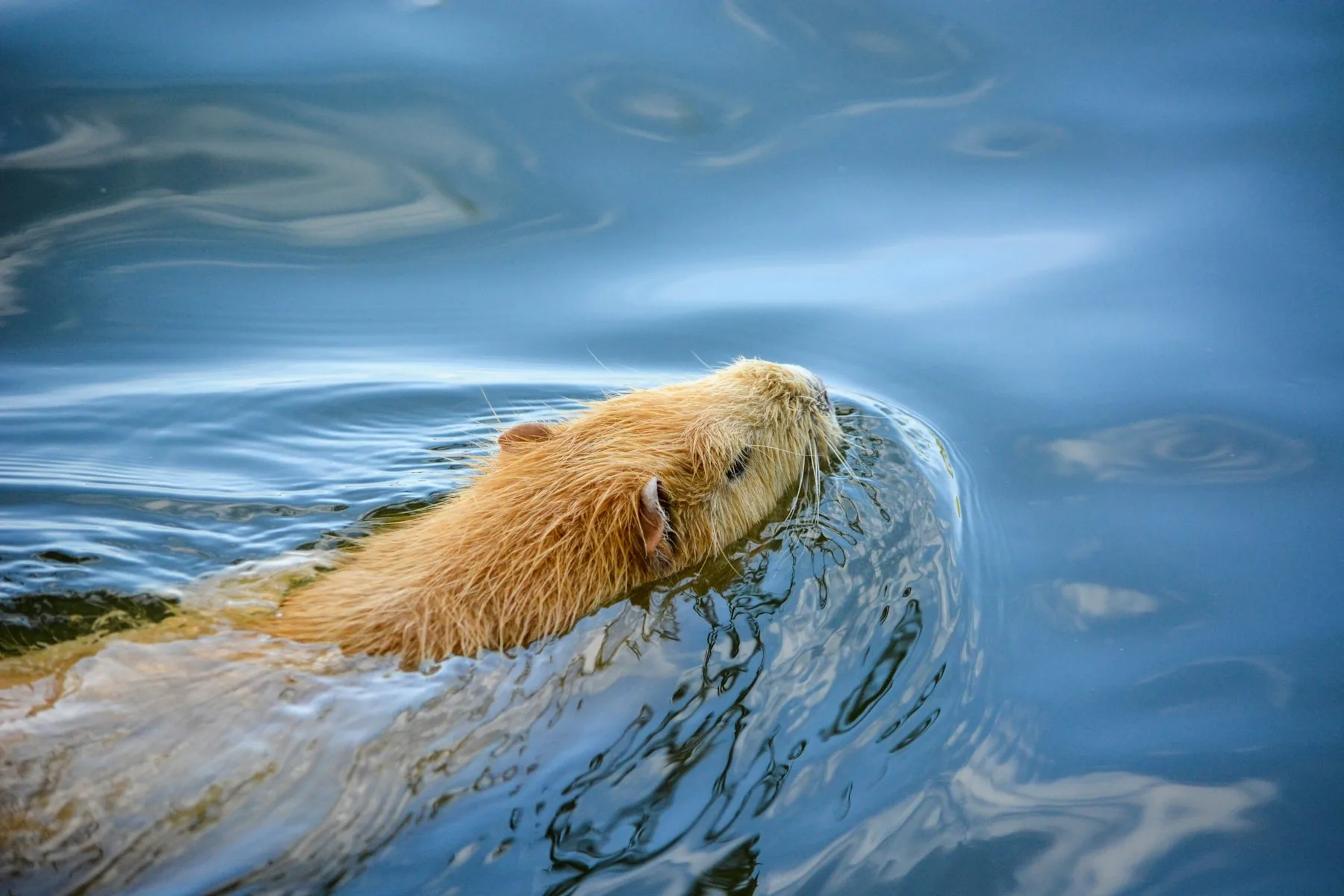
The behavior is typically not a deep dive. Capybaras sink low, often resting at the bottom in shallow water, or maintain a low profile with only the top of the head breaking the surface. Eyes scan, ears track, nostrils breathe quietly. The body does very little.
| Water behavior | What it helps with | Honest translation |
|---|---|---|
| Sinking low | Visual cover from a predator on the bank | Going off-screen, biologically |
| Wallowing in mud | Skin moisture, temperature, parasite reduction | Spa day, but the spa is survival |
| Group water entry | Coordinated retreat from shared threat | The meeting moves locations |
| Resting at the bank | Fast access to cover | Always sitting near the exit |
| Crossing rivers | Habitat connection during dry season | A wetland animal moves between wetlands |
What To Watch At A Zoo Or Wildlife Park
The best swimming behavior is often subtle. A capybara may step into water without drama, lower its body until only the top of the head shows, pause, scan, then drift back toward the group. That is the whole point. No cannonball. No applause. Just a wetland animal making itself harder to read.
At a good facility, watch the edges. Are the banks sloped instead of vertical? Can the animal enter and leave without slipping? Is there shade near the water? Do keepers keep visitor noise away from the pool edge? The AZA Capybara Care Manual treats aquatic access as a husbandry issue, and this is where you can see why: a bad edge turns water from safety into a trap.
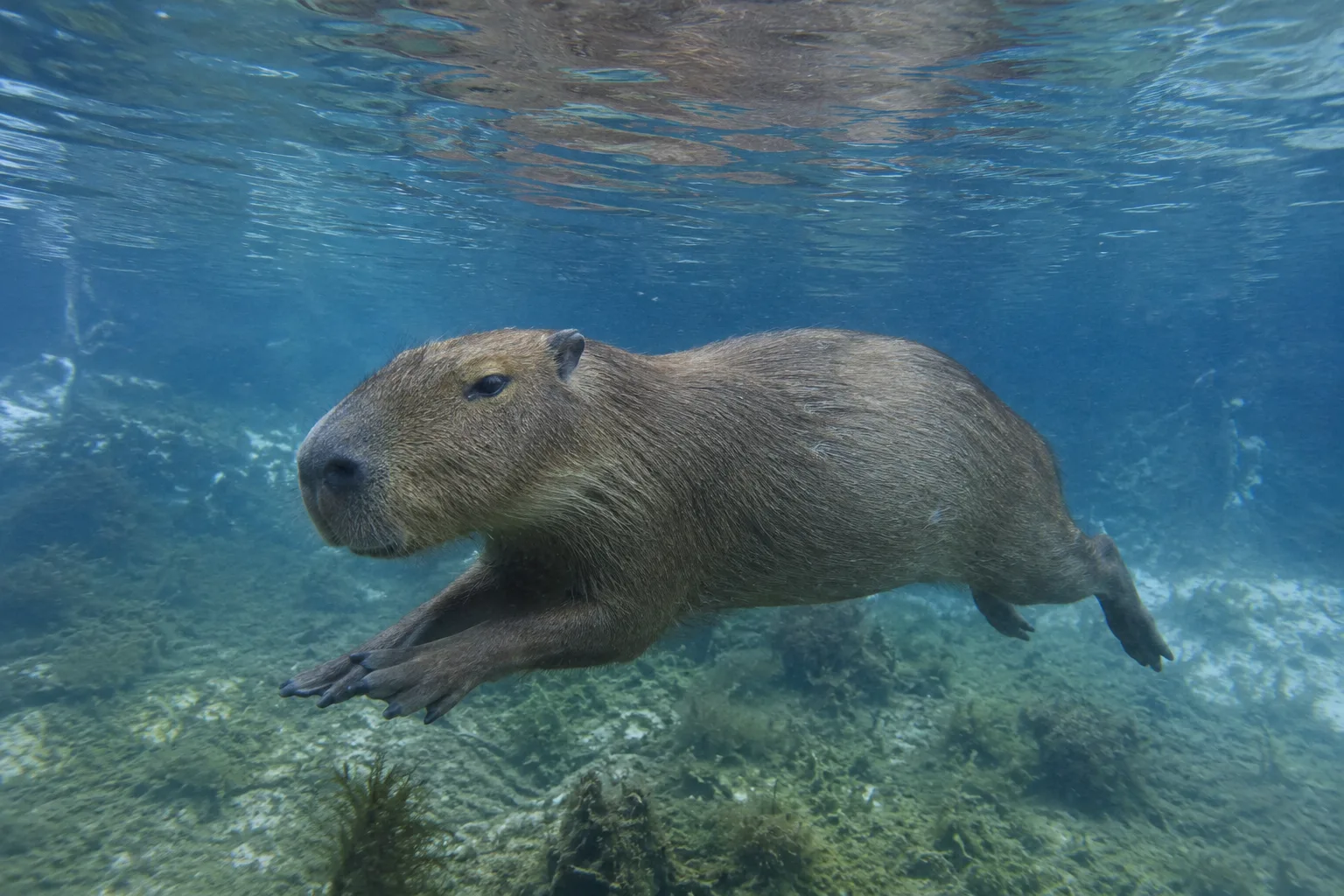
One good zoo moment beats 40 clipped bath videos. Stand quietly for ten minutes and you may see the sequence: graze, orient, step down, submerge, scan, return. The animal is not doing nothing. It is running a tiny risk assessment with ears.
This is also why capybara water content is so easy to misread. A relaxed soak, a heat-management soak, a stress retreat, and an escape response can all look like “capybara in water” from 30 feet away. The difference is context: what happened before entry, how the group moved, whether the animal keeps scanning, and whether it returns to grazing when the disturbance passes.
Misconceptions About Capybara Swimming
“They are just rodents, water is enrichment not a need.” Welfare standards in the AZA Capybara Care Manual and reputable zoos treat water access as a baseline requirement, not a perk. A capybara without real water is a capybara whose normal behavior is suppressed.
“A bathtub is enough.” Not for the long run. A bathtub-sized container does not allow the full submerge-and-rest behavior that defines a capybara’s relationship with water. It is a holding tank, not a habitat feature.
“They are stronger underwater than at the surface.” Not really. They are strong swimmers, but their actual trick is the long submerge with low energy use. The drama is the patience, not the speed.
“If they like water, they will love a pool I install in my yard.” A pool is one noun. A capybara water plan is filtration, drainage, refilling, slope, footing, shade, and a vet to call when algae becomes a problem. The full ownership reality is worth reading first.
“Swimming means they are basically aquatic pets.” No. They are semi-aquatic grazers, which means land and water both matter. A good habitat has grazing space, dry rest, shade, social group space, and safe water access. Water alone is not the whole care plan.
What Water Access Should Look Like In Captivity
For zoo-quality care, the AZA manual treats aquatic access as husbandry. Real water access means a body of water big enough to submerge in, with safe slope on both sides, clean and regularly turned over, with shade and substrate that does not cut feet. It also means staff who know what stress and skin issues look like, and a backup vet for the days that go wrong.
The same logic applies for any reader curious about owning one. The water is the part most home setups get wrong, and it is often the part that quietly degrades welfare while everyone insists the animal “loves the pool.” If you want to see this done well, the U.S. zoo viewing guide lists facilities that handle water habitats seriously. For the broader picture on where capybaras swim in the wild, the native range guide covers the wetland ecosystems they evolved for.
The practical test is simple: can the animal choose water, leave water, rest dry, avoid crowding, and keep the water clean enough that skin and feet stay healthy? If the answer is “sometimes, when we remember to refill it,” the setup is not capybara care. It is a prop with plumbing.
For normal fans, the takeaway is simpler and nicer: when you see a capybara near water, you are seeing the animal in its proper grammar. The bank, the shallows, the eyes above the surface, the group nearby — that is not background. That is the sentence.
A capybara without real water access is not living a capybara-shaped life. The animal will survive, but it did not vote for land-only mode. That is the thing fans should hold onto: the calm posture by the water is the whole point.