
Four pups, on average. Animal Diversity Web and San Diego Zoo Wildlife Alliance both document the typical capybara litter as approximately four pups, with a range that spans from one to eight. The average is the most useful planning number; the extremes are documented but not typical.
What makes the litter size less interesting than what the pups do immediately after birth: they walk. Within hours. This is the part that separates capybaras from most of the rodent world in terms of reproductive biology.
Litter Size: The Actual Numbers
San Diego Zoo Wildlife Alliance reports litters of 2-8 young, with 4 being the typical average. Animal Diversity Web’s account cites an average of around 4 young per litter. Britannica gives a similar range. The AZA Capybara Care Manual notes that litters vary and that the facility should be prepared for the typical range when breeding is managed.
| Litter size | Frequency |
|---|---|
| 1 | Uncommon but documented |
| 2-3 | Below average; occurs |
| 4-5 | Most typical range |
| 6-7 | Less common; documented |
| 8 | Documented upper limit; unusual |
The high end (7-8 pups) occurs but is significantly less common than the 3-5 range. Reporting a specific upper limit of 8 is consistent with Animal Diversity Web documentation, though these large litters are not the norm to plan around.
Born Ready: What Precocial Means In Practice
Capybara pups are among the most developmentally advanced of any rodent at birth. The comparison to other species clarifies how unusual this is:
- Mice: born blind, hairless, unable to move effectively — 21-day gestation
- Rabbits: born blind, with only fine downy fur, unable to thermoregulate — 30-33 days gestation
- Capybaras: born with eyes open, full dense fur, able to walk and run within hours — ~150 days gestation
The 150-day investment produces a fully prepared animal. Capybara pups have:
- Eyes fully open and functional from the moment of birth
- A complete coat of the same coarse fur as adults
- Functional limbs — they stand within minutes and walk within hours
- The ability to begin grazing (solid food) within the first few days, even while still nursing
- Social integration with the group from day one
This is not metaphorical readiness. Field documentation and zoo observations both confirm that capybara pups are moving with the group and interacting with adults within the first day of life. The contrast with a litter of mouse pups — which are essentially fetal externally — is difficult to overstate.

Communal Nursing: The Group Care System
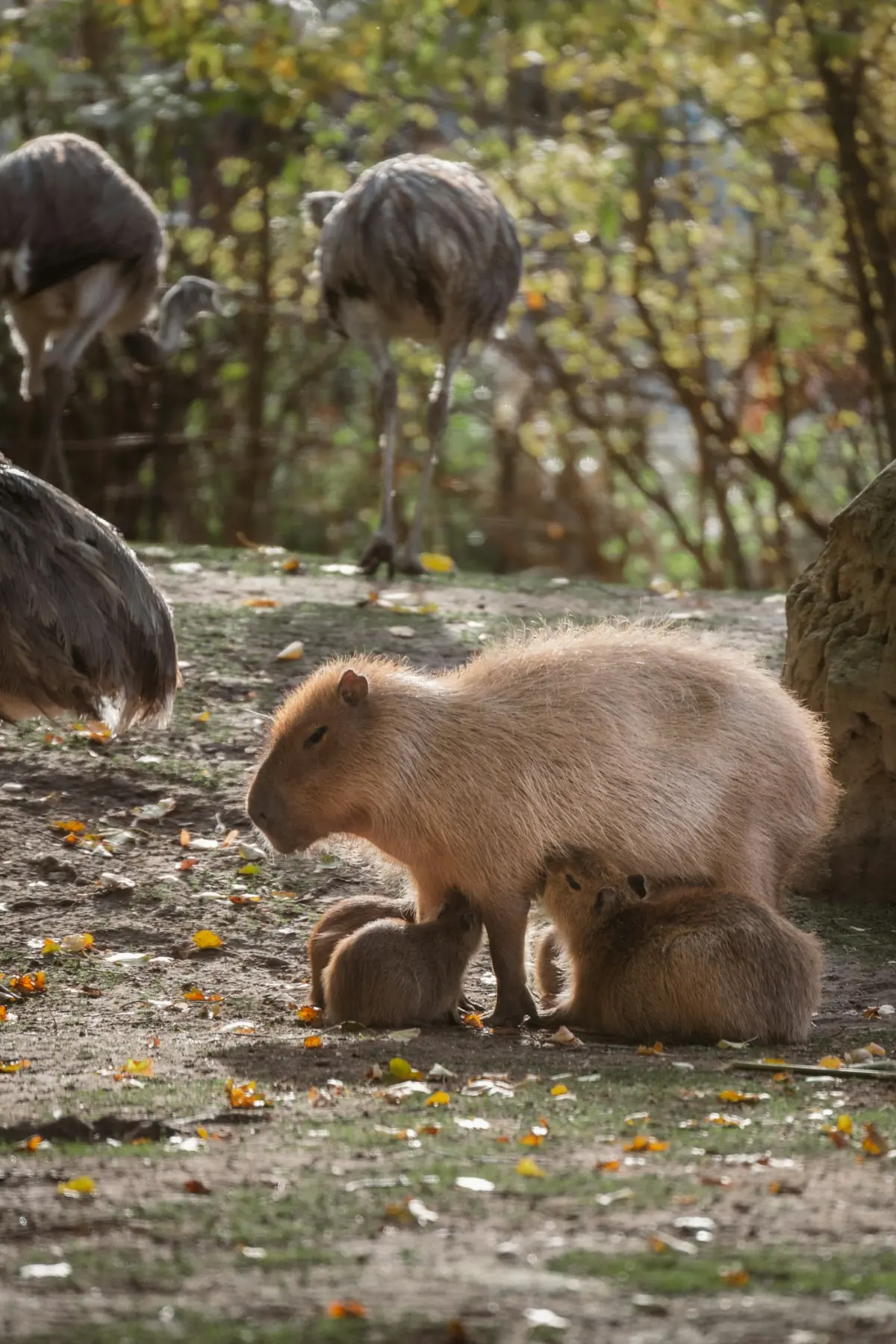
One of the more distinctive aspects of capybara reproduction is documented communal nursing. Smithsonian’s National Zoo notes that capybara pups may nurse from multiple lactating females in the group, not exclusively from their biological mother. Animal Diversity Web confirms alloparental care in capybara groups.
This is significant for several reasons:
Resilience: if a mother is injured, captured by a predator, or otherwise unable to nurse, the pups are not automatically lost. Other lactating females continue nursing.
Nutritional distribution: pups may access different females depending on availability, which distributes the nursing burden across the group and may buffer nutritional variation in individual mothers.
Social integration: nursing from multiple females strengthens pup bonds to the broader group rather than to a single individual. This supports the social cohesion that adult capybaras depend on for survival.
The communal nursing system is consistent with the overall capybara social structure: the group, not the individual mother-pup pair, is the functional unit of care and survival.
Early Development: First Weeks
What the first weeks of capybara pup life look like:
Days 1-3: The pup is walking, nursing from the mother and potentially other females, and staying very close to adults. The group provides protective cover. No nest — the pup moves with the group from the start.
Days 3-14: The pup begins attempting to eat vegetation alongside adults. Nursing continues. The pup’s movement is integrated with the group — when adults move to water, the pup follows.
Weeks 2-8: Grazing becomes a more substantial part of the diet; nursing gradually decreases. The pup’s social position within the group begins to form — it learns the group’s hierarchy and social signals.
Months 2-8: Progressive weaning. The pup continues growing (capybaras take approximately 12-18 months to reach adult size). Sexual maturity is reached at approximately 12-18 months.
Misconceptions About Capybara Pups
“Baby capybaras look like tiny adults.” In some ways, yes. The fur coat, body proportions, and open eyes give them an adult appearance. But their size (pups weigh approximately 1.5-2 kg at birth; adults reach 35-65 kg) and behavioral development make the difference clear.
“A capybara pup needs to stay with only its mother.” Not according to the evidence. Communal nursing and group integration are natural and appropriate. Artificially isolating a pup with only its mother may be more stressful than the group context.
“Larger litters are better.” Larger litters place greater nutritional demands on the mother and the group’s nursing capacity. There is no welfare advantage to very large litters; average-sized litters with well-nourished mothers produce healthier pups.
“Capybara pups are helpless for weeks.” No. The precocial birth means pups are mobile from birth. “Helpless for weeks” describes mice, not capybaras.
The full reproductive picture — from mating through gestation to birth — is in how capybaras reproduce and how long capybaras are pregnant.