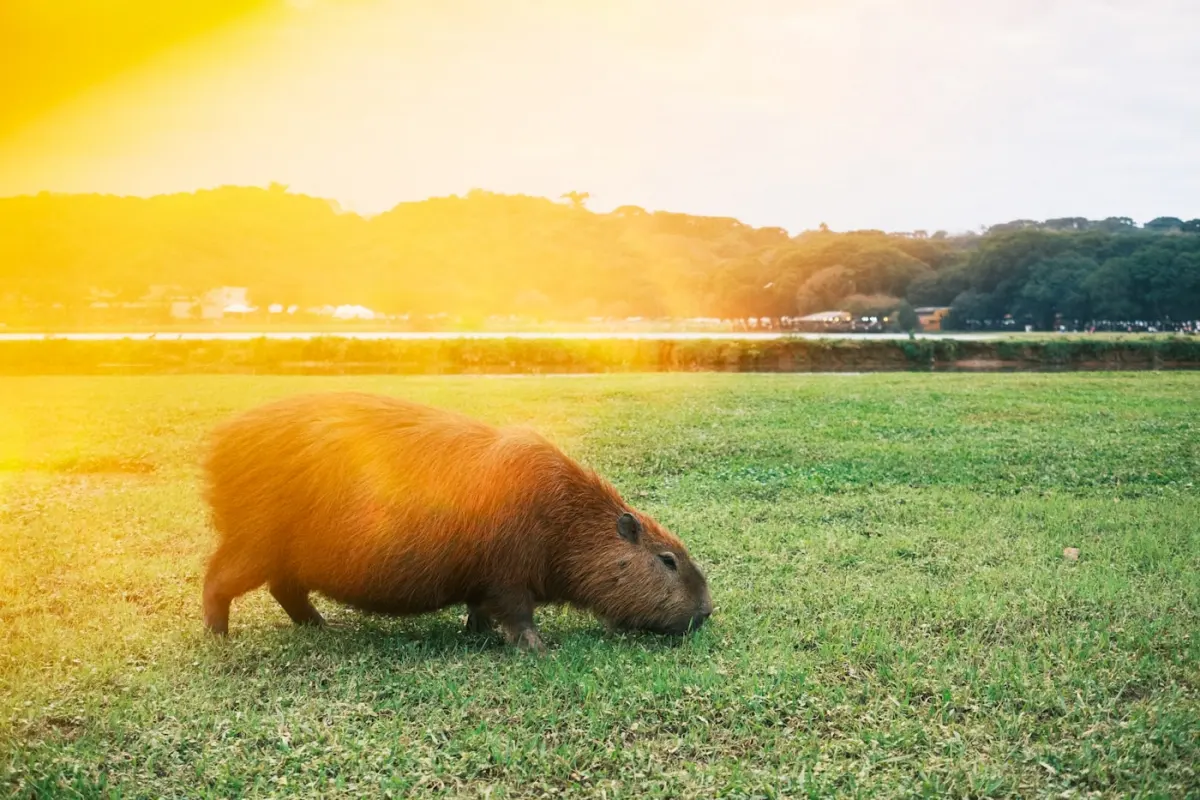
A capybara looks calm because not reacting is the best move it has. It is a large grazer in open country shared with jaguars, caimans, and anacondas, and the strategy that kept the species going was never fighting and rarely bolting. It was standing still, staying in a group, keeping water close, and saving the alarm for something that has earned it. What reads as serenity is a threat-management system running well, with the sensitivity turned deliberately low.
The internet version is the zen animal, the friend of every species, the one mammal that solved inner peace. That is about half right. The half it gets wrong is the more interesting half.
They are not serene. They are a prey animal whose best strategy is not reacting.
Capybara calm is structural. It is produced by a group that shares the watching, water within a short sprint, and a feeding schedule that fills most of the day. Remove any one of those and the same animal stops looking calm within minutes. The temperament did not change. The conditions did.
Calm Is a Position, Not a Personality
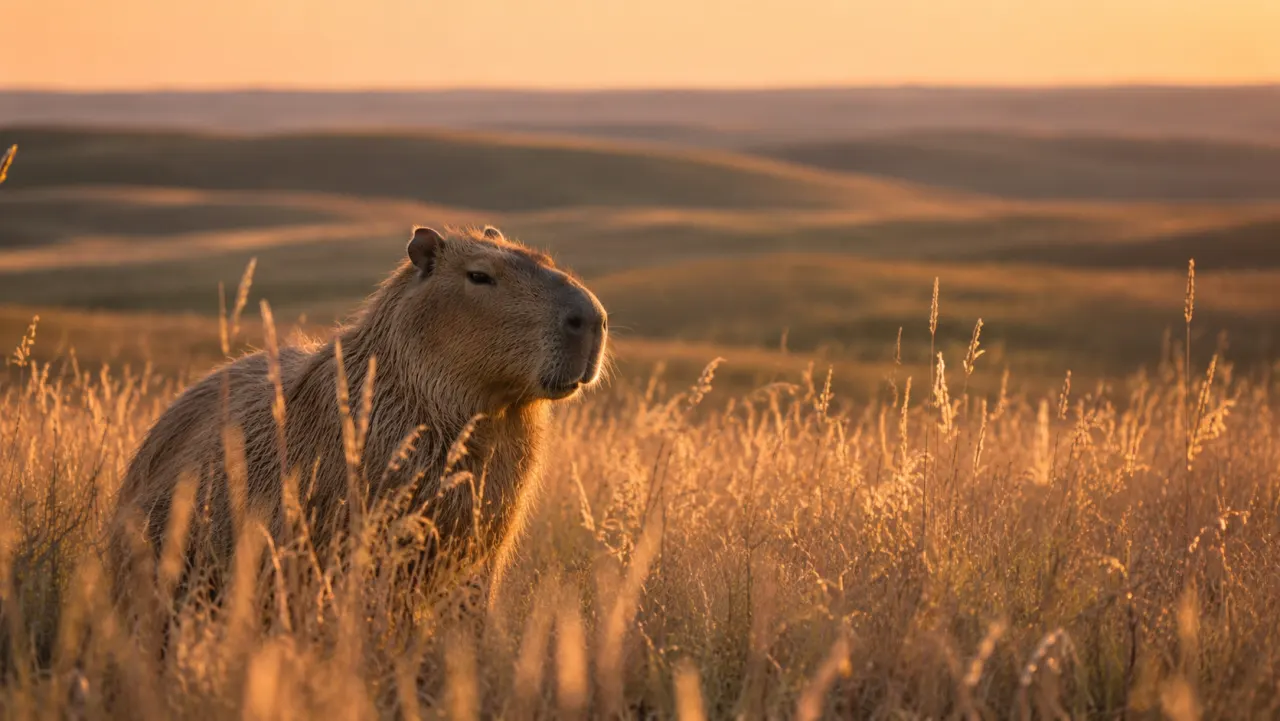
A capybara grazing on a riverbank is doing two jobs at once and only one of them is eating. Animal Diversity Web is blunt about it: while grazing, capybaras “are constantly on the lookout for predators and give an alarm bark when one is spotted.” The head-down animal is not off duty. It is one sensor in a distributed array.
That is a different thing from relaxed. The AZA Capybara Care Manual classifies capybaras as flight animals and instructs accredited facilities to build hides into every enclosure so an animal always has somewhere to go. Nobody writes that requirement for a species that has stopped worrying.
Read those three together and the calm stops being mysterious. A capybara covers a small area, slowly, surrounded by other capybaras, next to a place where it is almost impossible to catch. Nothing in that arrangement rewards a fast reaction.
| Condition | What it does | What happens without it |
|---|---|---|
| A group of around 10 | Splits the watching so any one animal can put its head down | Continuous solo vigilance, the load the behavior evolved to share |
| Water within a short sprint | Converts a chase into a five-minute breath-hold the predator cannot follow | The escape plan is running on land, which capybaras lose |
| Cover and shade | Somewhere to go that is not the middle of an open field | AZA requires hides for exactly this reason; without one there is no retreat |
| All-day grazing | Fills the schedule with a low-arousal activity that doubles as watching | Idle time, and idle prey animals get restless rather than serene |
The Group Watches So No One Animal Has To
Capybaras live in groups of around 10 adults, ranging from 3 to 30, with much bigger aggregations forming around water in the dry season. The San Diego Zoo Wildlife Alliance fact sheet records dry-season gatherings of up to 100 animals at a single water source.
The arithmetic is the whole mechanism. One capybara has to cover 360 degrees by itself, permanently. Twelve capybaras facing loosely different directions each cover a slice, and an approach from any angle gets picked up by whichever animal happens to be pointed at it. No individual has to be clever. There just has to be enough of them, spread out enough.
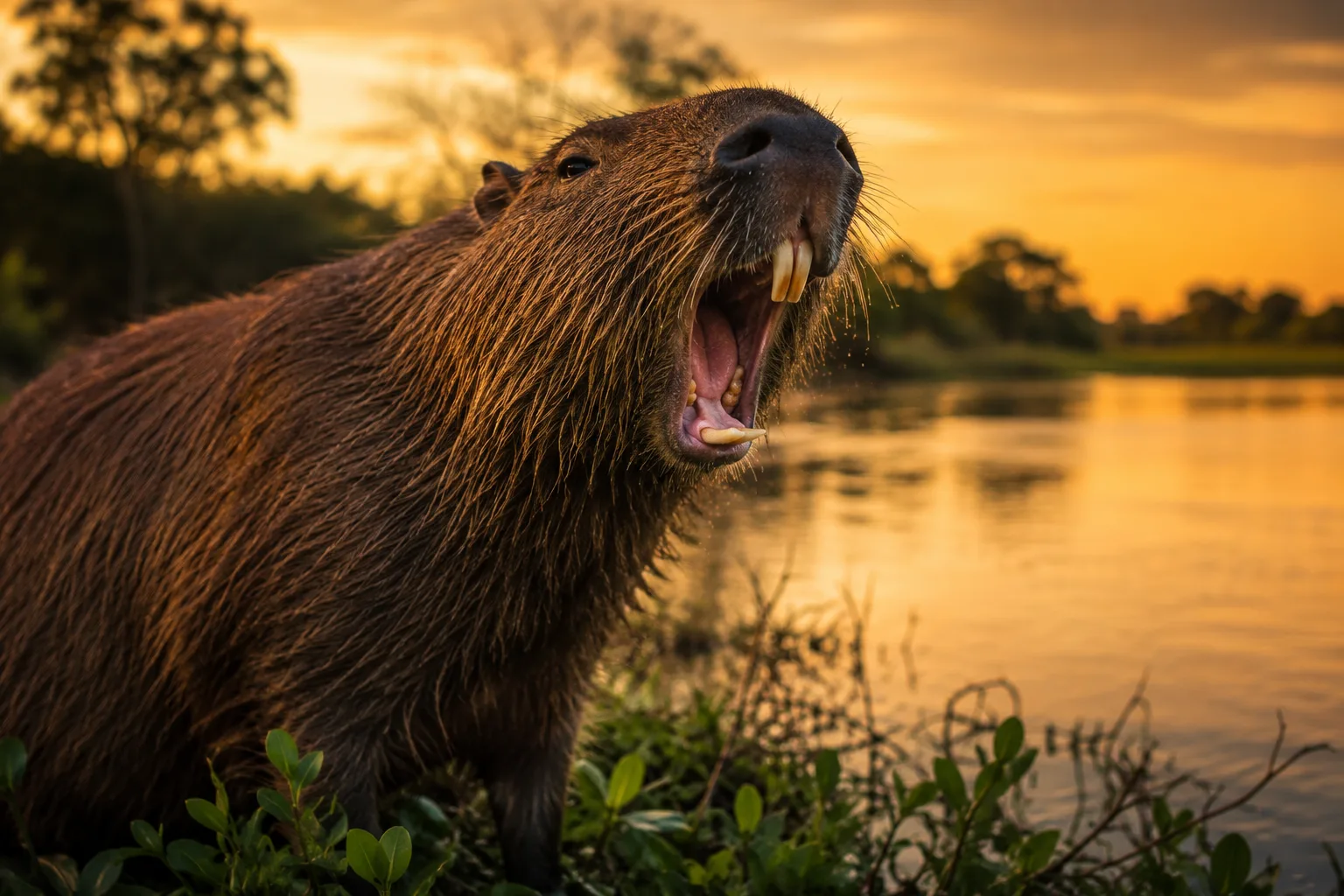
Here is the detail worth keeping. Most of the warning calls in a wild capybara group come from the subordinate males. The animals at the bottom of the ranking, the ones who live at the edges of the group rather than the comfortable middle, are the ones doing the shouting. The dominant male gets the good position precisely because somebody else is standing where the trouble shows up first. When the bark goes up, the response is standardized: stand alert, or go into the nearest water. It is one of seven distinct capybara calls, and it is the only one the whole group acts on at once.
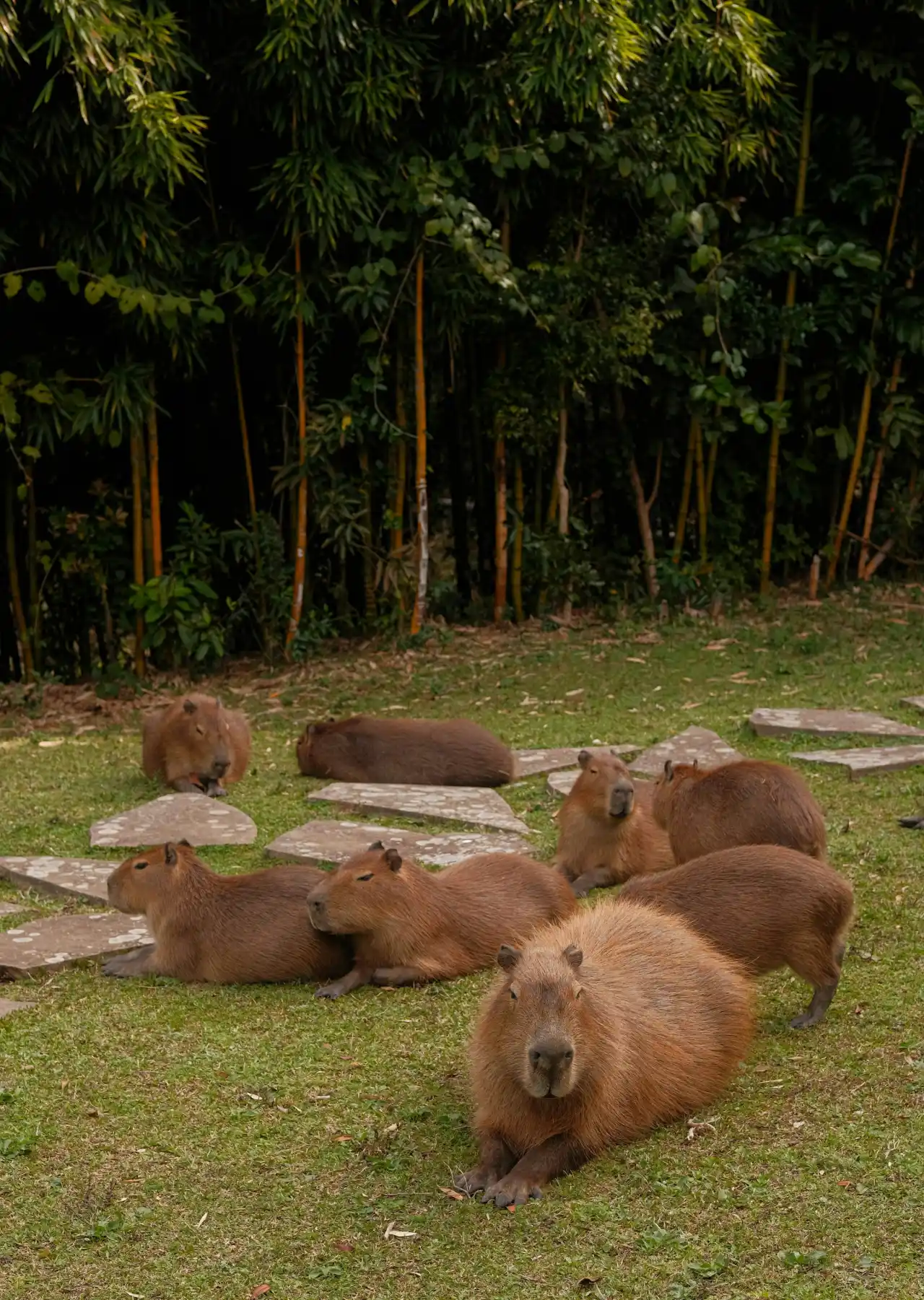
AZA guidance calls capybaras a gregarious species that should be housed in a social setting, either with other capybaras or other species. A solo animal is running the entire watch alone, permanently, with no relief. It may still look placid. The system it evolved to use is switched off.
That is also why the “does it need a friend” question has a boring answer and a firm one. Capybaras need a companion for a structural reason, not a sentimental one.
Water Is the Exit, and It Changes the Math
Most large grazers live with the knowledge that a committed predator will eventually win the chase. Capybaras have an option almost nobody else in their neighborhood has: they can leave the category.
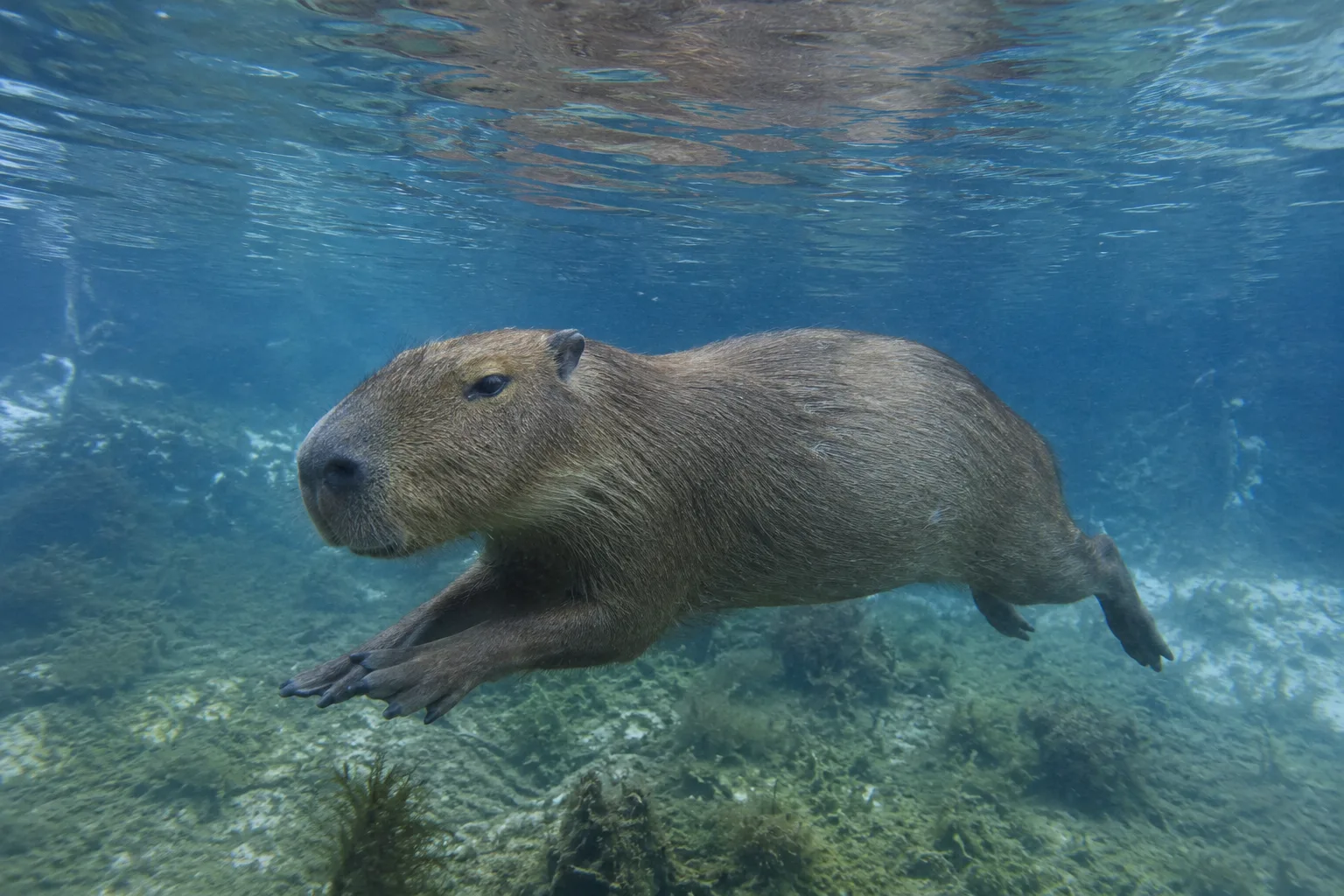
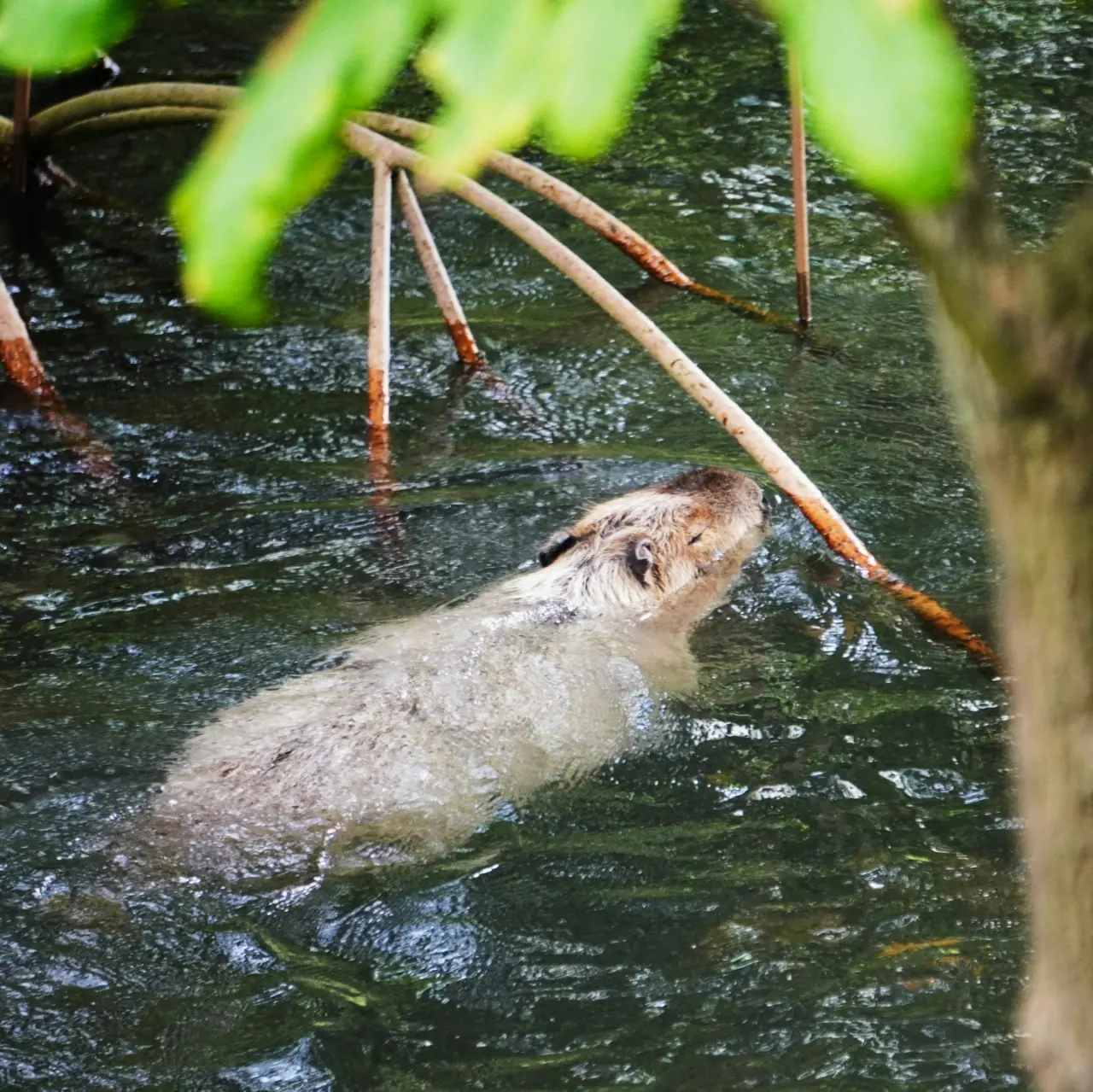
Animal Diversity Web describes the move directly. Capybaras “often hide in the water, with just their nostrils and eyes exposed, and can stay completely submerged for up to five minutes.” Five minutes is a long time in a hunt. A jaguar swims, but it is not going to sit on a riverbank waiting out a submerged rodent that has planned for this.
The distance to the bank is doing quiet work in every calm-looking photograph you have ever seen. A capybara five meters from water and a capybara a hundred meters from water are in genuinely different situations, and they behave differently. Grazing pressure, resting spots, group spacing along the river, all of it tracks the water line. The San Diego Zoo Wildlife Alliance records groups spacing themselves 100 to 500 meters apart along a river, which tells you the bank is the organizing feature of capybara geography, not an amenity.
Managed care encodes the same fact. the median pool in AZA capybara exhibits is 88 m² (950 ft²), and the depth norm is at least 1.8 meters with a gradual incline, because the animal has to be able to fully submerge and get out again. That is not a decorative pond. It is the escape route, built to code.
Grazing All Day Leaves No Room for Drama
The least discussed reason capybaras look unbothered is that they are busy. The AZA manual estimates an adult capybara needs roughly 2,500 kilocalories a day, and says those calories should come from foods that are high in fiber and relatively low in energy, which means “the capybara should occupy much of its day eating and chewing.”
That single sentence explains a lot of the visible behavior. An animal on a high-volume, low-density diet does not have spare hours. It has a shift. Capybaras are large hindgut fermenters with digestive efficiency comparable to ruminants, so the strategy works, but only if the chewing keeps going. Grazing is not what they do between the interesting parts of the day. It is the day.
Low-arousal, repetitive, all-day feeding is also the ideal cover for vigilance. The animal is stationary, facing outward, ears free, nose working. A capybara that suddenly stops grazing has told you something. A capybara that keeps grazing has told you nothing is wrong. That binary is most of what you are actually reading when you look at a group and decide they seem peaceful.
My honest read: the zen framing is the least interesting version of this animal. An herbivore that solved the predator problem with arithmetic, a river, and a schedule is a much better story than a rodent with a good attitude.
Where the Science Stops and the Meme Starts
Every source in this guide describes behavior. None of them describes a capybara's emotional state, and there is no published capybara stress-hormone baseline behind the "least stressed animal on earth" claim. We can say what a capybara does and under what conditions. What it is like to be one is not on the record.
The gap is where the bad advice lives. If capybaras are calm by nature, a small pen with one animal in it is fine, because the calm travels with the animal. If the calm is produced by conditions, that same pen is a welfare problem with a photogenic surface.
| What people believe | What is actually going on |
|---|---|
| Capybaras are naturally zen | The calm is conditional. Take away the group, the water, or the cover and it goes. |
| They get along with everyone because they are friendly | The tolerance points outward at other species. Inside the herd there is a strict male ranking, enforced daily. |
| Nothing bothers them | They give a repeated coughing alarm bark at predators, and the whole group acts on it. |
| They are calm because they are slow | They graze slowly. They also run in short bursts and swim well enough to lose most land predators. |
| Capybaras have unusually low stress hormones | Not documented. Behavior is what the sources describe. Physiology is what the internet added. |
| A calm-looking capybara is a well-kept capybara | A resting animal and a shutting-down animal photograph identically. The difference shows up over weeks. |
The interspecies tolerance is real and worth its reputation, but it answers a different question. Why capybaras are so friendly is about low-threat positioning toward other species. This page is about the baseline setting itself.
What Stress Looks Like When It Shows Up
Capybaras have stress responses and they are observable. The AZA manual lists the signs staff watch for in quarantine: pacing, prolonged vocalization, sudden movements such as running or jumping, and a general display of unease. That is a specific list, written by people who have to make the call in real time, and it is a better guide than any adjective.
Longer-running problems show up more slowly. Coat condition, weight, feeding frequency, and willingness to be near the rest of the group all drift before anything dramatic happens.
Watch a mixed group at a zoo for twenty minutes and you get the whole system in miniature. A maintenance cart rattles along the service path behind the exhibit. Nothing visible changes for about half a second. Then one animal at the far edge, not the biggest one, lifts its head. Two more come up. The group does not scatter, because nothing has resolved into a threat yet, but every head is now pointed at the same quadrant and no one is chewing. The cart passes. Heads go back down in roughly the order they came up. Total elapsed time is maybe eight seconds, and the family standing at the rail has seen a full alarm cycle and read it as capybaras being sleepy. That is the thing itself. Not an absence of reaction. A very cheap one.
What All of This Means at the Zoo
If you want to check whether the calm in front of you is the real thing, stop looking at the face. Capybara faces carry almost no information, which is most of why the meme works. Look at the arrangement instead.
Is there more than one animal. Is there water deep enough to disappear into, with a way out. Is there somewhere shaded to retreat to that is not visible from the rail. Are the animals spread out and facing different directions, or bunched and facing the same way. Are they eating. A group that is spread, mixed-direction, and chewing is a group whose conditions are met. That is what calm actually looks like from the outside, and it is a checklist rather than a vibe.
The one thing this page deliberately does not cover: what happens when capybaras are not getting along. Rank disputes, breeding season, and the warning ladder before a bite are a separate topic with separate evidence, and they live in the guide on whether capybaras are aggressive.
None of this is veterinary guidance. If you keep or work with capybaras, an exotic-animal vet and your facility’s protocols outrank anything written here.