The short answer
If a capybara clip looks impossible, the question worth asking is not “would a capybara do that.” It is “does the water behave correctly.”
That reordering matters because capybaras are a bad species to apply your instincts to. They are the largest rodents alive, they spend much of the day in water, they are comfortable around animals that ought to eat them, and they handle objects with their forepaws. A lot of genuine capybara footage looks fabricated. Meanwhile the clips that actually are fabricated tend to give themselves away in the physics rather than in the animal.
So the useful test runs in two directions at once: check the scene for generation artefacts, and check the behaviour against what the animal really does.
Four checks that work
These are ordered by how often they catch something.
1. Watch the water, not the animal. A 50-kilogram body entering water displaces it. It makes a splash, then a wake, then ripples that persist and interact with the edges of the frame. Generated video is still unreliable at sustained fluid simulation, and the most common failure is water that simply does not respond — a large animal lands and the surface stays glassy, or a wake appears and then vanishes between frames.
2. Check the contact points. Where a body meets a surface is where fabrication shows. Feet that hover a few pixels above ground, a shadow that does not move with the animal, two shadows pointing in different directions, or fur that passes through a solid object. Scrub back a second and watch the feet.
3. Watch limbs across frames. Length and shape should be constant. A leg that lengthens, a paw that gains or loses a digit, an ear that swaps sides — these are frame-to-frame consistency failures, and they are easiest to catch on a second viewing when you already know where the animal is.
4. Ask whether the scene has a reason to exist. Real footage usually has an accidental quality: bad framing, a hand entering the shot, ambient noise, someone talking. Generated clips tend to be centred, well-lit, short, and free of anything irrelevant. A clip with no mess in it is worth a second look.
Worked example: a fabricated clip
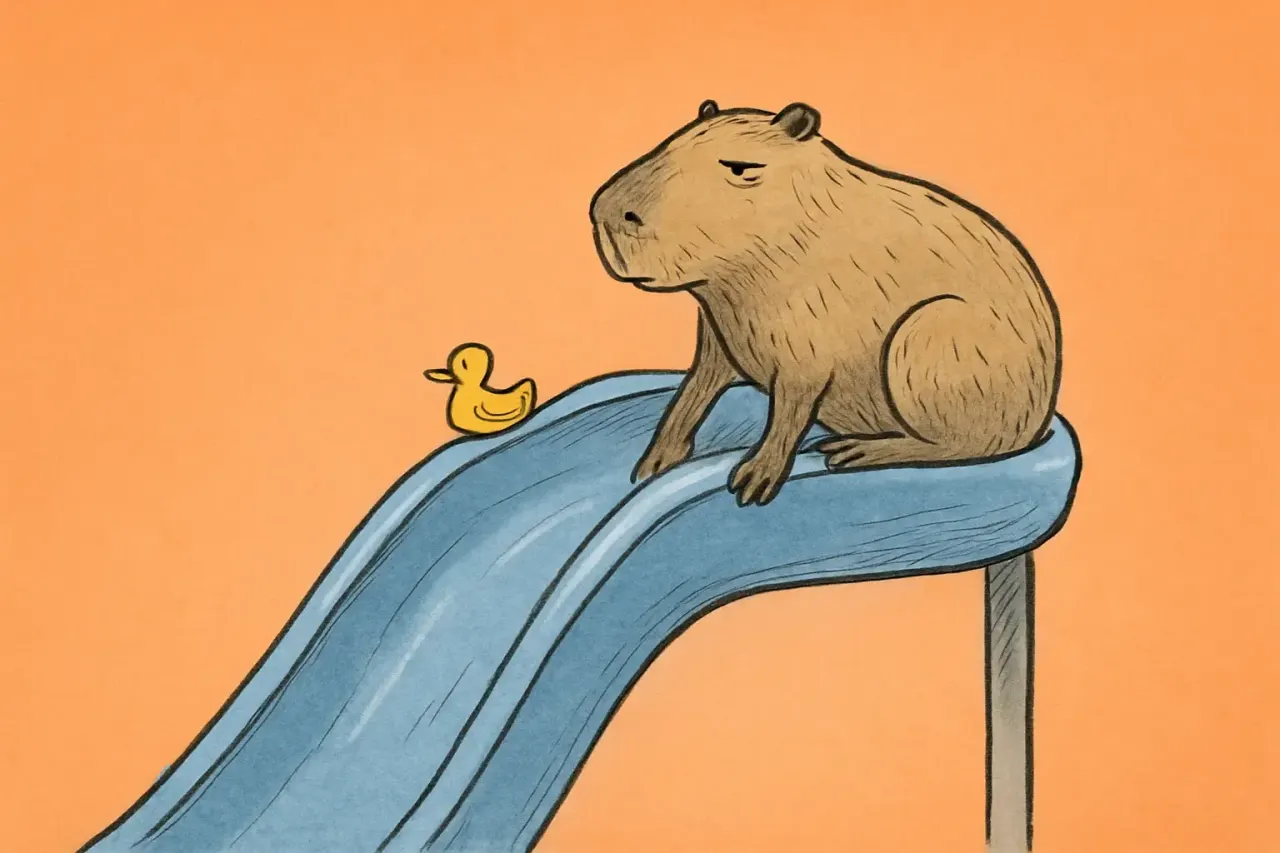
In August 2026 a short video circulated showing a capybara materialising on a waterslide and wrapping itself around a rider’s legs. It passed 140,000 likes on X before the same comment threads that were sharing it worked out what was wrong with it.
Two tells, both physical. The capybara makes contact with moving water and produces no initial splash at all. And one of its forelimbs visibly changes shape mid-clip. Nobody needed to analyse the face, the fur or the lighting. The scene failed at the point where a body met water, which is check one and check three.
Worth noting what did not give it away: the premise. A capybara doing something affectionate and slightly absurd is entirely on-brand for the species’ reputation, which is precisely why the clip travelled. Plausibility of behaviour was the weakest signal available, and the people who relied on it got it wrong.
Worked examples: two real clips people doubted
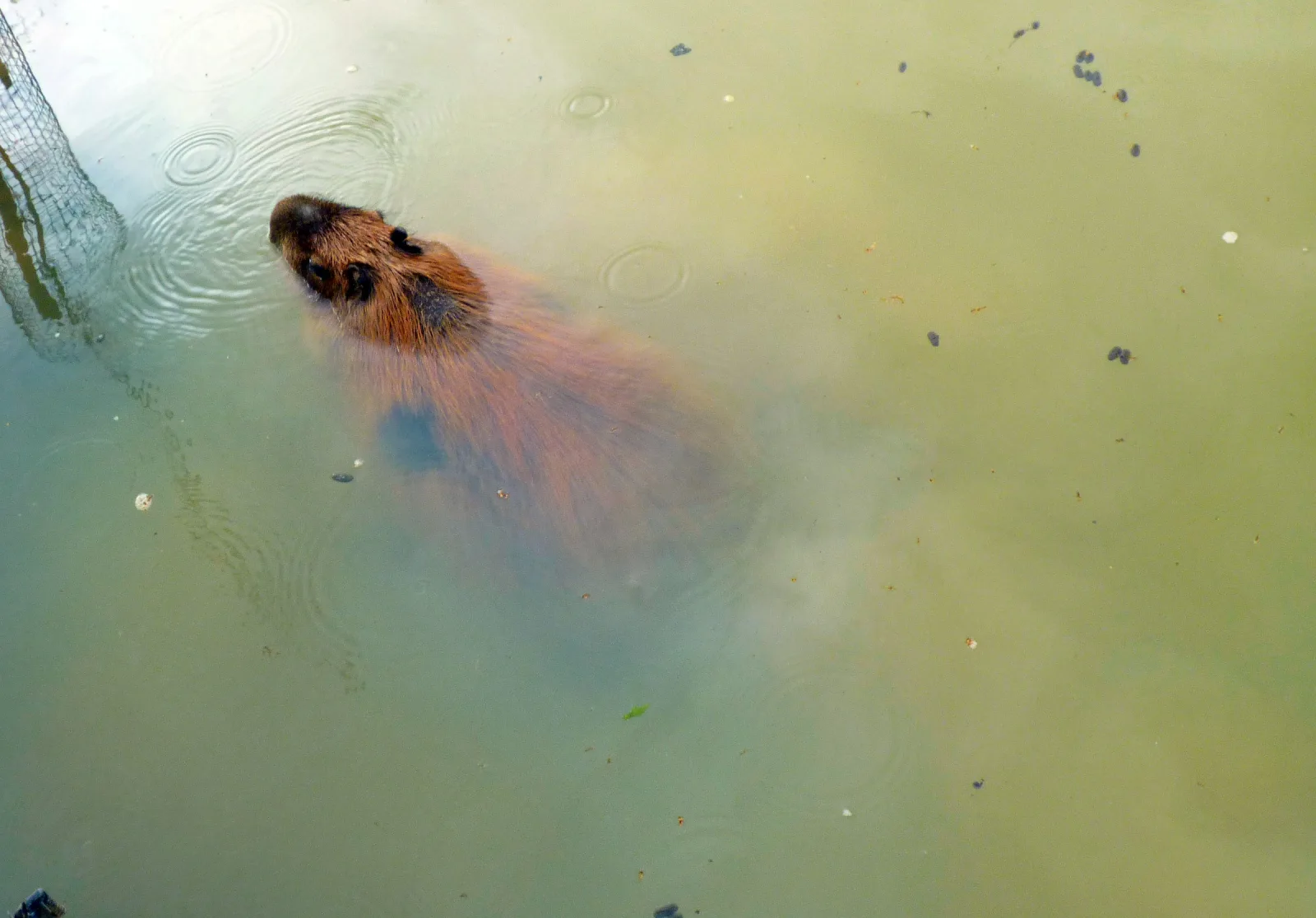
The underwater walk. A clip of a capybara strolling along a riverbed, fully submerged, drew a wave of viewers insisting it had to be generated. It is ordinary behaviour. Capybaras are semi-aquatic; their eyes, ears and nostrils sit high on the skull specifically so the animal can stay almost entirely underwater and still see, hear and breathe, and they can hold their breath for several minutes. They use water for temperature regulation, because they have very few sweat glands, and as an escape route from predators. A capybara walking underwater is not a stunt. It is a Tuesday.
The stick twirl. A fourteen-second clip of a capybara rotating a branch in its forepaws collected around 700,000 views and a great deal of martial-arts joking, plus a persistent undercurrent of “this is AI.” It is not. Object manipulation with the snout and forepaws is normal exploratory behaviour, and captive capybaras are routinely given enrichment items to handle for exactly that reason. The animal in that clip is in a rocky enclosure with companions resting nearby — a setting entirely consistent with a zoo or wildlife park, and entirely inconsistent with a generated scene, which rarely bothers to include uninvolved background animals doing nothing.
Both clips failed the vibe test and passed every physical check. That asymmetry is the whole point.
Staged is not the same as generated
There is a third category that neither test catches, and it deserves naming: real footage of a real capybara in a situation someone arranged.
A capybara in a bathtub with citrus fruit floating around it is a real animal in a set-up. A capybara wearing something is a real animal that has been dressed. Neither is fabricated, and neither tells you anything about wild capybara behaviour. Staging is not dishonest by itself, but a staged clip presented as natural behaviour is the most common form of misinformation about this species — considerably more common than AI, and much harder to spot, because every physical check passes.
The question to hold onto is not only “is this real” but “is this what capybaras do.” Those have different answers more often than you would expect.
What to do when you cannot tell
Three things, in order of usefulness.
Look for a named source. A zoo, a park, a named person, a location. Fabricated clips and repost accounts share a characteristic: no one is ever identified. If the post cannot tell you which animal this is or who cares for it, that is a real signal even when the footage is genuine.
Search for the same clip elsewhere. Real events attract multiple angles, follow-ups and local coverage. A clip that exists only as a single upload with no reporting around it is a clip nobody could confirm either.
And if it still will not resolve, let it stay unresolved. “I don’t know whether that one is real” is an entirely reasonable place to stop, and it is a much better outcome than confidently sharing either a fabrication or a debunk of something that actually happened.
Check the splash, the shadow and the limbs. If those hold, the clip is probably real — and if the behaviour still seems impossible, the gap is more likely in what you know about capybaras than in the footage.