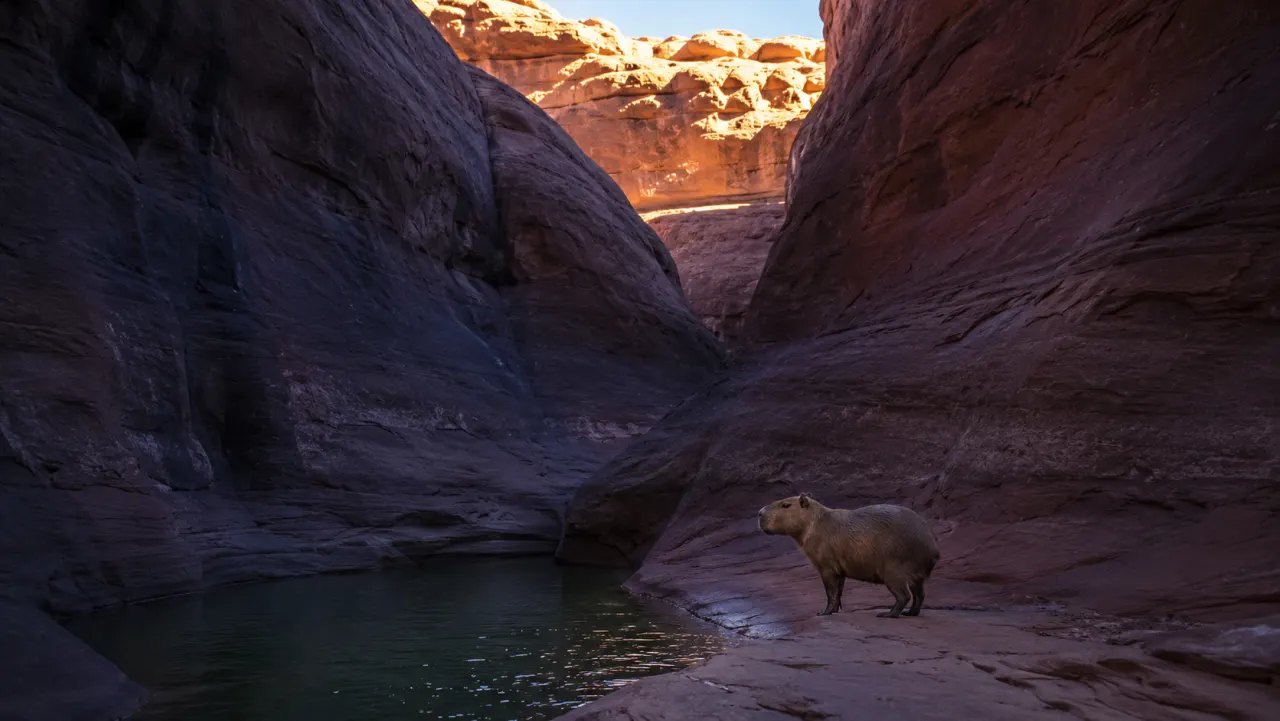
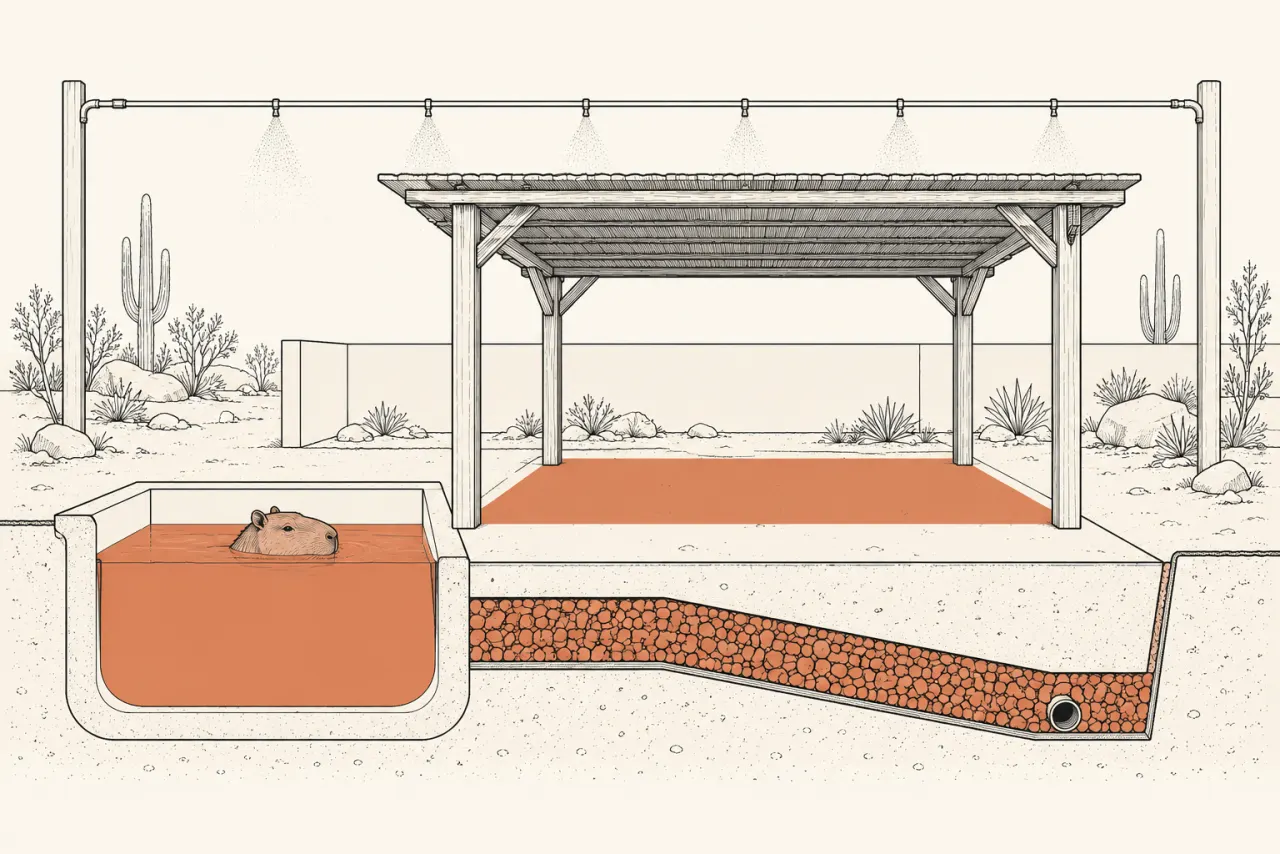
Start with the number that reframes everything: in a survey of AZA-accredited facilities that keep capybaras, the smallest exhibit on record was 95 m² (1,023 sq ft), and it held one nonbreeding pair. The median was 523 m² (5,630 sq ft). Inside that space, the median pool ran 88 m² (950 sq ft).
Those figures come from the AZA Capybara Care Manual, and they are the spine of this page. They are also the reason most backyard plans stall at the drawing stage rather than the build stage.
This is not a construction how-to. Site conditions, climate and local code decide too much of that. It is the specification sheet you should be holding before anyone quotes you a price.
What the AZA Manual Specifies, and What It Leaves Open
The manual publishes the observed dimensions of real capybara exhibits. It is careful about what those dimensions are.
The AZA Rodent, Insectivore and Lagomorph TAG has not set minimum space guidelines for capybaras. Every dimension above came out of an unpublished 2014 survey of what accredited facilities had actually built. There is no square footage anyone can hand you and call a standard, which cuts both ways: nobody can tell you a number is required, and nobody can tell you a smaller one is fine.
Here is the same information as a build sheet, with the failure mode attached to each line. The middle two columns are drawn from the manual; the last column is editorial.
| Element | What the manual gives | Why it exists | The shortcut that fails |
|---|---|---|---|
| Ground space | Smallest recorded exhibit 1,023 sq ft for a pair; median 5,630 sq ft | Grazing and normal locomotion, not just containment | A lawn sized for the pool and nothing else, so the animals live on the water’s edge |
| Pool area | Median 950 sq ft, smallest recorded 150 sq ft | Feeding, mating, escape and hiding all revolve around water | A stock tank, which meets none of the depth, slope or area figures |
| Pool depth | At least 6 ft with a gradual incline is the norm; 3.5 ft is the recorded floor | Full body submersion and safe self-rescue | Vertical sides, which turn a pool into a trap |
| Pool sanitation | Unfiltered pools cleaned and disinfected at least weekly | Capybaras defecate in water | Filtration sized for ornamental fish |
| Barrier | Approximately 6 ft, wire mesh at least 8 gauge, glass 14 to 20 mm | Egress prevention and keeping native fauna out | Chain link alone, which the manual links to teeth damage |
| Shelter | Heated and bedded wherever lows reach 40°F | Cold tolerance is conditional on a warm retreat existing | An unheated three-sided run-in shed |
| Substrate | Mulch, sod, hay, leaf litter, straw, sand, gravel or flagstone in resting spots | Joint health and footpad quality, especially in older animals | Concrete with a drain, which is easy to hose and hard on feet |
The Pool Is the Whole Project
Everything else on the list is a fence, a shed and some dirt. The pool is engineering, and it is where honest quotes go strange.
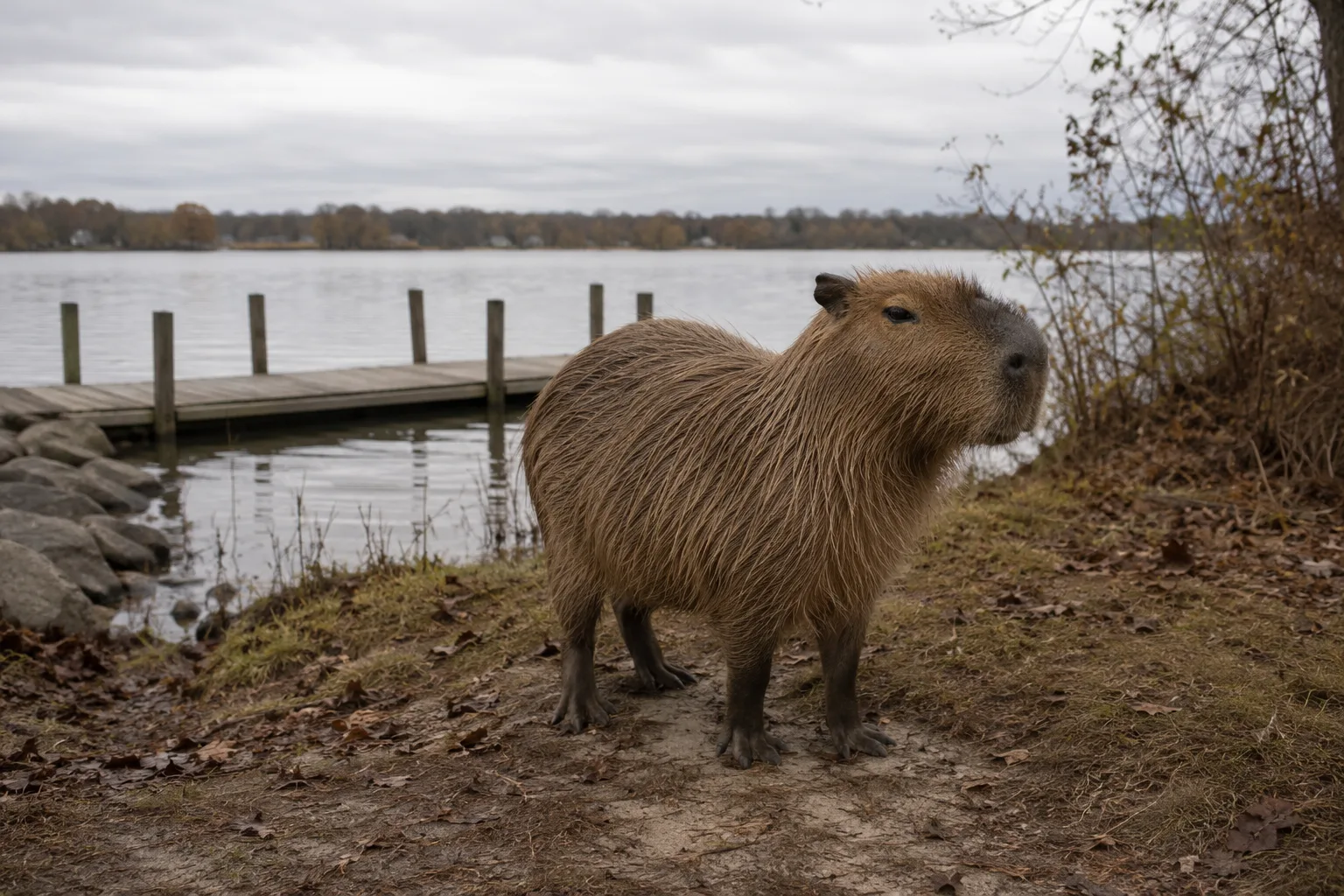
The manual is unambiguous that pools belong in both indoor and outdoor enclosures, which means a cold-climate build needs two water systems rather than one that gets shut off in November. The water can be a pool, pond, river or lagoon. What it cannot be is decorative.
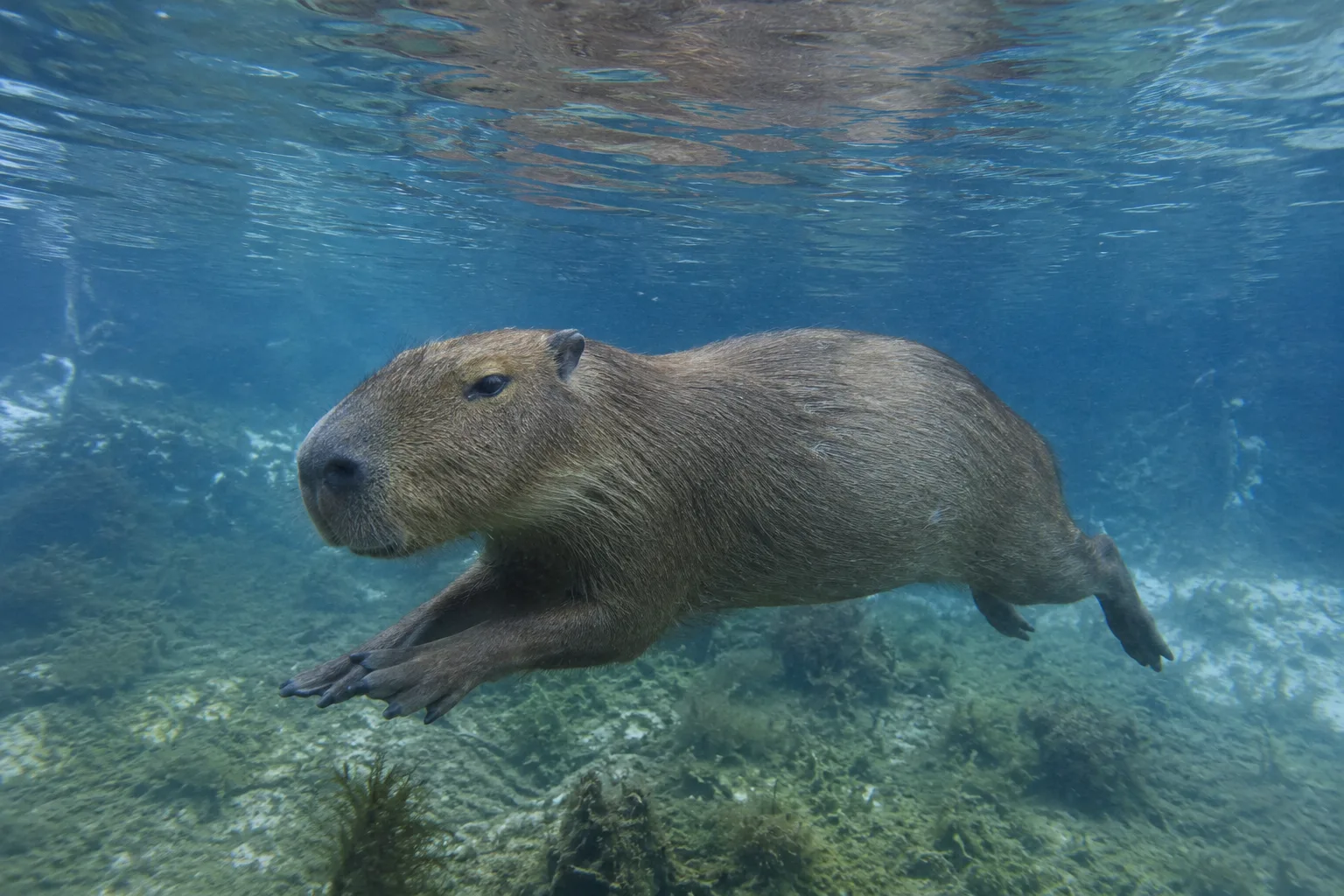
Depth first: at least 1.8 m (6 ft) with a gradual incline is the norm, and 1.1 m (3.5 ft) is the shallowest recorded. The incline is not a comfort feature. An adult capybara runs 27-79 kg (60-174 lb), and a wet animal at the top of that range trying to leave a vertical-sided pool is the injury scenario the slope exists to prevent.
Capybaras defecate in water. The manual requires that artificial pools without recirculating, filtered water be cleaned and disinfected at least once a week, and that natural pools have filtration for solid waste, especially where the water is shared with other habitats. Whatever you build, you are also committing to draining and refilling it or to running filtration sized for a large mammal.
So the water design has four jobs at once, and they conflict. It has to be deep enough to submerge in, graded enough to exit, drainable enough to sanitise weekly, and filtered enough that draining weekly is not the only option. A pond that hits three of those and misses drainage becomes a hygiene problem within a season, and the fix is excavation.
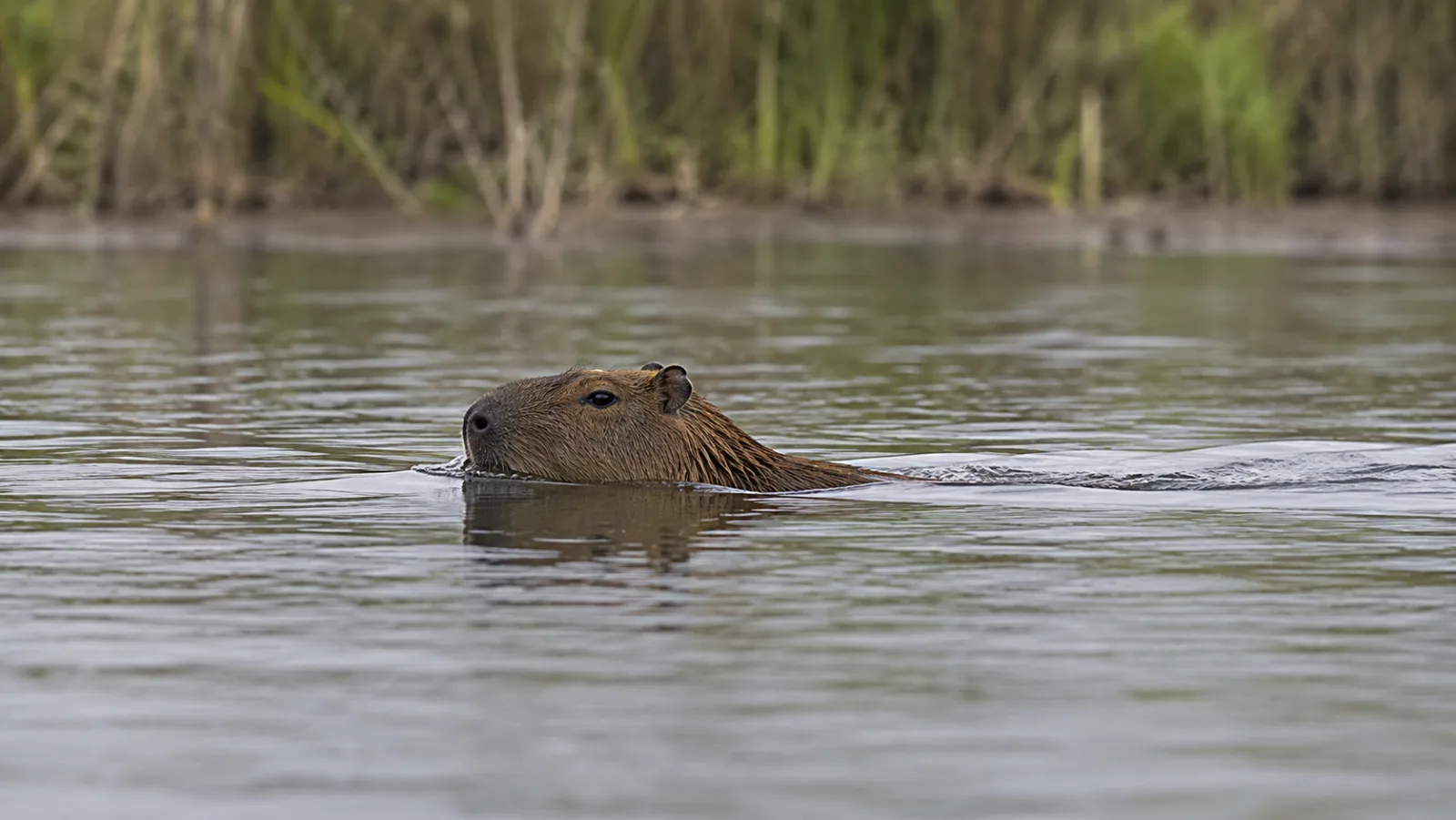
Winter is the part people postpone. The manual treats water access as year-round, not seasonal, so a northern build has to answer what the animals swim in during January before it answers anything about landscaping.
Fencing: Six Feet, and Not the Threat You Expect
The containment conversation online is mostly wrong, and it is wrong in a useful direction.
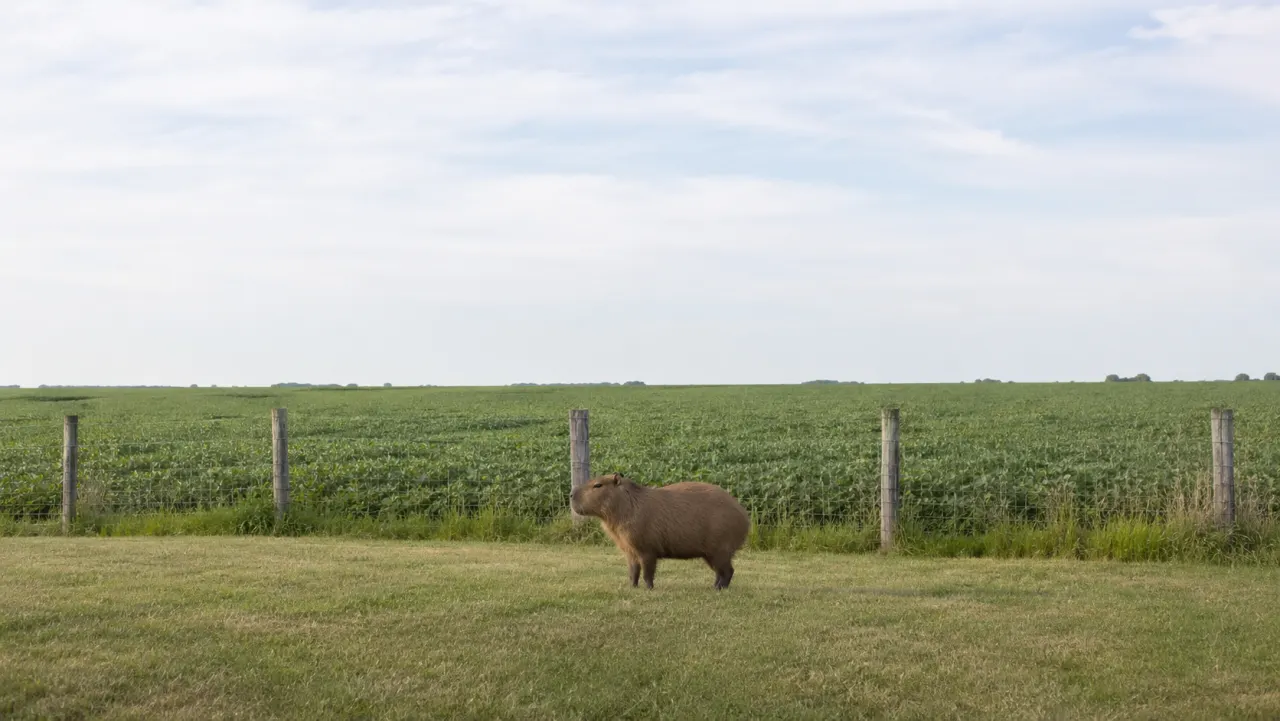
The manual says a barrier of approximately 1.8 m (6 ft) should suffice, and gives the reason plainly: capybaras are not capable of climbing or jumping high or long distances. It goes further and states there are no known risks associated with un-topped capybara exhibits. Fully enclosed capybara exhibits exist, but they are usually mixed-species enclosures housing flighted birds or climbing animals, so the roof is for someone else.
That is the good news, and it is worth saying out loud because the internet will sell you a roof.
The specifications that do matter are material ones. Wire mesh should be at least 8 gauge. Glass barriers run 14 to 20 mm. Barriers should be built from materials that allow a clear line of sight without creating a health risk, and they should keep native fauna out of the enclosure, though the manual notes birds are not a threat. Chain link earns a specific caution: superficial wounds and teeth damage are associated with it.
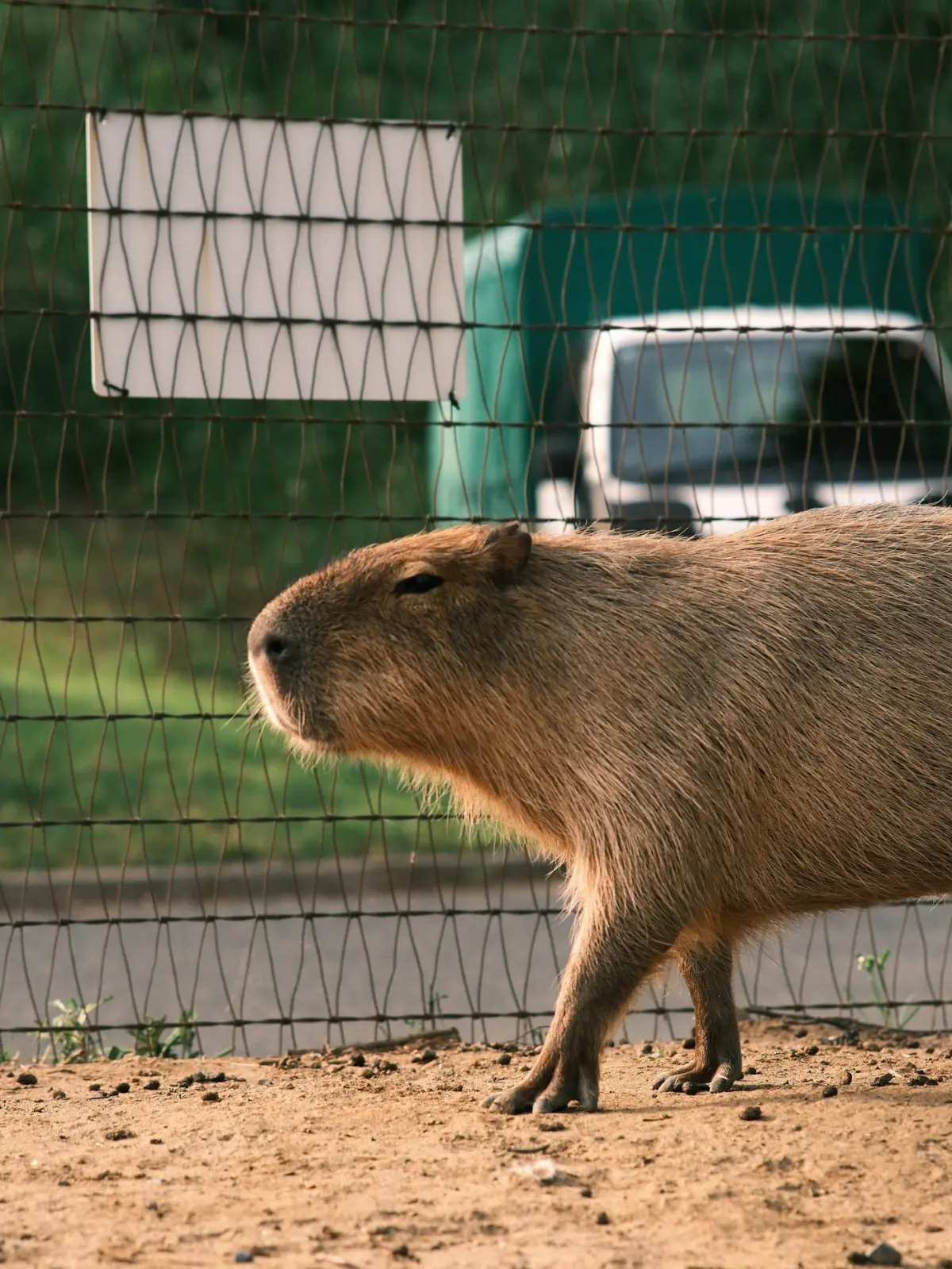
The real escape route is water, and this is the one that gets overlooked. AZA accreditation requires that all exhibit and holding-area water inflows and outflows be securely protected against animal injury or egress. A drain, an overflow or a culvert at the pool’s low point is a hole in the perimeter that happens to be full of the animal’s favourite medium. Screen it during the build, because retrofitting a screen onto a live drain means draining the pool.
| What people believe | What the manual actually says |
|---|---|
| ”Capybaras dig out, so bury the fence deep” | The manual does not describe capybaras as diggers, and does not specify below-grade fencing. Its stated containment risk is egress through water infrastructure. |
| ”They can climb, so the pen needs a top” | They cannot climb or jump high or long distances, and un-topped exhibits carry no known risk. |
| ”Four-foot fencing is plenty” | Roughly six feet is what the manual names, with 8-gauge mesh as the minimum material spec. |
| ”Chain link is the default choice” | It is associated with superficial wounds and teeth damage. Usable, but not a free choice. |
| ”A big pond means less maintenance” | Capybaras defecate in water. Unfiltered pools need weekly cleaning and disinfection regardless of size. |
Shade, Shelter, and the Two Temperatures That Decide the Build
Two numbers set the shelter requirement, and they work as pairs rather than as tolerances.
Capybaras may be kept outdoors in areas with lows of 4°C (40°F) as long as a heated shelter with bedding such as straw, hay or mulch is provided. They tolerate 32-38°C (90-100°F) as long as they have access to water and shade, with the manual naming pool, mister or mud wallow as acceptable water forms and trees, shelters, shade cloth or indoor access as acceptable shade. AZA accreditation separately requires sufficient shade whenever sunlight is likely to cause overheating or discomfort.
Read either number without its condition and you have built the wrong thing. “Capybaras handle 40°F” is a true sentence that has killed the second half of more than one plan.
Indoor humidity should sit between 30% and 70% relative humidity, though the manual notes capybaras tolerate 15-20% in drier climates without apparent problems. Southwestern builds should note that and then go straight back to worrying about the evaporation rate on a 950-square-foot pool.
Substrate and Hides: The Parts That Look Optional
The ground finish is the cheapest line on the build and the one most likely to be value-engineered away.
Natural substrates are specified: mulch, sod, hay, leaf litter, river rock, straw, gravel, sand and flagstone. The whole enclosure does not need deep substrate. What it needs is localised soft spots for resting and sleeping, and the manual ties those directly to joint health and footpad quality, particularly where geriatric animals are in the group. Soiled bedding gets replaced daily, and the enclosure gets cleaned daily.
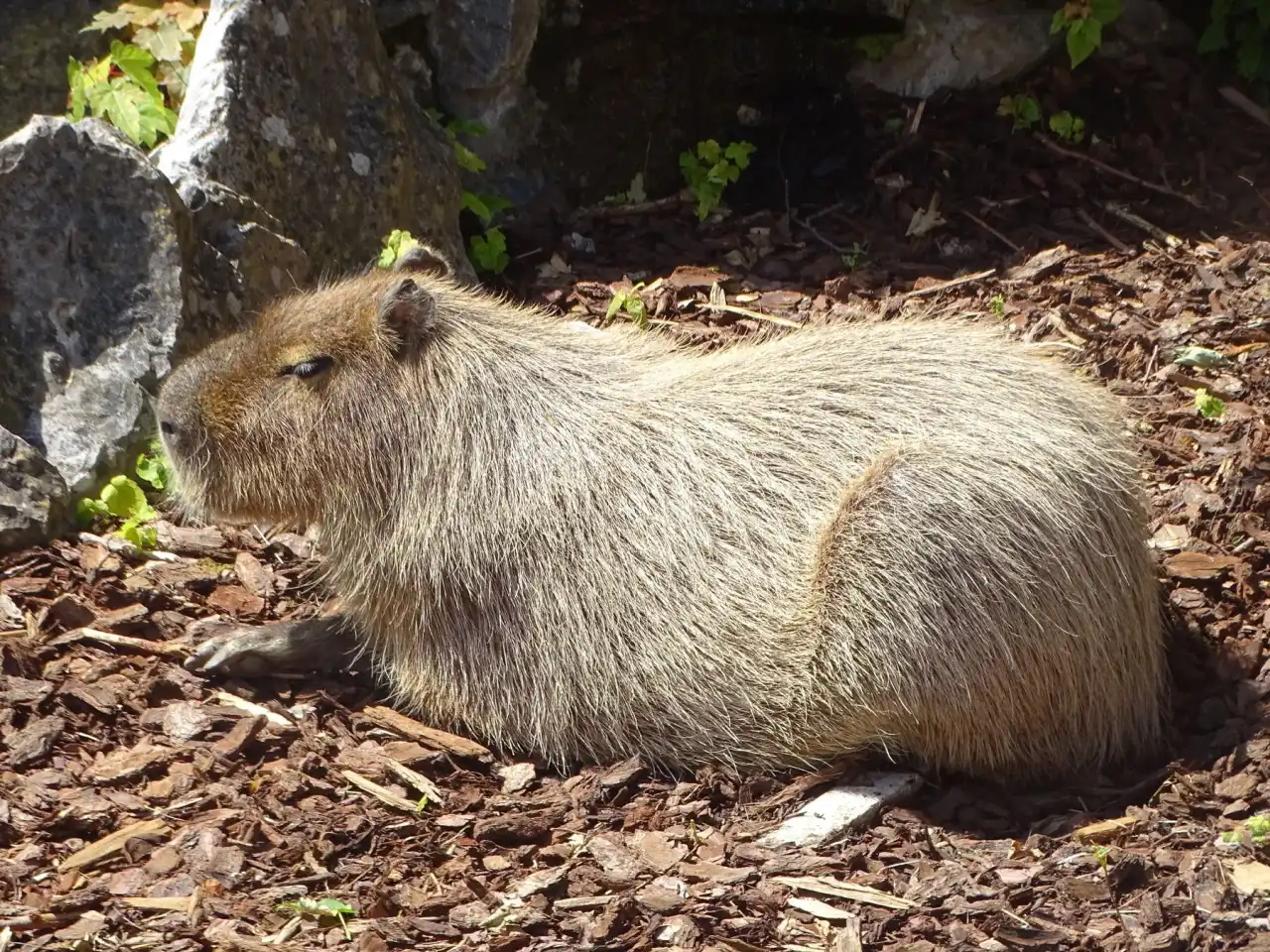
Hides are a requirement, not enrichment. Capybaras are flight animals and need cover, which the manual says may require more than one hide area within the enclosure. It also says exhibits should be well planted so individuals have visual barriers from each other, which is the detail that catches people out: the animals need to be able to get away from each other, not only from you. Wooden shelters, caves, holding access, vegetation, rocks, logs and bamboo all count.
Capybaras scent mark on trees and rocks, and the manual says it is usually more efficient to replace logs and plants than to clean them. Build that into the plan as a consumable rather than a fixture.
The Order to Build It In
Sequence matters more here than on a normal outbuilding, because two of these steps are excavation and the rest sit on top of them.
-
Pick the ground for drainage and shade, before anything is drawn
Where the water goes when it leaves the pool, and where the shade falls at 2pm in July, are site facts you cannot change later. Everything downstream is placed around them.
-
Excavate the pool with the drain and the exit slope in the same pass
Depth, gradual incline and a low-point drain are one job. Adding a drain to a finished pool means emptying and reopening it.
-
Size filtration for a large mammal, then decide the weekly routine
The manual's weekly clean-and-disinfect requirement applies to pools without recirculating filtered water. Filtration is what buys you out of it. Choose deliberately rather than discovering the answer in month two.
-
Screen every water inflow and outflow
Accreditation treats these as egress and injury points. Do it while the pool is dry, because the retrofit costs a full drain.
-
Run the barrier at roughly six feet, with the pool inside the line
8-gauge mesh or heavier, sightlines kept clear, and chain link either avoided at contact height or backed with something that does not damage teeth. No top needed.
-
Build the heated, bedded shelter before the first 40°F night
In a cold climate this includes indoor water, because the manual puts pools in indoor enclosures too. This is the step that separates a three-season build from a real one.
-
Lay resting substrate and place hides last, and still before the animals
Multiple hides, planting for visual separation between individuals, soft dry spots for sleeping. Cheap, quick, and the first thing that gets skipped.
Somewhere around step two is where this stops being a hobby project. A contractor handed a plan for a six-foot-deep, 950-square-foot pool with a graded bank, a low-point drain, mammal-grade filtration and a screened outflow does not hear “pond.” They hear a small municipal installation, and they price it that way, and the number that comes back is usually the moment the honest version of the conversation finally starts.
My read, for what it is worth: the fencing is the part people overbuild and the drainage is the part they underbuild, and only one of those two mistakes can be fixed without a machine.
If the numbers on this page landed harder than expected, that is the page working. Take the full welfare picture from the capybara care guide, put a real figure on the build with the cost guide, check whether any of it is permitted where you live using the state legality map, and read capybara health and common medical issues for what a badly built enclosure eventually shows up as.