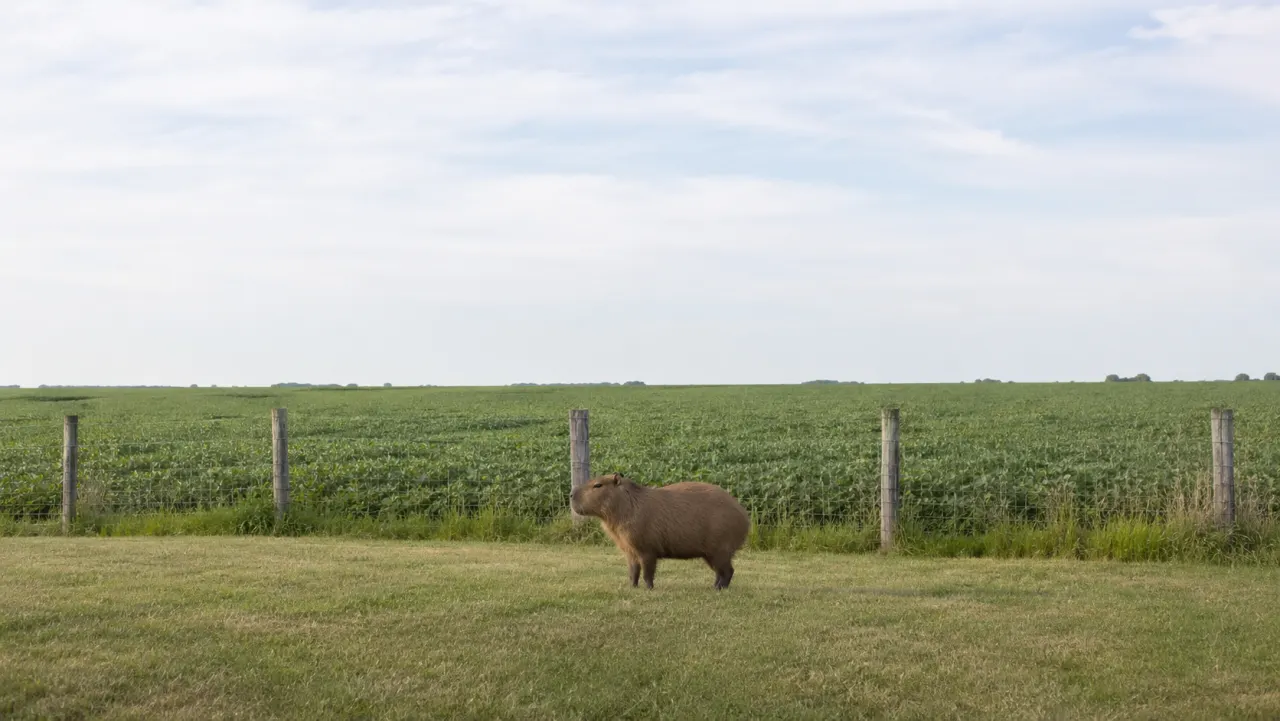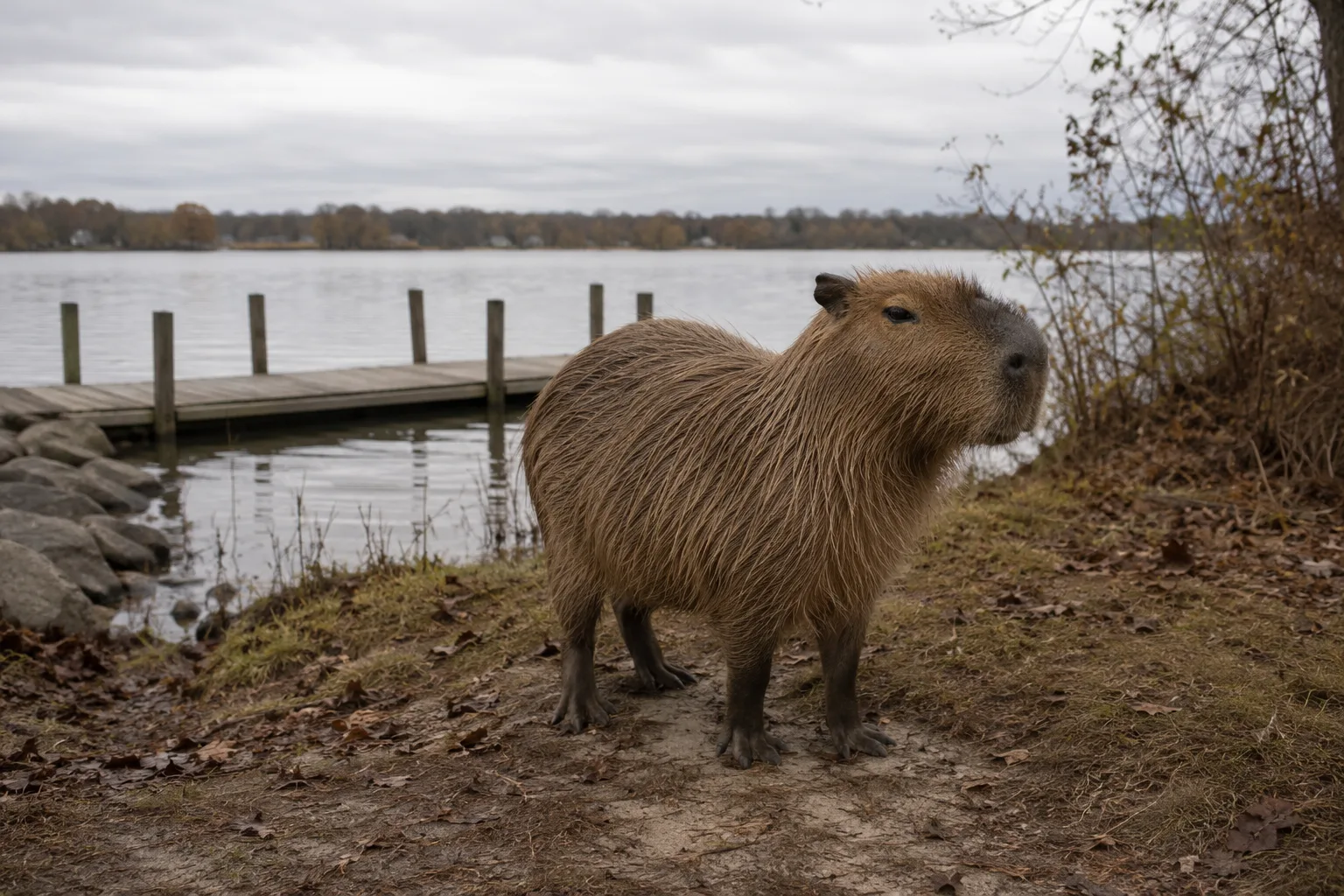
Michigan has no capybara permit. Not a strict one, not an easy one. The Department of Natural Resources issues a permit to hold game in captivity, but “game” is a closed list written into MCL 324.40103, and it runs badger, bear, beaver, bobcat, coyote, deer, fox, muskrat, opossum, otter, raccoon, skunk, squirrel, woodchuck and a set of birds. A South American rodent is not on it. So there is no state office sitting on a yes or a no for you. That is a different situation from a permit state, and in a few ways a worse one.
No state permit exists, so your township decides
Michigan's captive-game permit is tied to the statutory definition of game in MCL 324.40103, a fixed list of native species. The Large Carnivore Act reaches seven named cats and bears. The prohibited-species statute names one mammal, nutria.
The state requirement that does apply is documentary: MCL 287.719 wants an official interstate certificate of veterinary inspection on the animal when it enters. Everything else is local.
The Short Answer: There Is Nothing to Apply For
People arrive at this question expecting a permit, because that is how the neighbouring states work. Ohio has a category. Illinois has a category. Michigan has a list of native game animals and a separate list of dangerous carnivores, and a capybara is on neither.
The absence cuts both ways. There is no application to fail, no facility inspection to schedule, no annual renewal. There is also nobody at the state who will put in writing that you are allowed to do this, which matters enormously the first time a code enforcement officer knocks.
If you want one sentence to carry into every phone call: Michigan regulates this animal at the local level and at the state line, and nowhere in between.
The Large Carnivore Act Is the Wrong Law to Be Reading
Search “Michigan exotic animal law” and the Large Carnivore Act is the first thing you find. It is a real law with real teeth and it has nothing to do with your question.
MCL 287.1102 defines a large carnivore as a lion, a leopard including snow and clouded leopards, a jaguar, a tiger, a cougar, a panther or a cheetah, plus a bear of any species native or non-native, wild or captive-bred, including hybrids. That is the whole category. Rodents are outside it by definition, not by omission.
| Michigan framework | What it actually covers | Where a capybara lands | Status |
|---|---|---|---|
| Large Carnivore Act, MCL 287.1102 | Seven named cats and all bears | Outside the definition | Source-checked |
| Permit to hold game in captivity | ”Game” per MCL 324.40103, a fixed native list | Not on the list, no permit issued | Source-checked |
| Prohibited species, MCL 324.41301 | Names nutria as the only prohibited mammal | Not named | Source-checked |
| Importation, MCL 287.719 | Animals entering Michigan, exotics included | Health certificate applies | Source-checked |
| City, township and county codes | Exotic and non-domestic animals, zoning, enclosures | Decides your address | Verify before action |
The captive-game list is the one worth reading twice, because it explains why the DNR call goes the way it does. Beaver and muskrat are on it. Both are semi-aquatic rodents. Michigan wrote a permit for holding those animals in captivity because they live here and the state manages them. It never wrote one for the largest rodent on earth, because nobody expected to be asked.

Can You Have a Capybara as a Pet in Michigan? Your Township Decides
This is the version of the question most Michigan searchers actually type, and the honest answer is that it stops being a wildlife question and becomes a zoning question.
Michigan has 83 counties and roughly 1,700 local units of government, which is an unusual amount of local authority for one state. Detroit, Grand Rapids, Lansing and Ann Arbor all restrict non-domestic mammals. Most of the suburban ring around Detroit does the same. Rural townships vary wildly, and plenty of them have never written an exotic animal ordinance at all.
Here is what a township call actually sounds like. You ask the clerk whether the township restricts exotic animals. The clerk says no, because there is no ordinance with that phrase in it. You ask whether the parcel allows livestock or non-domestic animals, and now you are in a different section of the code with a different answer. You ask about a pond or a pool as an accessory structure, and you are transferred to the zoning administrator. You ask about fencing height and setbacks and you are transferred again. None of those people said no. None of them said yes either, and none of it is in writing yet. That last part is the whole job.
Deposit paid, transport booked, animal in the barn, and then a neighbour complaint pulls the zoning administrator out to the parcel. In a state with no permit to wave, "the DNR said it was fine" is not a document, and a verbal from a clerk who has since left the job is not one either. Get the ordinance section number and the reply in email.
Unincorporated land helps and does not settle it. Deed restrictions, drainage rules, agricultural zoning definitions and an insurer’s opinion all sit outside the ordinance book.
The State Paperwork That Is Real
There is one state requirement people miss, and it triggers the moment the animal crosses into Michigan.
The Animal Industry Act defines “animal” to include exotic animals, and defines an exotic animal as a species not native to the United States. MCL 287.719 requires an animal imported into Michigan to be accompanied by an official interstate health certificate or an official interstate certificate of veterinary inspection, unless one of the narrow slaughter, poultry or aquaculture alternatives applies. None of those describe a capybara arriving in a trailer.
That certificate is written by a USDA-accredited veterinarian in the state the animal is leaving, not by yours. Which means the seller’s vet is part of your paperwork chain, and you want that arranged before the deposit rather than the week of transport. Ask the state veterinarian’s office at MDARD how it wants a capybara entered, because the animal sits at the seam between the exotic-animal category and the non-native rodent category, and the office that answers the phone is the one whose answer counts.
Who Actually Decides, and in What Order
-
Your township, city or village clerk
First, not last. Ask by parcel address, not by town name, and ask three separate questions: exotic or non-domestic animals, livestock in your zoning district, and accessory structures including ponds and enclosures. Request the ordinance section numbers in writing.
-
The county, if you are unincorporated
County animal control and the county zoning office split the question between them. Neither will volunteer the other's answer.
-
MDARD, state veterinarian's office
Import documentation for the animal under MCL 287.719, and confirmation of which category it is being entered under. Do this before transport is booked.
-
Michigan DNR Wildlife Division
Worth a call to confirm nothing has changed, even though the captive-game list is statutory. A short written reply saying no DNR permit applies is a useful document to hold.
-
An exotic veterinarian, plus a backup
Michigan State University's veterinary college in East Lansing is the anchor, and it is a long drive from most of the state. Ask both practices whether they treat capybaras and what happens at 2am in February.
-
USDA APHIS, only if money is involved
Paid encounters, exhibition or breeding pull in Animal Welfare Act licensing on top of everything above.
What a Michigan Winter Asks of the Enclosure
The legal layer in Michigan is thin. The climate layer is not, and it is the part that quietly kills most of these plans.
Those figures come from the AZA Capybara Care Manual, which puts the outdoor low at 4°C (40°F) with bedded, heated shelter and notes that pools may be as shallow as 1.1 m (3.5 ft) but the norm is at least 1.8 m (6 ft) with a gradual incline. The manual’s median pool across surveyed AZA exhibits is 88 m² (950 ft²).
Now hold that against a state where the Lake Michigan snow belt and the Upper Peninsula spend a good part of the year well under the floor. Water access is not a summer amenity for this animal. It is where they cool down, where they mate, where they go when something frightens them, and the manual describes an alarm bark whose whole purpose is to send the group into the water. Take the water away for four months and you have removed the animal’s main coping behaviour, not a feature of the enclosure.

If you want the honest opinion in this piece: Michigan’s legal thinness is the least interesting thing about the question here. A permit state at least forces someone to look at your enclosure before the animal arrives. Michigan will let you build the wrong thing in complete compliance.
Nothing to the State, and One Certificate You Cannot Skip
Michigan’s state bill is zero, and the page has already explained why: there is no office with an opinion on file. That leaves exactly one piece of state paperwork with a real cost attached.
The certificate is a private veterinary cost rather than a state fee, which is why it disappears from most Michigan budgets. It should not. It is issued in the state of origin by an accredited vet, it has to be in hand before the animal moves, and it routes through MDARD and the Animal Industry Act rather than the DNR.
Michigan's decision-maker is the township, and townships vary from no ordinance at all to an outright prohibition. Ask two questions in the same email: whether the animal is permitted at the parcel, and what the permit costs if one exists.
Then the part no authority prices: heated indoor space, water deep enough to submerge in through a Michigan winter, and a second animal. The capybara cost guide covers it, and deliberately does not quote a purchase price for the animal.
Michigan Myths Worth Dropping Before You Buy
| What Michigan buyers believe | What is actually true |
|---|---|
| ”The Large Carnivore Act is the law to check” | It defines a large carnivore as seven named cats plus bears. A rodent was never in scope, so the act neither permits nor forbids anything here. |
| ”No state permit means the state said yes” | It means no state office has an opinion on file. Your township does, and theirs is the one that gets enforced. |
| ”Capybaras are banned in Michigan as invasive” | MCL 324.41301 lists exactly one prohibited mammal, and it is nutria. Different animal, different family, similar silhouette in a bad photo. |
| ”The DNR will sort out the paperwork” | The import certificate is an Animal Industry Act requirement under MCL 287.719, handled through veterinarians and MDARD, not the DNR. |
| ”A heated shed covers a Michigan winter” | The AZA floor is 40°F outdoors with bedded heated shelter, and water access year-round. A shed with a lamp is not that. |
| ”One capybara is easier to overwinter” | Winter workload barely changes per animal, and the social requirement does not pause in January. |
Where Michigan Nets Out
Michigan is not a hard state to get a legal answer in. It is a hard state to get a written one.
Start with the township clerk and the parcel address, get ordinance section numbers by email, and only then work outward to the county, MDARD and a short confirming note from the DNR. Line up the exotic vet and the backup before any money moves, because the second one is the one you will actually need. Then price the winter honestly: heated indoor space, heated water deep enough to submerge in, and a generator, for two animals rather than one.
A detail worth keeping if you take nothing else from this page. In AZA-managed collections, adult female capybaras average about 61 kg (135 lb) and adult males about 50 kg (110 lb). The females are the bigger animal, and the enclosure has to be sized for them.
If you are still in, read the capybara cost guide and the care guide next. For a sanity check on whether the animal fits the life, do capybaras make good pets is blunter than this page is. Nearby states run on different logic, and the Ohio and Wisconsin guides are worth reading before you assume the answer travels. The state-by-state map puts Michigan in national context.
This guide is current as of September 5, 2026. Statutes and local ordinances change, so treat it as a screening path rather than legal advice, and confirm with the DNR Wildlife Division, the MDARD state veterinarian’s office and your township or city before acting.