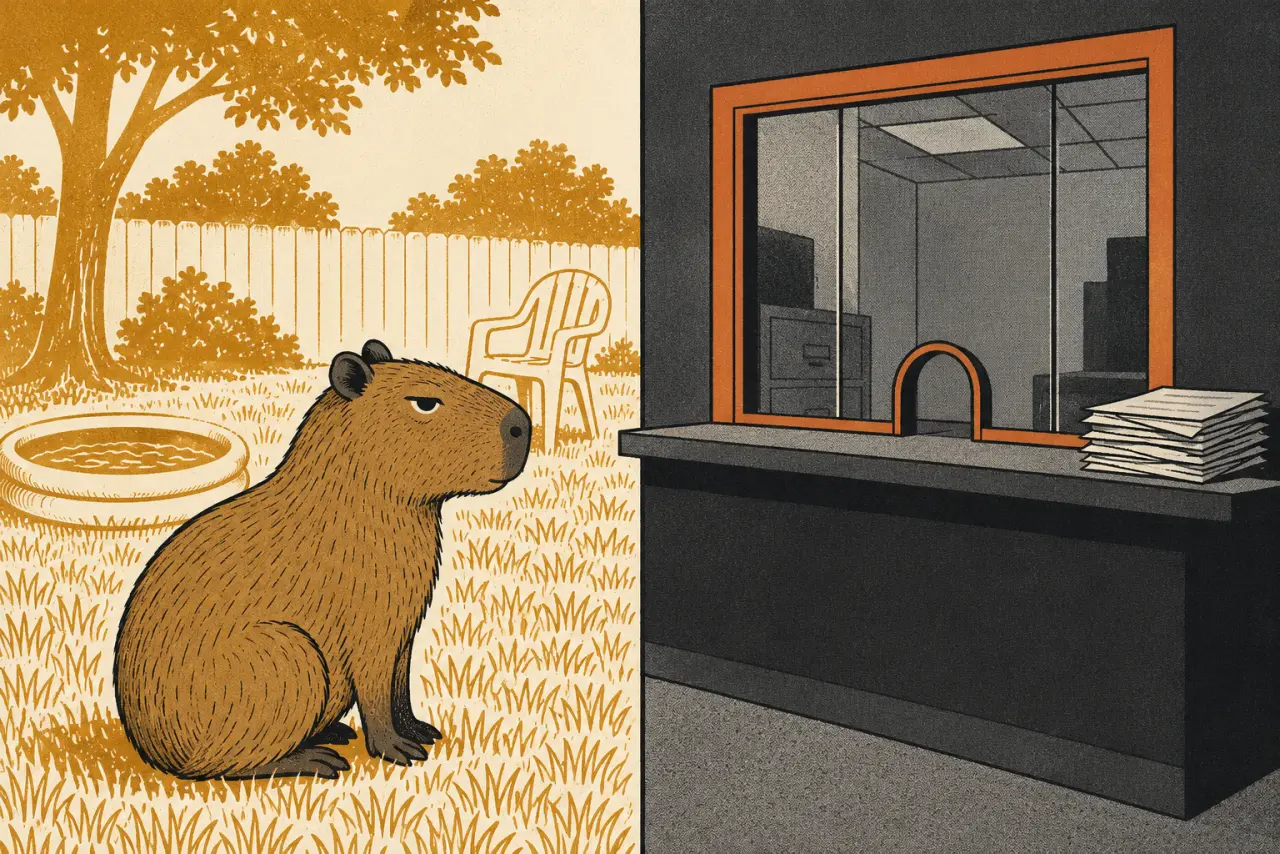
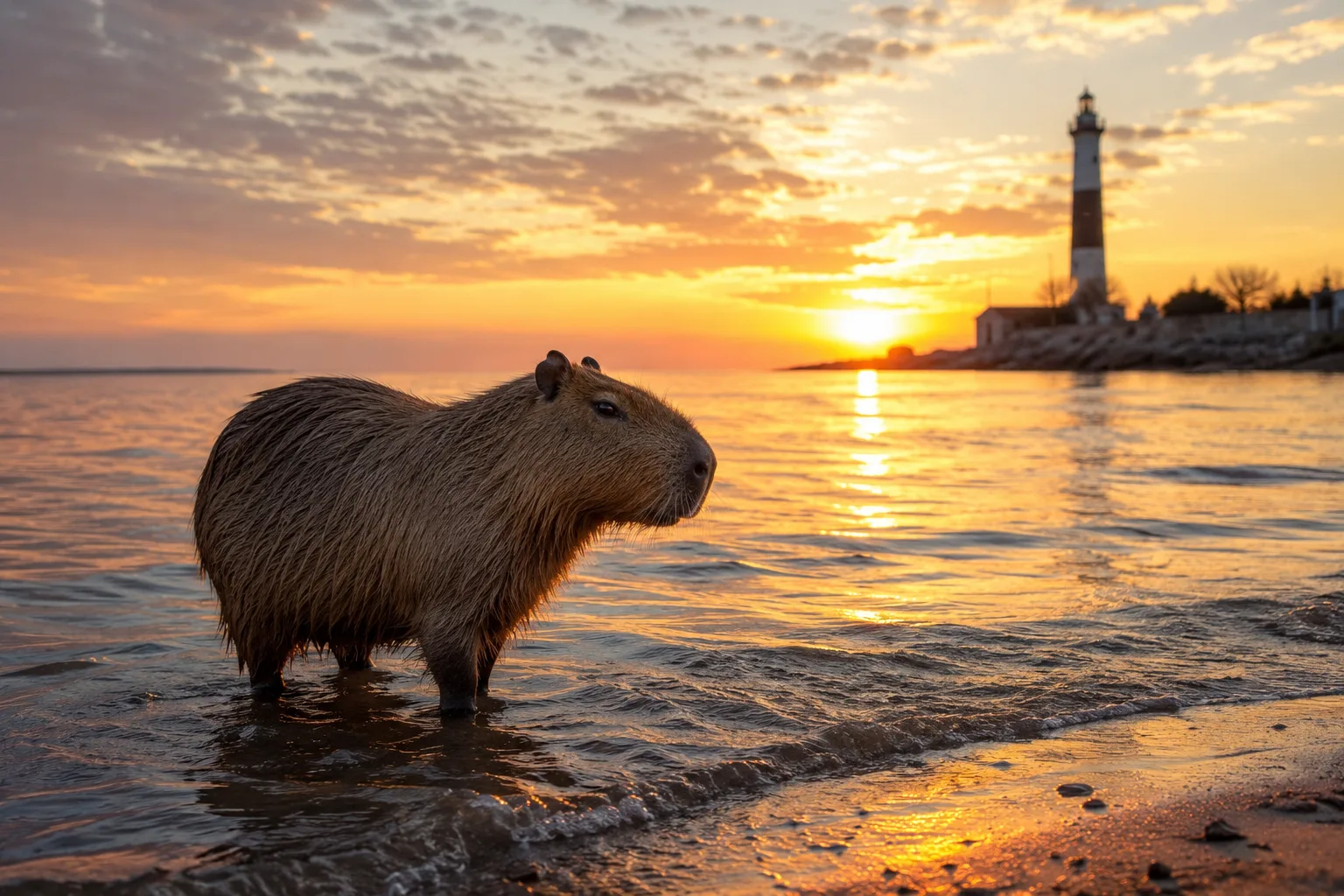
Yes, with a permit, and it is a cheaper permit than almost anyone expects. New Jersey’s rule runs the opposite way from most states: N.J.A.C. 7:25-4.2 bars possession of any exotic or nongame mammal without one, and 7:25-4.5 extends that to anything the state has not specifically exempted. The exemption list at 7:25-4.4 runs hamster, gerbil, guinea pig, mice and rats, chipmunk, red squirrel, flying squirrel, pygmy goat, alpaca, guanaco, llama and bison. No capybara. So a permit is required, and the one that covers a pet is the Exotic and Nongame Individual Hobby Permit. The mammal fee is $10.
Permit required, and it is the hobby permit, not the dangerous-species one
Capybaras are not on New Jersey's exemption list at N.J.A.C. 7:25-4.4, so 7:25-4.5 requires a permit. They are also not named on the potentially dangerous species list at 7:25-4.8, which is the important half: 7:25-4.9 says those species may not be kept as pets or for hobby purposes at all.
The Exotic and Nongame Individual Hobby Permit is $10 for mammals, one permit regardless of how many animals it covers. Municipal ordinances and zoning are separate questions and always will be.
The Short Answer: New Jersey’s List Runs the Other Way
Most state guides in this series ask whether a species has been banned. New Jersey inverts it. The Division’s starting position is that you may not possess an exotic mammal, and the only way out is an exemption or a permit.
That inversion is why so many articles about New Jersey capybaras get the shape of the answer wrong. Nobody had to add capybaras to anything for the permit requirement to bite. They just had to leave them off a short list of twelve familiar animals, which is exactly what happened.
The upside is that the path is unusually well defined for a permit state. There is a named permit, a published fee, a written set of criteria, and a phone number. Compared to states where the honest answer is “call and hope,” New Jersey is legible.
The Guinea Pig Is Exempt. The Capybara Is Not.
This is the whole hinge, and it is worth seeing side by side.
Exempt at 7:25-4.4 — no permit
- Guinea pig, Cavia porcellus
- Hamster, gerbil, mice and rats
- Chipmunk, red squirrel, flying squirrel
- Llama, alpaca, guanaco
- Bison, pygmy goat
Not exempt — permit required at 7:25-4.5
- Capybara, Hydrochoerus hydrochaeris
- Every other exotic mammal the rule does not name
- Silence in the rule means permit, not permission
- The list is closed, not illustrative
The guinea pig entry is the one that gets people. Guinea pigs and capybaras are both caviomorph rodents from South America, and to anyone who has watched a capybara eat, the family resemblance is not subtle. New Jersey exempted the one that fits in a plastic tub and left the one that weighs as much as an adult human on the permit side of the line. Which is, when you look at it for a second, entirely reasonable.

The Permit You Want Is Not the Dangerous-Species One
Almost every article about New Jersey capybaras routes the reader to the Potentially Dangerous Species permit. That is the wrong door, and taking it would end the conversation.
N.J.A.C. 7:25-4.8 defines a potentially dangerous species as an exotic or nongame animal that in the Division’s opinion can inflict serious or fatal injury, or that could become an agricultural pest or a menace to public health or indigenous wildlife. Its mammal entries are primates, bears, non-domestic cats and dogs, and under Rodentia, prairie dogs and ground squirrels. Capybaras are not there.
That absence is load-bearing. N.J.A.C. 7:25-4.9 sets the criteria for a potentially dangerous species permit, and one of them states plainly that the species “shall not be kept as a pet, for hobby purposes” or in circumstances the Department judges harmful to the animal or hazardous to the public. NJ Fish and Wildlife spells out the practical version on its own permit page: Quaker parrots, wallabies, wild canids, wild felids, primates, venomous snakes and alligators may not be kept as pets for any reason. If a capybara sat in that category, the answer to this page’s question would be a flat no.
The 7:25-4.8 list is written as "including but not limited to," and the test turns on the Division's opinion rather than the printed names. So the classification is not frozen. Ask the permits unit to confirm in writing which permit type applies to Hydrochoerus hydrochaeris before you send anyone a deposit, and keep the reply.
What the Division Actually Judges the Application On
N.J.A.C. 7:25-4.7 lists five criteria, and they are welfare criteria rather than public-safety ones. Read as a checklist for a capybara they get demanding fast.
| Criterion at 7:25-4.7 | What it means for a capybara |
|---|---|
| Adequate diet | Continuous access to grass and grazing, not a bowl of vegetables twice a day |
| Housing allowing normal behaviour patterns | Water deep enough to submerge in, grazing ground, shade, and company |
| Housing preventing escape and injury | Secure perimeter fencing, and a pool the animal can climb out of unassisted |
| Lawful acquisition | Paperwork showing the seller was legal in their own state |
| Prompt veterinary treatment, free of disease | A named exotic vet before the animal arrives, not after |
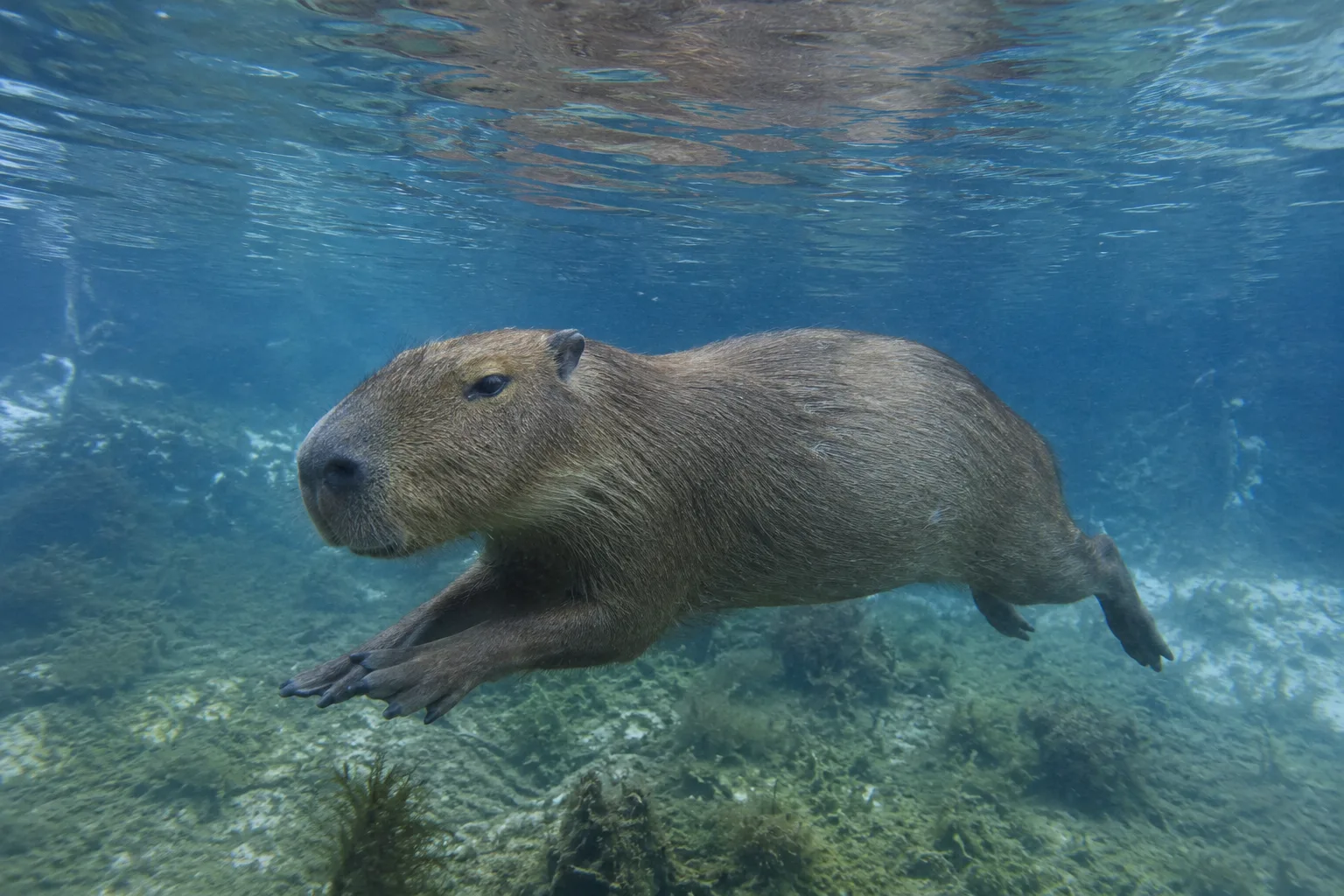
The second row is where a New Jersey application either works or does not. “Normal behaviour patterns” is a phrase with teeth for a species whose alarm response is to get into water. Remove the water and you have removed the behaviour, and the criterion is not written in a way that lets you argue around that.
Can You Have a Capybara as a Pet in New Jersey? The Lot Is the Problem
The permit is $10. The enclosure is not.
Those numbers are from the AZA Capybara Care Manual, and the median AZA exhibit is 5,630 ft². An acre is 43,560 ft², so a quarter-acre New Jersey lot is roughly 10,890 ft² before you subtract the house, the driveway, the septic field and the setbacks. The zoo median takes half of what is left.
Now the part that actually stops people, which is not the size. It is the pond. Call a municipal building department about a six-foot-deep water feature in a residential zone and you are no longer discussing an animal. You are discussing an accessory structure, a fence ordinance, a pool barrier code, a soil disturbance threshold, possibly a wetlands buffer if the parcel is anywhere near water, and a drainage plan. Each of those sits with a different desk. None of them has heard of the Individual Hobby Permit, and none of them is obliged to care. A contractor will quote the excavation happily. The permit that lets you dig it is the slow part, and in the denser counties it is frequently the part that ends the project.
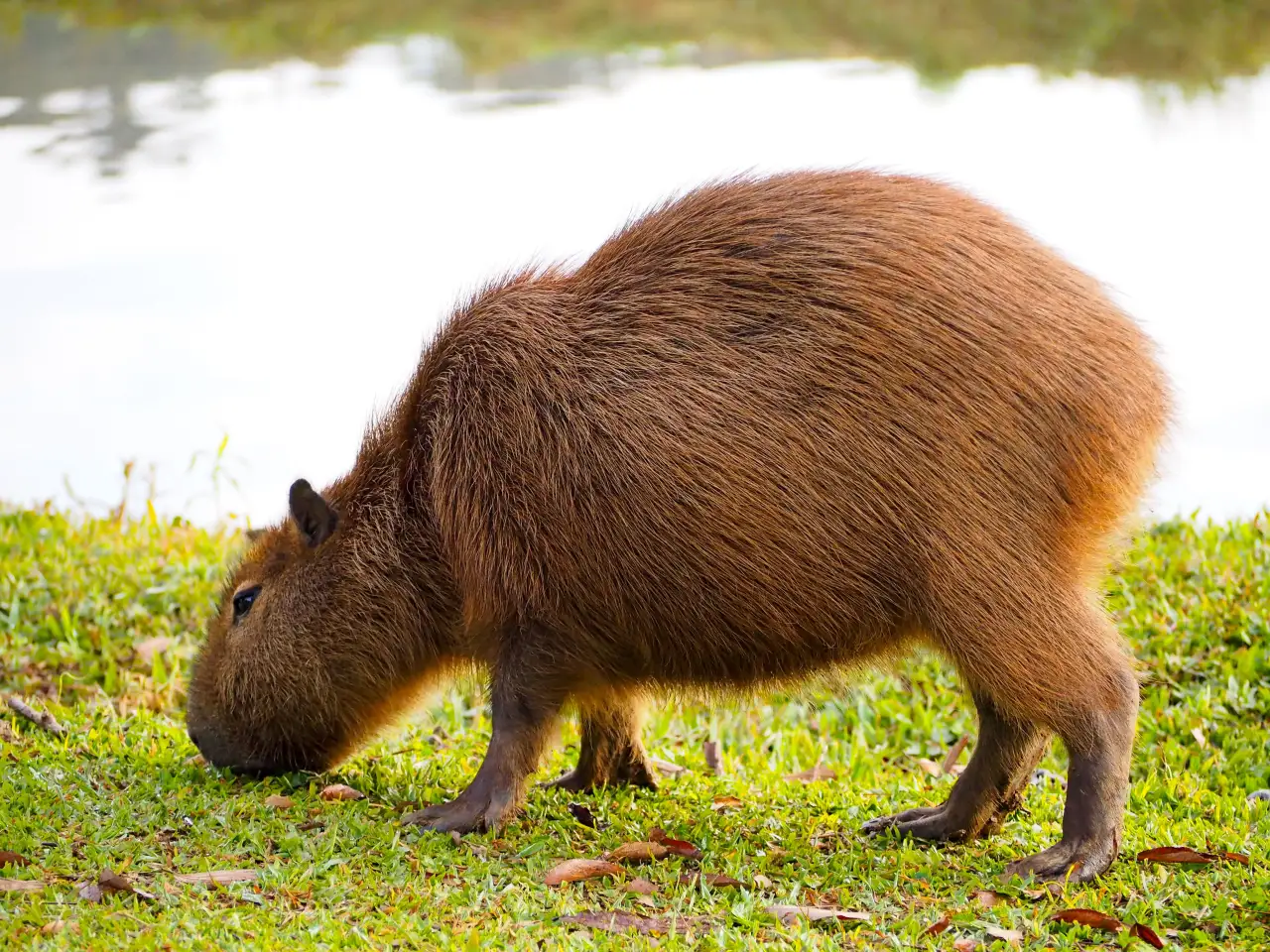
South Jersey is where this gets realistic. Salem, Cumberland and Cape May counties, plus the agricultural parts of Atlantic and Burlington, have the parcel sizes and the zoning categories that make the enclosure conversation short. North Jersey and the Philadelphia-facing suburbs generally do not.
Who to Call in New Jersey, and What to Ask
| Who | What to ask | Why it matters | What changes the answer |
|---|---|---|---|
| NJ Fish & Wildlife permits unit | Which permit type applies to Hydrochoerus hydrochaeris, in writing | Settles the hobby permit versus dangerous-species question at the source | Rulemaking, and the Division’s own classification opinion |
| Municipal zoning officer | Whether a pond or enclosure of this size is permitted on your parcel | This is the layer that ends most New Jersey plans | Zoning district, lot size, setbacks, wetlands buffers |
| Municipal clerk or code enforcement | Whether the town restricts exotic or non-domestic animals | Municipal codes work independently of the state permit | Incorporated town versus rural township |
| HOA or deed holder | Whether covenants prohibit non-domestic animals | Covenants are contractual, and a state permit does not touch them | Development age, recorded restrictions |
| Two exotic-animal veterinarians | Whether they treat capybaras and cover after-hours calls | 7:25-4.7 expects prompt veterinary treatment as a condition | Distance, species experience, emergency arrangement |
| USDA APHIS, if commercial | Whether the intended use triggers Animal Welfare Act licensing | Paid encounters or exhibition adds a federal layer | Public access, revenue, breeding |
Ten Dollars, and What the Hobby Permit Does Not Cover
The permit that governs a capybara in New Jersey costs less than lunch, which is the most misleading thing about it.
The application is not a formality despite the price. It asks for the species and sexes, a thorough description of the caging including dimensions, and a description of the food. The twenty-day temporary permit receipt has to travel with it, and the form says plainly that permits are denied where receipts are missing.
A hobby permit is the state agreeing that the species may be held. It is not your municipality agreeing that it may be held at your address, and New Jersey has 564 of those.
Everything the ten dollars does not touch — the animal, the enclosure, the water, the exotic vet — is in the capybara cost guide. It does not print a purchase price, on the view that a number from an opaque market is worse than no number.
New Jersey Assumptions That Do Not Survive the Rulebook
| What New Jersey buyers believe | What is actually true |
|---|---|
| ”Capybaras are a potentially dangerous species in NJ” | They are not named at 7:25-4.8, whose rodent entries are prairie dogs and ground squirrels. It matters, because 7:25-4.9 bars pet keeping for that category. |
| ”If it isn’t banned, no permit is needed” | New Jersey’s list is a positive one. 7:25-4.5 requires a permit for any exotic mammal not exempted at 7:25-4.4. |
| ”A guinea pig is exempt so a capybara probably is” | The exemption names Cavia porcellus specifically. Family resemblance is not a legal category. |
| ”The permit will be expensive and slow” | The mammal fee is $10.00 per permit, not per animal. The expensive part is the enclosure and the municipal approvals. |
| ”A state permit beats a town ordinance” | It does not, and it never has. Municipal codes, zoning and HOA covenants clear separately. |
| ”NJ winters rule this out” | The AZA outdoor floor is 40°F with heated, bedded shelter. That is a heating bill and a building, not a disqualification. |
The New Jersey Bottom Line
New Jersey is the rare state where the state layer is the simple part. A $10 permit, five published criteria, and a permits unit that will tell you which category the animal sits in if you ask by scientific name and ask in writing.
Then the real work starts, and it is municipal. Zoning district, pond as accessory structure, fence and barrier code, setbacks, covenants. Do that layer before the deposit, in that order, because the state permit is worth nothing on a parcel where you cannot build the enclosure the state permit asks you to build.
The honest read: the $10 fee makes New Jersey look permissive and it is not. It is a state that decided the gate should be a welfare standard rather than a price, and welfare standards for a semi-aquatic herd animal are expensive to meet. That is a defensible way to write a rule. It is also why very few New Jersey households will clear it.
If you are still working through it, the capybara cost guide covers what the enclosure actually runs, and the care guide covers the water and grazing requirements the Division’s criteria point at. Why capybaras love water explains why the pool is not negotiable. Neighbouring states run different systems, so read the New York and Pennsylvania guides before assuming the answer travels, and the state-by-state map for national context.
This guide is current as of September 5, 2026. Classifications change by rulemaking, so treat this as a screening path rather than legal advice, and confirm with the NJ Fish and Wildlife permits unit and your municipality before acting.