Most state exotic-animal law never mentions rodents. Legislatures write their dangerous-animal statutes around lions, bears, primates and crocodilians, a capybara falls outside the list by accident, and the honest answer becomes “the state does not address this.”
Idaho addresses it.
Permit required — and the rule names capybaras
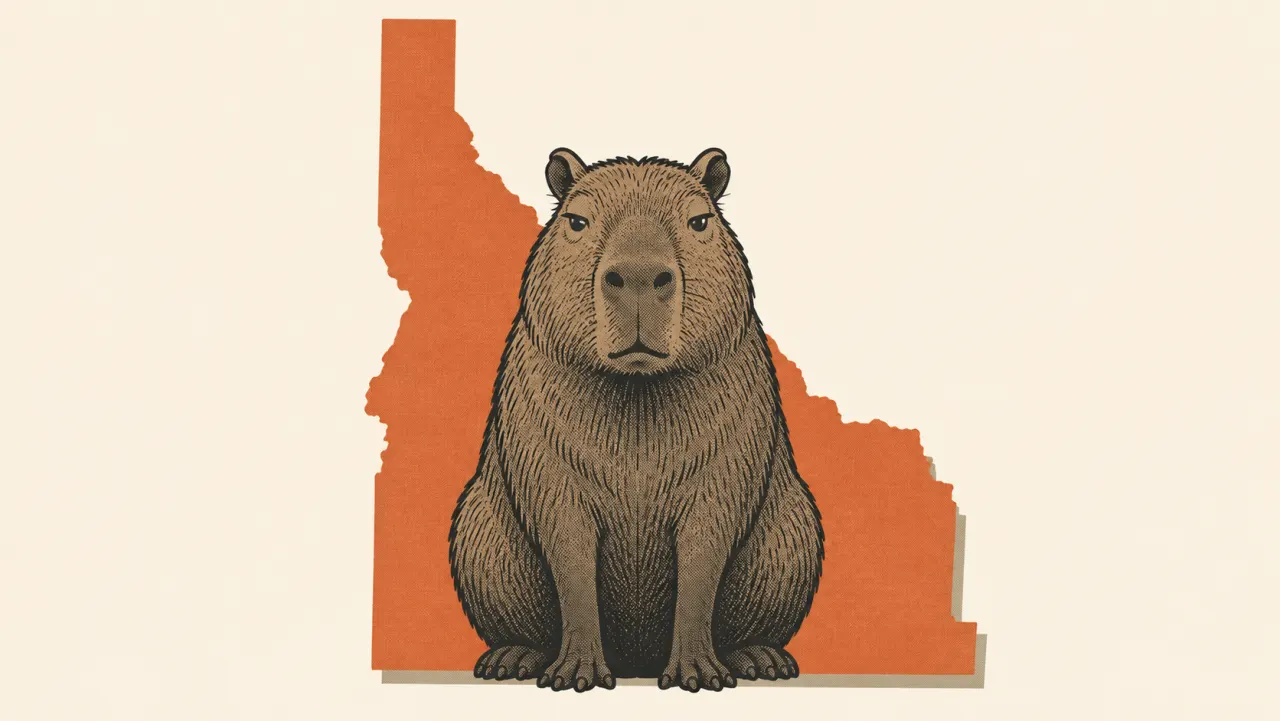
IDAPA 02.04.27, the Rules Governing Deleterious Exotic Animals, covers "all South American rodents except guinea pigs and chinchillas," with capybaras and Patagonian cavies named in the parenthetical. Possession requires an Application for Possession of Deleterious Exotic Animals through the Idaho State Department of Agriculture.
Importation is a separate process with its own requirements. You need both.
The Short Answer: Idaho Names Them
There is no ambiguity to resolve here, which makes Idaho the easiest of the state guides to write and the one most often reported wrong. Generic exotic-pet listicles tend to sort states into “banned” and “legal,” and Idaho is neither. It is a permit state, with a rule that reached the capybara deliberately rather than by oversight.
The Idaho State Department of Agriculture defines deleterious exotic animals as those “determined by ISDA to be dangerous to people, the environment, livestock, agriculture, or wildlife of the state.” That is a broader test than the dangerous-wild-animal statutes most states run, and the breadth is the point — it lets the department regulate an animal that poses no threat to a human being but could pose one to a watershed or a hay crop.
What IDAPA 02.04.27 Actually Covers
The deleterious list is organised by group rather than by individual species. The rodent entries are what matter here:
Deleterious — permit required
- All South American rodents, including capybaras and Patagonian cavies
- African rodent species
- Prairie dogs
Carved out — no permit
- Guinea pigs
- Chinchillas
The two exceptions are worth pausing on, because they explain the shape of the rule. Guinea pigs and chinchillas are South American rodents with long, established captive-breeding histories and no realistic prospect of establishing a wild population in Idaho. Everything else in that continental group got swept in.
Idaho is not claiming a capybara will hurt you. The classification is about risk to agriculture, livestock, native wildlife and the environment — the standard concerns for a large grazing animal that is a strong swimmer and reproduces readily. It is closer to an invasive-species framework than a public-safety one.
The order Rodentia is not banned wholesale. Idaho picked specific rodent groups it considered a risk and left the rest alone, which is a more considered piece of rulemaking than most states manage on this question.
Possession and Import Are Two Different Doors
This is where Idaho applications go wrong, and it is the single most practical thing on this page.
ISDA runs importing and in-state possession as separate processes with distinct requirements. A seller who has shipped animals into Idaho before has, at most, solved half of your problem — and solved it for themselves rather than for you. A possession permit does not authorise the animal to cross the state line, and an import clearance does not authorise you to keep it once it arrives.
Deposit paid, transport booked, one clearance in hand, and the other one either refused or still pending on the day the animal is supposed to move. Get written confirmation on both before money changes hands. A seller's confidence is not a permit.
Why Local Rules Can Still Say No
A state permit is permission from the state. It is not permission from Boise, Meridian, Idaho Falls, or your county.
Idaho municipalities restrict exotic animals, livestock-type animals in residential zones, outdoor enclosures, standing water features, setbacks and fencing on their own authority. A city ordinance can make a permitted animal unlawful at your specific address, and neither ISDA nor the seller will check that for you.
Rural acreage helps but is not a cloak. County zoning, drainage rules, private covenants and an insurer all still have views, and in Idaho the water question tends to attract more attention than people expect — a capybara needs a real pool, and a real pool on agricultural land is its own conversation.
ISDA Twice, and in This Order
Sequence matters, because each answer changes what you need to ask next.
-
Idaho State Department of Agriculture — possession
Ask about the Application for Possession of Deleterious Exotic Animals for Hydrochoerus hydrochaeris. Use the scientific name. Ask what the application requires, what the review timeline is, and what conditions typically attach.
-
ISDA Animal Industries — importation
A separate conversation, even though it is the same department. Ask what clearance is needed to bring the animal in, what health documentation applies, and whether the origin state changes anything.
-
City or county animal control
Give them the address, not the town. Ask whether exotic animals or large non-domestic mammals are permitted there, and get the answer in writing.
-
Zoning or planning
The enclosure, the fencing height, the pool and any drainage it needs. This is where rural plans usually meet their first real obstacle.
-
An exotic veterinarian
Before the deposit, not after. Ask directly whether they treat capybaras and handle emergencies, and how far you would be driving at 2am.
-
USDA APHIS — only if commercial
Any public exhibition, paid interaction or breeding operation brings federal licensing into it.
The Care Reality That Should Slow You Down
A permit answers whether you may. It says nothing about whether you should, and the Idaho climate makes that a sharper question than the paperwork suggests.
The AZA Capybara Care Manual describes an animal built around water, continuous grazing, group life and secure space. Idaho winters mean heated shelter and a water plan that does not freeze, which is a plumbing and utilities problem before it is an animal problem.
The Strictest-Sounding State Charges Nothing
Idaho names capybaras in its deleterious exotic animal list, which sets an expectation the fee schedule then completely fails to meet. There is no fee schedule.
That combination is unusual and it is worth understanding rather than celebrating. Idaho is not being permissive. It has chosen to gate on the application instead of the fee, and the application is substantial: genus and species, the purpose for possession, the named Idaho veterinarian who will provide care, a statement of your training and experience with the species, confinement specifications, and a copy of local zoning approval where the local authority requires one.
A permit that costs nothing and lasts the animal's life sounds like the lowest bar in the country. What it actually means is that the department expects to get the decision right once, at the front, on the evidence you supply, including a vet who has already agreed to take the animal on.
Federal licensing is the only fee in sight, and only if you exhibit or deal: $120 under 9 CFR § 2.1(a)(2), three-year term under § 2.5(a).
Everything the free permit does not cover is in the capybara cost guide.
The Permissive-West Assumption Fails Here
| What Idaho buyers believe | What is actually true |
|---|---|
| ”Idaho is a permissive western state, so it will be fine” | Idaho is one of the strictest states on this specific animal, because it regulates by ecological risk rather than by whether something bites. |
| ”Capybaras aren’t dangerous, so a dangerous-animal rule can’t apply” | The category is deleterious, not dangerous. The test is harm to agriculture, livestock, wildlife and environment. |
| ”The breeder handles the permits” | The breeder handles their side of a sale. Possession is your permit, in your name, at your address. |
| ”One permit covers it” | Two processes: possession and importation. They are administered separately. |
| ”Guinea pigs are legal so capybaras must be” | Guinea pigs are one of exactly two carve-outs from the South American rodent entry. The carve-out is the reason, not the pattern. |
The Idaho Verdict
Idaho gives you something most states do not: a clear answer. The rule names the animal, the department that administers it is identifiable, and the application has a name. That is a better starting position than the ambiguity most would-be owners are working with elsewhere.
It also sets a real bar. Two clearances, a local ordinance check, a winter water plan, a vet who takes the call, and a second capybara — because one is not a smaller commitment, it is a worse one.
If the paperwork feels like too much, that is useful information arriving early and cheaply. The animal is a fifteen-year decision.
Then read the capybara cost guide, the care guide, and the state-by-state map for how other states handle the same question.
This guide is current as of September 5, 2026. Rules, agency interpretations and local ordinances change, so treat it as a screening path rather than legal advice, and confirm with ISDA before acting.