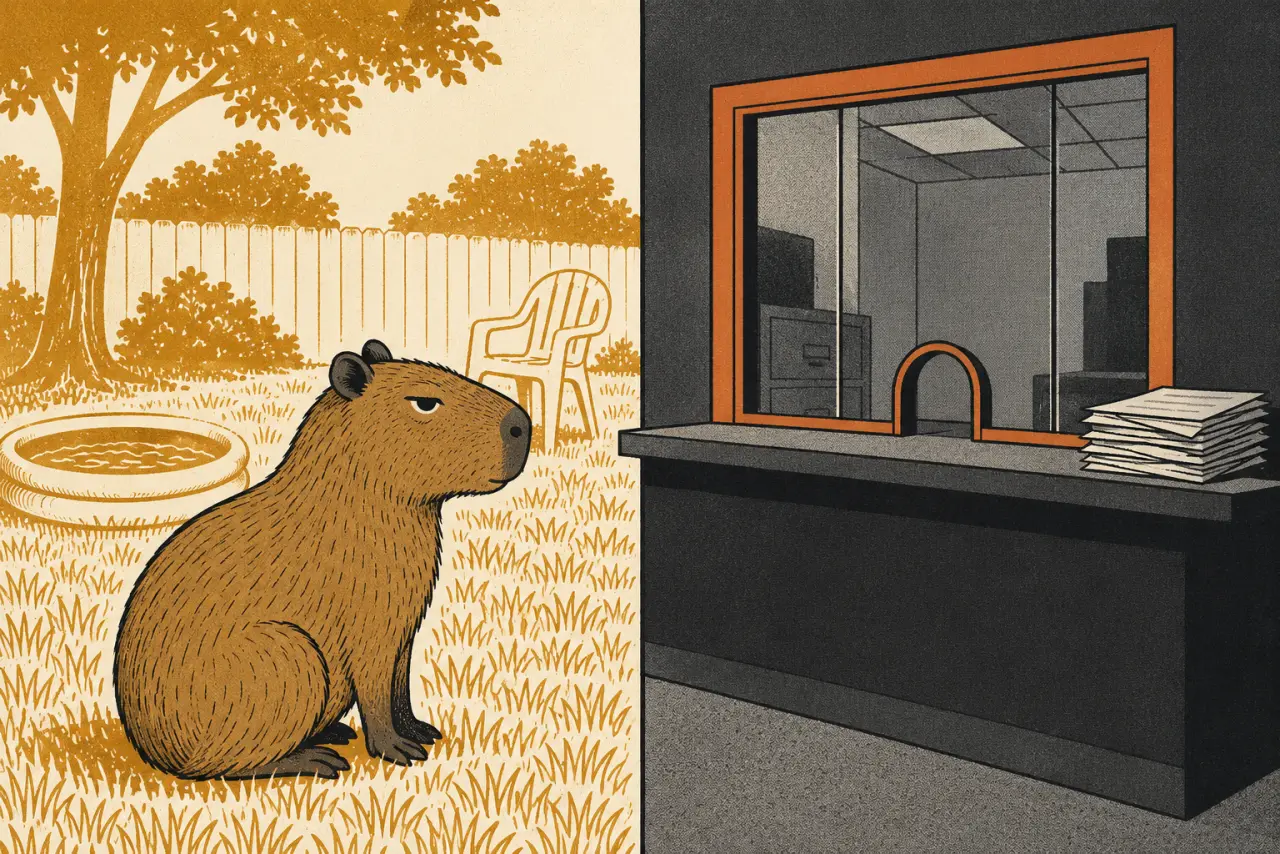
Oregon does not make capybara fans squint at a vague exotic-pet paragraph. It names the animal.
No, capybaras are not legal for ordinary private ownership in Oregon. Oregon Administrative Rule 635-056-0050 lists capybara, Hydrochaeris hydrochaeris, as a prohibited mammal.
There is the answer. The capybara did not even get a mysterious gray area to stand in.
Oregon names the animal
Oregon does not leave capybara fans squinting at a vague exotic-pet paragraph. The state addresses the animal directly, which makes this one of the clearer answers in the series — and the clarity runs in the restrictive direction.
Oregon Explicitly Lists Capybaras As Prohibited
OAR 635-056-0050 says that, except as otherwise provided, live wildlife listed in the rule may not be imported, possessed, sold, purchased, exchanged, or transported in Oregon. Under prohibited mammals, Oregon lists “Capybara — Hydrochaeridae — Hydrochaeris hydrochaeris.”
The scientific spelling in modern sources is often Hydrochoerus hydrochaeris; Oregon’s rule text uses Hydrochaeris hydrochaeris. The common name does the important work here. It says capybara.
| Oregon rule item | Meaning for a private owner |
|---|---|
| Capybara listed as prohibited mammal | Ordinary private ownership is not allowed |
| Import prohibited | Do not bring one into Oregon |
| Possession prohibited | Do not keep one in Oregon |
| Sale or purchase prohibited | Do not buy or sell one in Oregon |
| Transport prohibited | Do not move one through normal private channels |
What Prohibited Means In Real Life
For normal readers, prohibited means: no pet capybara, no backyard capybara, no “but the breeder said,” no importing a baby from another state, no selling one, no capybara birthday encounter business from a suburban property.
This is not one of those states where the practical answer is “ask five offices and bring snacks.” You can still contact ODFW for confirmation, and you should before doing anything involving live wildlife, but the baseline public rule already answers the private pet question.
Oregon’s wildlife integrity rules exist to protect native wildlife, agriculture, public health, and ecosystems from harmful nonnative species. Whether a capybara personally looks peaceful is not the test. Regulations are written for risk classes, not facial expressions.
The Exceptions Are Not A Pet Loophole
Oregon’s Division 56 page says permits for prohibited or unclassified species are not issued for importation and possession of live wildlife except to AZA-accredited facilities, colleges, universities, and facilities that can demonstrate compliance with standards in the rule.
That is not a secret pet route. It is an institutional route.
| Exception type | Why it does not help a normal owner |
|---|---|
| AZA-accredited facility | Professional zoo context, not household ownership |
| College or university | Research or education setting, not a pet |
| Qualified facility under rule standards | Institutional compliance burden |
| Ordinary household | Not the pathway described |
If someone tells you they can get around Oregon’s capybara rule with “a permit,” ask for the specific rule, facility type, and written agency confirmation. Then expect the air to get quieter.
The Paper Trail Worth Keeping
Even when the state answer is a clear no, it helps to know which office holds which piece of the answer. Oregon’s rule is public, but rule text gets revised, and the only confirmation that protects you is one you can point to in writing. If you ever do call around, ask narrow questions and write down who said what.
| Agency / document | What to ask | Why it matters | What changes the answer |
|---|---|---|---|
| ODFW (Division 56 rule) | Is capybara still listed as prohibited under OAR 635-056-0050? | This is the rule that answers the private pet question | A rule revision or reclassification |
| ODFW permits office | Are any permits issued for private possession of a prohibited mammal? | Confirms the institutional-only pathway in writing | A new permit class for private holders |
| Oregon Dept. of Agriculture | Do any exotic-animal or import rules also apply? | Separate agency, separate paperwork | A change to import or exotic-animal rules |
| City / county animal control | Are there local rules on exotic or large animals? | Local rules add limits even where state law already says no | A stricter local ordinance |
The point of the table is not to find a yes. It is to make sure the no you are working with is the current one, on the record, from the office that owns it.
Common Misreadings, Corrected
Most of the confusion around Oregon comes from people applying the wrong state’s logic, or trusting a seller who has not read Oregon’s rule at all.
| Myth | Better answer |
|---|---|
| ”It’s legal somewhere nearby, so Oregon must allow it too.” | State lines matter. Oregon names capybara as prohibited regardless of what a neighbor allows. |
| ”A breeder will ship one if I just pay for a permit.” | Oregon does not issue private-possession permits for prohibited mammals. A seller’s confidence is not a legal finding. |
| ”It’s only banned because the rule is outdated.” | The rule reflects wildlife-integrity risk classes, not the temperament of one animal. |
| ”I’ll keep it quiet, it’s just one pet.” | Possession, transport, and import are each separately prohibited. There is no quiet version of this that is legal. |
What Owning One Would Actually Require
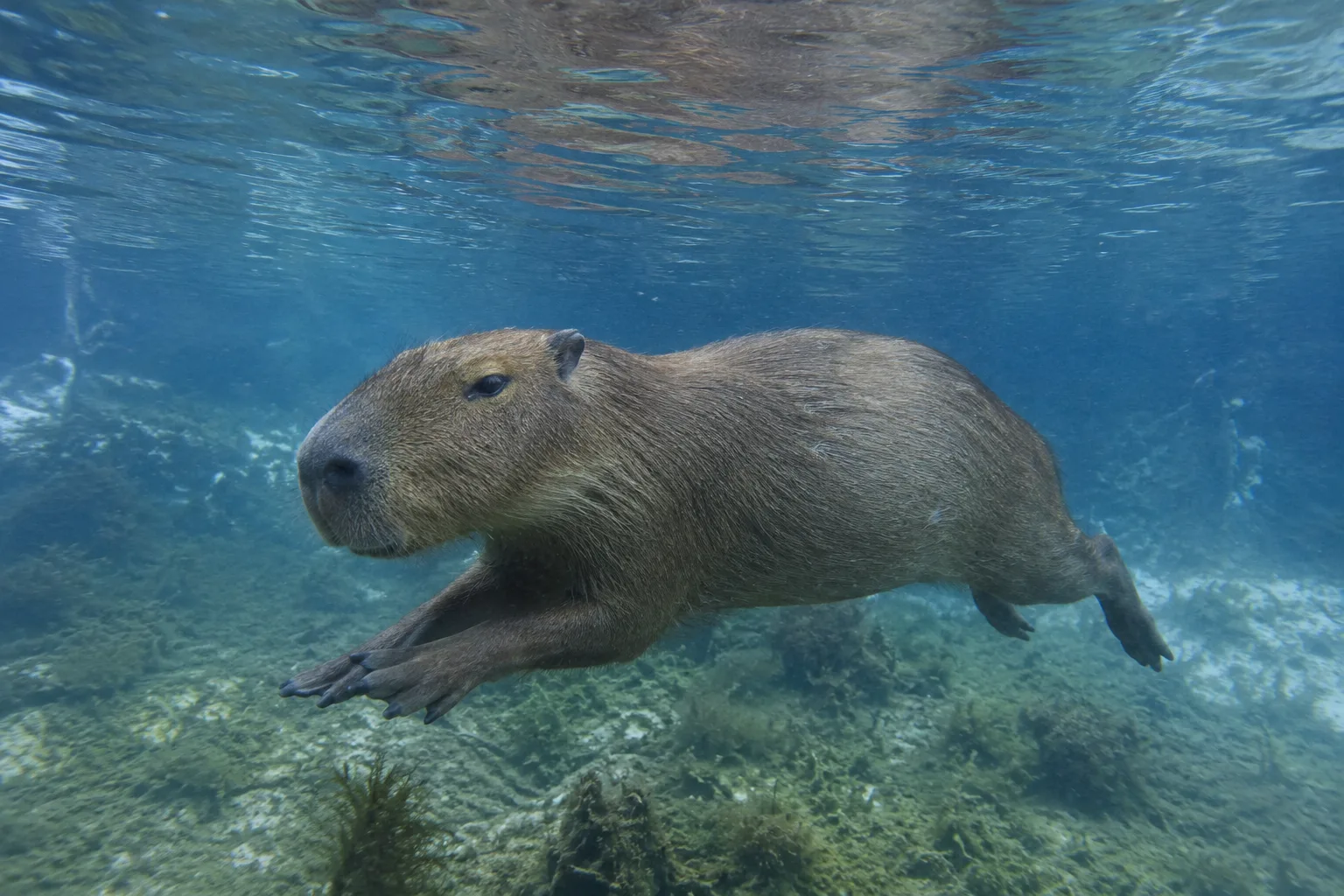
Set the law aside for a second, because the welfare math is its own argument. A capybara is the world’s largest rodent, with adults often in the range of about 77 to 145 pounds, and it is built for a life Oregon backyards do not offer. They are semi-aquatic grazers from South America, which means real water to swim in, not a kiddie pool as decoration. They are intensely social herd animals, so a single capybara is a lonely capybara, and solitary housing is a genuine welfare stressor rather than a minor inconvenience.
The diet is not casual either. Like guinea pigs, capybaras cannot make their own vitamin C and need it supplied steadily, or they get sick. They are hindgut fermenters that re-ingest soft morning feces to pull nutrients from grass, which is normal and necessary and not something you can tidy away. Their teeth grow continuously, so they need the right forage to keep wearing them down. On top of all that, you would need an exotic vet who actually treats large rodents, and those are not on every corner. The honest version is that even in a state where the paperwork said yes, most homes could not give a capybara a good life. Oregon’s no quietly spares a lot of animals a bad one.
Local Rules Still Matter, But State Law Already Answers
Usually legal guides spend time on local ordinances because a city can say no even where the state says maybe. In Oregon, the state answer is already a no for ordinary private capybara ownership.
Local rules still matter for facilities, displays, zoning, animal welfare, business licensing, and public-contact situations. They just do not rescue the private pet plan.
For buyers, this is the useful sentence: do not contact out-of-state breeders about shipping a capybara to Oregon. If the seller says it is fine, the seller is not reading Oregon’s prohibited species rule for you.
The Better Oregon Capybara Plan
Current as of June 2026: treat this as a starting point, not legal advice. Recheck ODFW’s current rule text and any facility-specific requirements before any Oregon wildlife plan, especially near the scheduled November 2026 publish date.
The practical takeaway is short. For an ordinary household, the answer is no, and there is no permit path that turns it into a yes. Do not buy from an out-of-state breeder, do not arrange shipping, and do not treat a seller’s “it’s fine” as confirmation. If you have an unusual situation, a facility plan, a research context, or a genuine institutional case, confirm the rule directly with ODFW in writing and talk to an Oregon attorney who knows wildlife and exotic-animal law before spending a dollar.
This guide is general information, not legal advice. It reflects what is on the books as of June 2026, and rules change. For anything that affects a real decision, go to the relevant agency (ODFW, the Oregon Department of Agriculture, and your city or county animal control) and a qualified attorney, and rely on what they put in writing over what any article, breeder, or forum tells you.
The better plan is to see capybaras through legitimate facilities that already have the right permissions, space, social management, and veterinary support. Start with where to see capybaras in the US. If the pet thought keeps scratching at the door, read do capybaras make good pets and the capybara legal states map.
Oregon’s answer is blunt, which is a kindness. No ordinary pet capybara. The capybara can remain admired, unimported, and free of Portland side-hustle energy.