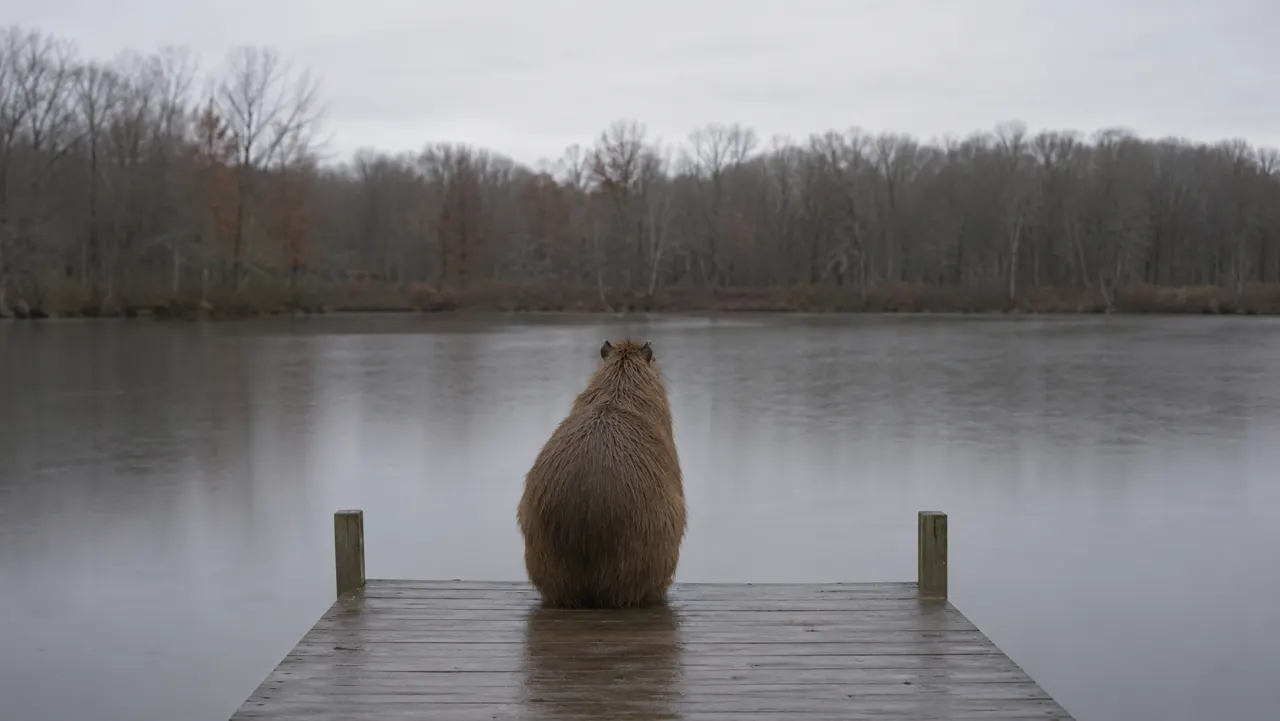
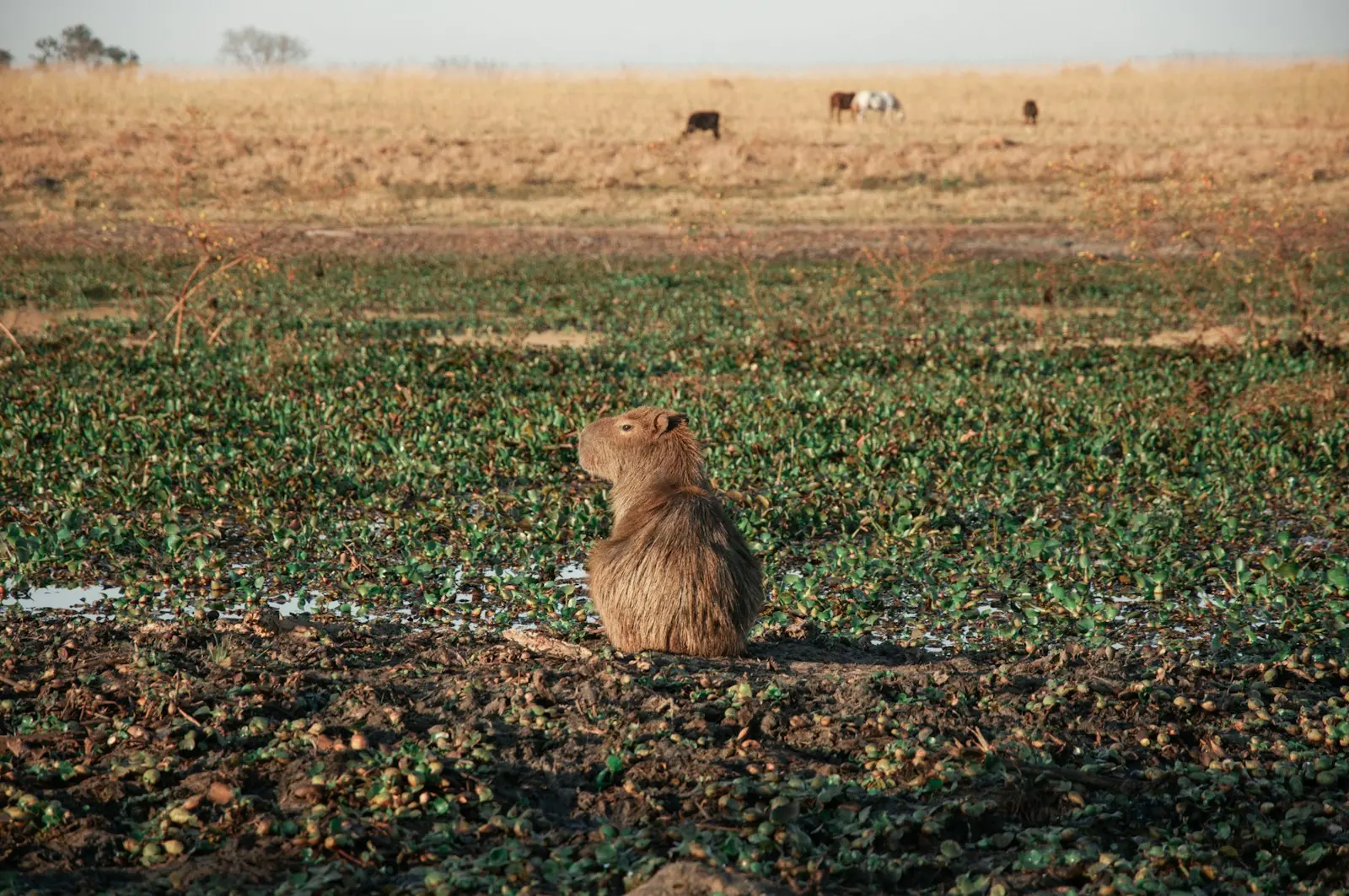
Capybaras make seven documented calls: whistle, cry, whine, squeal, bark, click and tooth-chattering. That list is not a vibe, it is the finding of a 2011 study in Ethology by Barros, Tokumaru, Pedroza and Nogueira, who analysed 2,069 recorded calls from 28 animals across three social groups. They sorted the seven into four jobs: contact, alarm, distress, and agonistic.
Notice what is missing from that list. There is no purr.
Seven call types, and the bark is the one that matters
Most capybara sound is quiet housekeeping: contact calls between animals who want to know where everyone is. The exception is the bark, which is an alarm signal, and which Animal Diversity Web notes often ends with the entire group rushing into water.
The Seven Calls Capybaras Actually Make
The call names and the four functional categories below come from Barros and colleagues. The plain-English descriptions and the “when you’ll hear it” column are editorial, built from those categories plus the field accounts on Animal Diversity Web. Where the research is explicit about a call, the row says so.
| Call | What it sounds like | What the animal means | When you’ll hear it |
|---|---|---|---|
| Whistle | Thin, repeated, carries a long way | Contact. “I am here and I am on my own” | A separated pup. Adults answer this one fast |
| Click | Short, dry, low-volume, easy to miss | Contact at close range | Resting groups, grazing, animals moving together |
| Bark | Flat and abrupt, dog-adjacent | Alarm, aimed at the group | Sudden movement. Often ends in the water |
| Cry | Drawn out, unmistakably unhappy | Distress group | Handling, confinement, something genuinely wrong |
| Whine | Thinner, nagging, repeated | Distress group, lower stakes | Social pressure, crowding, being displaced |
| Squeal | Sharp, loud, sudden | Distress group, the loud end | Pain, rough contact, a fight that landed |
| Tooth-chattering | Dry clatter with no voice in it | Agonistic. A warning, not a mood | Disputes over food, space, or mating access |
Seven is more than most people would guess for an animal whose entire internet reputation is based on not reacting. It is also more than a domestic cat’s commonly listed range, which is the comparison that usually makes the number land.
Why a Bark Moves the Whole Group Into the Water
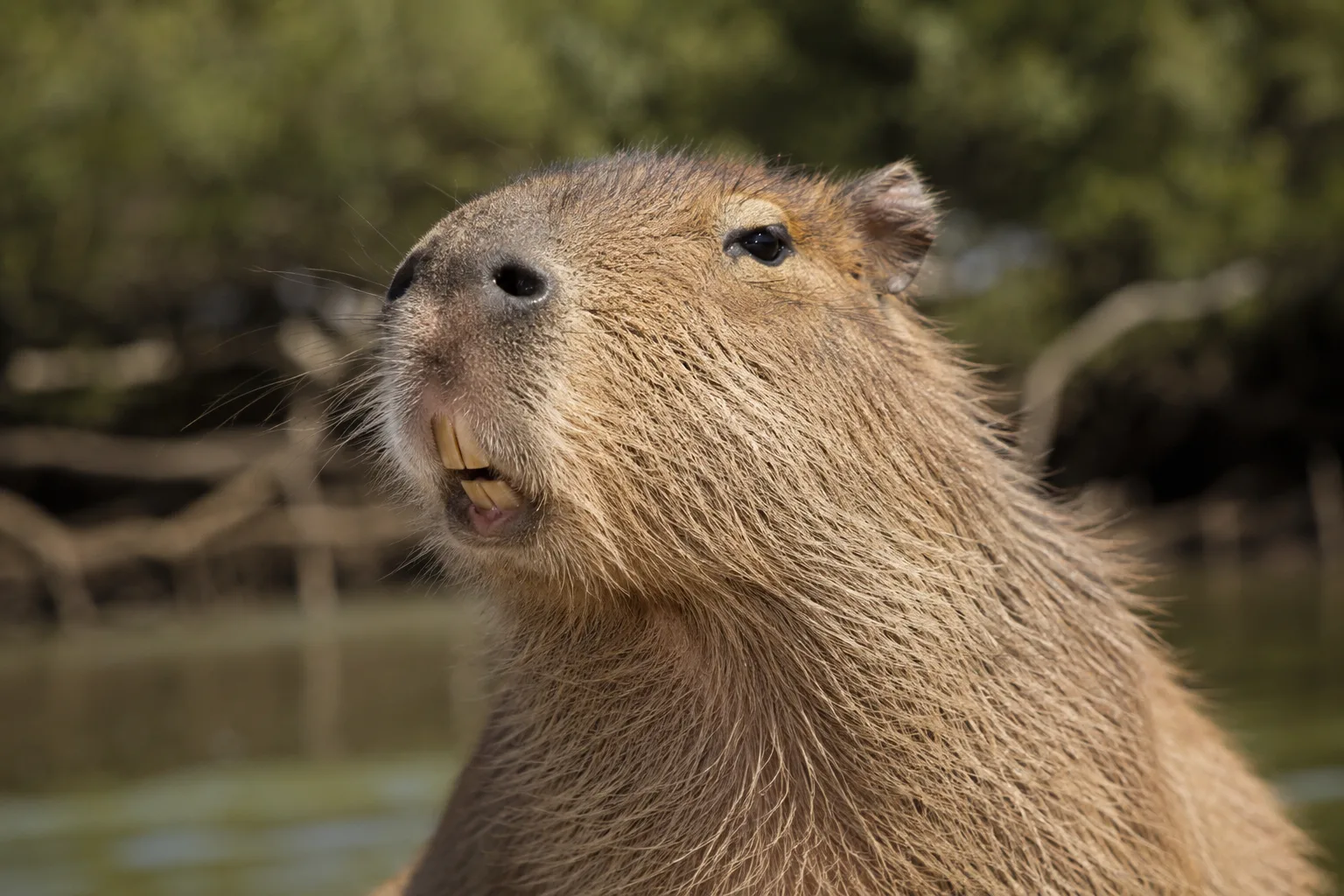
A bark is not a capybara being annoyed at you. It is a broadcast, and the audience is the rest of the group.
Animal Diversity Web puts it plainly: individuals bark to warn the group of danger, and this often results in the whole group rushing into the relative safety of the water. That is the behavioural fact worth carrying around. One animal makes a decision about a threat, and within seconds the decision belongs to everyone.
The water part is not decoration either. Once they are in, capybaras can float with only nostrils and eyes above the surface, and can stay fully submerged for up to five minutes. The bark is the first move in an escape plan that ends with an animal you can barely see.
-
One animal barks
Usually the one with the best angle on whatever moved. It does not wait for consensus.
-
Heads come up across the group
Grazing stops. This is the second you can actually watch happen, and it is faster than you expect.
-
The bark is repeated or picked up
A single bark that nobody answers fades out. A bark that gets echoed has been ratified.
-
The group moves toward water
Not scattering in all directions. One direction, and it is almost always the wet one.
-
Eyes and nostrils only
Up to five minutes fully submerged if it comes to that. The alarm system ends in a hiding place.
If you want the rest of that story, the capybara relationship with water explains why the escape route is always the same one.

The Whistle Is a Pup Saying It Got Left Behind
Of the seven calls, the whistle is the one with the clearest experimental evidence behind it, and it is a small heartbreak.
Dos Santos and colleagues, writing in the Brazilian Journal of Biology in 2014, recorded the loud repeated whistles that capybara pups emit when they get separated from the group while grazing or moving. Then they played those recordings to 20 unrelated adult capybaras, along with a bird call as a control.
The adults ignored the bird. They responded to the pup whistles in an average of 2.6 seconds. That is a stranger’s baby, and the reaction is immediate.
The sexes did not respond the same way. Females looked toward the sound for an average of 17.0 seconds; males managed 3.0 seconds before returning to whatever they had been eating. The researchers read this as evidence that the whistle works as a general isolation signal rather than a private mother-and-pup channel — any adult in earshot registers it.
This is the fact I would keep if I could only keep one. A capybara pup’s whistle does not need to reach its own mother. It reaches whoever is closest, and the average capybara adult takes under three seconds to care.
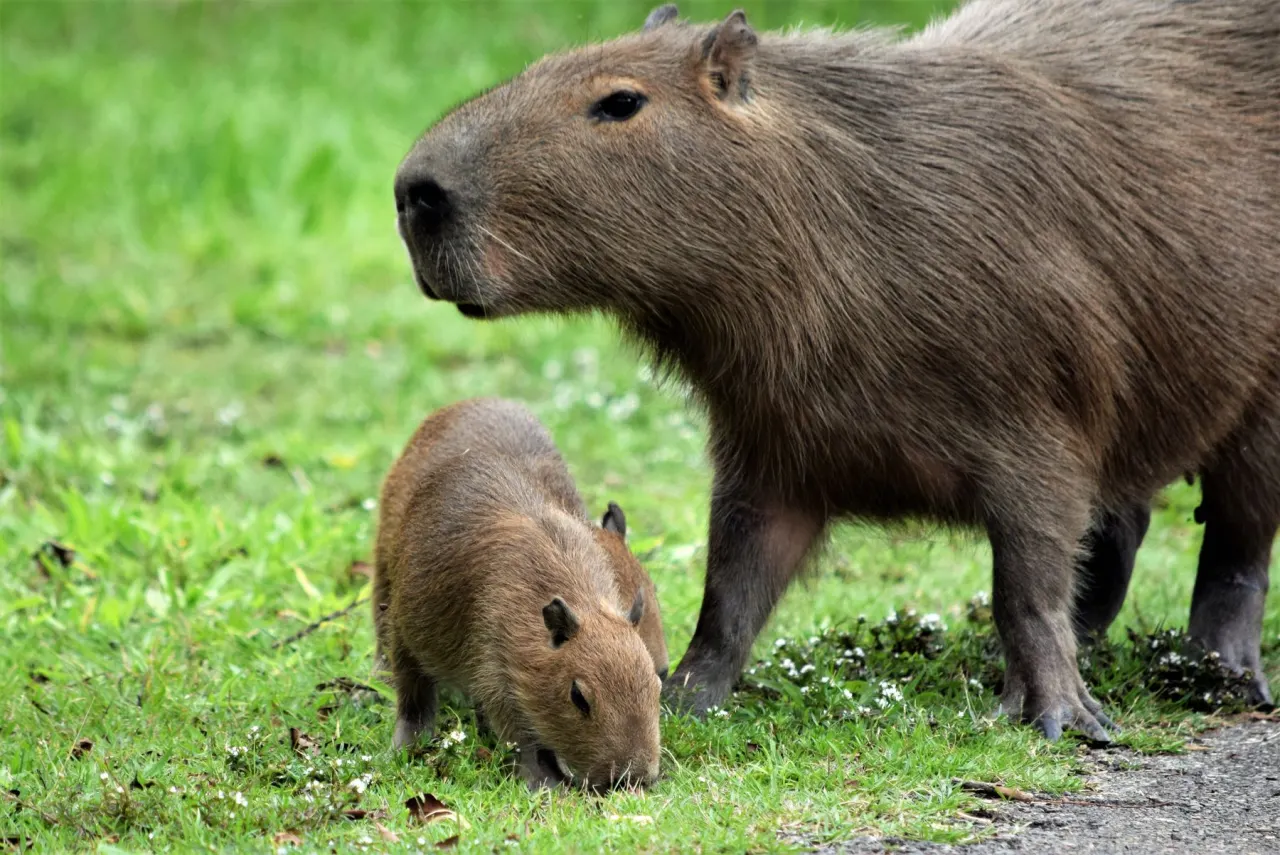
For more on how young capybaras operate inside the group, see the guide to baby capybaras.
Capybara Groups Have Their Own Click Accent
Here is the finding almost nobody repeats, and it is the best thing in the whole study.
Barros and colleagues compared the click calls of adults across the three captive groups they recorded. The clicks were significantly different between groups. Same species, same call type, measurably different depending on which group you were standing next to.
The authors had gone in expecting this, because capybaras are territorial, and a group-specific signal would do useful work: telling insiders from outsiders without anyone having to look up. What it means for a listener is stranger and better. The soft ticking you hear from a resting group is not generic capybara noise. It is that group’s version of it.
Clicks are also the call most likely to be mistaken for something else. They are quiet, close-range, and they turn up when animals are lying together doing nothing. Which is exactly the context in which a human decides they just heard a purr.
What People Get Wrong About Capybara Sounds
Capybaras are calm, not quiet. Animal Diversity Web describes young capybaras as vocalising almost constantly, with vocal communication among adults also common. The published repertoire contains no purr, so a soft close-range sound is a contact call, not a verdict on the animal's mood.
| Myth | Better answer |
|---|---|
| ”Capybaras are basically silent” | Seven documented call types, and young that vocalise almost constantly. The calls are short and low-volume, which is a different thing from absent. |
| ”That purring means it is happy” | There is no purr in the seven-call repertoire. The likely candidate is the click, a contact call. Mood is not what it encodes. |
| ”A bark means it is annoyed with me” | A bark is an alarm aimed at the group, not a complaint aimed at you. The group’s response tells you whether it was taken seriously. |
| ”Squeaky noises in the videos are happy noises” | Cry, whine and squeal sit in the distress category. The cuteness is in the human ear. |
| ”Imitate the call and you’ll bond with it” | Imitating an alarm signal adds a threat cue to a situation that already had one. Tooth-chattering is a warning, and copying it is a bad idea for the same reason. |
Tooth-chattering is worth singling out, because it is the point where sound and posture stop being separate topics. It travels with the rest of the threat display, so it belongs alongside the visual signals covered in the guide to capybara body language and the honest read on whether capybaras are aggressive. A chattering capybara has already told you twice.
How to Read a Capybara Sound at the Zoo
Stand at a capybara enclosure for twenty minutes and the pattern sorts itself out.
The first ten minutes are almost silent, which is why most visitors leave with the loaf theory intact. Then a stroller hits the rail, one animal barks, and every head in the enclosure comes up at once. The group drifts toward the pool, not fast, but all in the same direction, and two of them get in. Nobody is in danger. The system just ran, end to end, over a stroller.
After that it goes quiet again, and if you are close enough and the crowd has thinned, you start picking up the clicking. Which is when it stops being a rodent lying in wood chips and starts being a group of animals keeping tabs on each other.
The practical version is short. If you hear a bark, step back and lower your voice, then watch what the group does rather than what the one animal does. If you hear repeated crying or squealing, that is a distress call and it is a job for staff, not for a phone camera. If you hear a pup whistling, the animal it wants is not you.
And do not imitate anything. You will either be ignored, which is the good outcome, or you will land in the middle of a conversation you cannot follow — which is the same reason capybaras stay so calm in the first place. They have a way to say no long before anything visible happens.
The best capybara sound is not the loudest one. It is the click you finally notice after ten quiet minutes, followed by another animal lifting its head like the group just got a calendar alert.