New Mexico has the most structured system of any state in this series, and structure is not the same as clarity. The rule tells you exactly how the decision gets made. It does not tell you the decision.
Permit-based, and the group assignment decides everything
19.35.7 NMAC requires a Department of Game and Fish permit to import any live non-domesticated animal outside Group I. The director maintains a four-group Species Importation List, and any species not on it defaults to Group IV — prohibited to the general public.
The capybara's group is on that list, not in the rule. Ask NMDGF for the current entry before you do anything else.
The Short Answer: One List Decides It
Most of the state guides in this series end with “and then check your local ordinance.” New Mexico is different: the state layer itself is unresolved from the outside, because the operative document is a species list the department revises rather than a statute you can read.
That is not a failure of the rule. It is a deliberate design that lets New Mexico respond to new species without amending regulations. It just means anyone writing about it honestly has to stop at the point where the list begins.
How the Four Importation Groups Work
19.35.7 NMAC exists to protect native wildlife from contagious and infectious disease and from undesirable species, and to address human health and safety. Every live non-domesticated animal is sorted into one of four groups.
| Group | What it covers | Permit position |
|---|---|---|
| Group I | Semi-domesticated animals | No permit required |
| Group II | Non-invasive, non-dangerous species with no known risk to public health, native wildlife, livestock or habitat | Permits available |
| Group III | Species presenting minimal or manageable concerns | Permit with specific conditions to be met first |
| Group IV | Dangerous, invasive or undesirable species, and state or federally listed threatened, endangered or furbearer species | Prohibited to the general public |
Group IV is not an absolute ban. The rule preserves narrow routes for scientific study, restoration work, zoological display and qualified experts. None of those describes a private buyer.
The Group IV Default Is the Whole Risk
Here is the clause that changes how you should read every other page about New Mexico exotic pets:
Any species not listed defaults to Group IV. Silence is not permission in New Mexico. It is the most restrictive category, applied automatically.
Compare that to how the same absence plays out elsewhere in this series and the difference is stark:
In a negative-list state
- Iowa, Mississippi, West Virginia
- The statute names dangerous species
- Not named means outside the scheme
- Absence works in your favour
In New Mexico
- The director lists species by group
- Not listed means Group IV by default
- Group IV is prohibited to the public
- Absence works against you
This is why “capybaras aren’t mentioned in New Mexico law” is a genuinely dangerous thing to read on a forum. In New Mexico that sentence, if true, would be the bad outcome rather than the good one.
The One Question Worth Asking NMDGF
Do not ask whether capybaras are legal. Ask this instead:
"On the current Species Importation List, what group is Hydrochoerus hydrochaeris assigned to, and what conditions attach to an importation permit for that group?"
Scientific name, group assignment, conditions. That is a question with a filable answer. "Can I own a capybara" is a question that gets you a callback and no record.
Get it in writing, and note the date — the list is revised, and an answer from two years ago is not an answer.
In New Mexico, Local Comes First
New Mexico is unusual in that local authorisation is baked into the state process rather than sitting beside it. An importation permit application requires proof of local authorisation alongside containment plans, veterinary health certificates, federal permits and disease-free documentation.
That inverts the usual order. In most states you clear the state and then discover your city says no. In New Mexico your city has to say yes before the state will consider you.
Albuquerque, Santa Fe, Las Cruces and Rio Rancho each write their own animal ordinances. Get the local answer first, because you will need it as an attachment.
NMDGF, Your City, Then NMDGF Again
-
NMDGF — group assignment
The question above, by scientific name, in writing. Everything downstream depends on the answer, and if it comes back Group IV the process stops here.
-
City or county animal control — local authorisation
Not a courtesy call. Proof of local authorisation is a required element of the state application, so you need this documented.
-
NMDGF — importation permit application
Containment plan, veterinary health certificate, disease-free documentation, federal permits if any, plus the local authorisation from step two.
-
New Mexico Livestock Board
Animal-health and movement requirements, which sit outside the wildlife permit.
-
An exotic veterinarian
You need one for the health certificate anyway. Confirm they treat capybaras and handle emergencies, and how far away they are.
-
USDA APHIS — only if commercial
Public exhibition, paid interaction or breeding brings federal licensing into scope.
The Desert Care Problem Nobody Warns You About
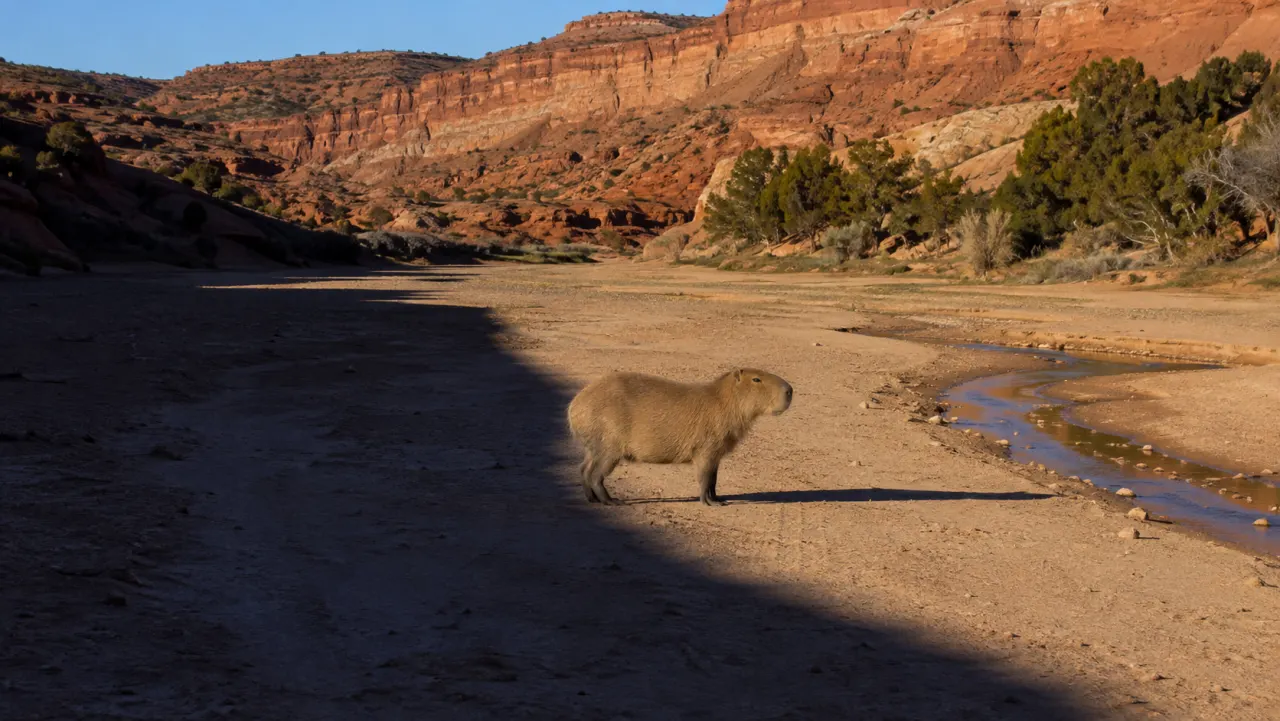
New Mexico is the hardest climate in this series for a capybara, and the permit process will not tell you that.
Capybaras thermoregulate by wallowing, and their skin dries and cracks without regular immersion. The AZA Capybara Care Manual treats water access as fundamental rather than enriching. Maintaining a clean, filtered, refilled pool for two large grazing animals through a New Mexico summer is a water-consumption commitment in a state where that is not a trivial thing to take on.
Shade is the second half of it. High-desert sun with no deep shade is a welfare problem within hours, not days.
The Rule Sets Two Prices, and Neither Is the Permit
19.35.7 NMAC is the importation rule, and reading it for a permit fee turns up almost nothing — which is itself the finding.
Group I is semi-domesticated and needs no permit. Group II is non-invasive and non-dangerous. Group III carries specific provisions. Group IV is dangerous, invasive or threatened, and is generally closed to the public. Which group a capybara sits in is the entire question, and the answer is not in the regulation you can read. It is on a list the director maintains.
Expedited processing buys speed on an application, not a favourable group assignment. Get the group in writing from the Department of Game and Fish before spending anything, including the surcharge.
One more line worth noting: 19.35.7.12(C) states that all application fees are non-refundable. A refused application does not return the money.
The costs that sit outside the permit entirely, the enclosure, water in a desert and the exotic veterinary reserve, are covered in the capybara cost guide.
Misconceptions New Mexico Readers Should Drop
| What New Mexico buyers believe | What is actually true |
|---|---|
| ”Not mentioned in the law means allowed” | Unlisted species default to Group IV, which is prohibited to the general public. Absence is the worst outcome here. |
| ”I’ll get the state permit then sort the city out” | Backwards. Proof of local authorisation is part of the state application. |
| ”The rule will tell me the answer” | The rule sets up the groups. The assignment lives on a list the director maintains and revises. |
| ”Dry heat is fine, they’re from a hot climate” | They are from a hot wetland. Heat without water and shade is the problem, not heat. |
| ”One capybara is easier” | One capybara is a welfare failure, and two is the honest water calculation. |
Where New Mexico Nets Out
New Mexico is the state where the honest answer is a question, and where getting that question exactly right saves the most money.
One written enquiry to NMDGF, using the scientific name and asking for the group assignment and the conditions. If the answer is Group IV, you have your answer and it cost you an email. If it is Group II or III, you now know what the permit requires and can go get the local authorisation that the application will demand.
What you should not do is read “capybaras aren’t on New Mexico’s banned list” anywhere and treat it as good news. In a Group IV-default state, it is the opposite.
Then read the capybara cost guide, the care guide, and the state-by-state map.
This guide is current as of September 5, 2026. The Species Importation List is revised, so treat this as a screening path rather than legal advice, and confirm the current entry with NMDGF before acting.