
Mexico is where a lot of capybara legality questions get fuzzy. People see “Latin America,” think “capybaras live there,” and quietly skip about seven legal steps.
The 2026 answer: capybaras are not a casual pet yes in Mexico. A legal plan depends on SEMARNAT procedures, legal-origin proof, possible exotic-pet authorization or registration, import rules, local law, and welfare conditions.
Also, common capybaras are South American animals. Mexico is not a magic local-exemption zone because both places are on the same hemisphere.
Mexico Is Not A Simple Yes Or No
SEMARNAT lists wildlife procedures covering UMAs, CITES, wildlife registration, and authorization for exotic specimens as companion animals. That is the framework to use, not seller chatter.
PROFEPA, Mexico’s environmental enforcement agency, has warned that illegal wildlife trade is a federal crime and that people who possess exotic fauna as companion animals need legal documentation. That is the line casual buyers should hear loudest. The animal’s paperwork is not a nice extra. It is the proof that the animal is not part of illegal trade.
| Mexican framework | Why it matters |
|---|---|
| SEMARNAT-08-056 | Authorization of exotic specimens as companion animals |
| SEMARNAT-08-032 | Registration of wildlife specimens as pets or birds of prey |
| UMA registration | Authorized wildlife management, not a private shortcut |
| Legal origin rules | Proof that the animal was lawfully sourced |
| PROFEPA enforcement | Illegal possession or trade can lead to seizure and penalties |

Legal Origin Is The First Serious Question
Mexico’s General Wildlife Law framework treats legal origin as central for wildlife outside its habitat. In practical buyer language: where did the animal come from, who was authorized to breed or transfer it, what document proves that, and does the species and individual match the paper?
If the seller cannot give clear documentation, do not rationalize it. Do not accept “my cousin has contacts.” Do not accept screenshots with the important parts cropped out. Ask for the relevant SEMARNAT authorization, legal-origin documents, invoices, registration details, and any import records.
The most capybara-fan sentence in this whole article is also the least romantic: loving capybaras means not feeding the wildlife trade.
UMA And Exotic Pet Authorizations Are Not The Same Thing
A UMA, or Unidad de Manejo para la Conservacion de la Vida Silvestre, is a registered wildlife management unit. It can be used for conservation or sustainable use under an approved management plan. It is not a casual “I want a capybara in my yard” sticker.
SEMARNAT’s exotic specimen companion-animal procedure is also specific. It exists for certain situations where exotic wildlife may be authorized as a companion animal, subject to requirements. The exact answer for a capybara depends on the species, source, individual, location, and intended use.
| If your plan is… | Ask about… |
|---|---|
| Keeping one as a companion animal | SEMARNAT-08-056 and legal-origin requirements |
| Registering an animal already held | SEMARNAT-08-032 and proof requirements |
| Breeding or managing wildlife | UMA framework and management plan |
| Importing from another country | Import, animal health, customs, and wildlife authorization |
| Public display or paid encounters | Commercial, local, and animal-welfare requirements |
Where The Confusion Usually Comes From
Most of the bad capybara advice in Mexico is not malicious. It is just a guess that sounds reasonable, repeated until it feels like a fact. The pattern is always the same: someone treats a continent-level vibe as a legal exemption, or treats a single document as the whole permission. Below are the assumptions that get buyers into trouble, with a steadier version of each.
| Myth | Better answer |
|---|---|
| It’s Latin America, so capybaras are basically a local animal | Common capybaras are South American. In Mexico they are exotic wildlife, which is a documentation and authorization question, not a default yes. |
| If a seller has one for sale, it must be allowed | A listing proves nothing. Legal origin and SEMARNAT authorization are what make possession lawful, and those live on paper, not in a sales pitch. |
| A UMA registration lets me keep one at home | A UMA is a managed wildlife unit with an approved plan, not a private ownership sticker. Companion-animal authorization is a separate track. |
| One permit covers everything | Source, transfer, registration, import, health, and local rules can each be their own step. A single document rarely closes all of them. |
| Paperwork is optional if the animal is healthy and friendly | PROFEPA treats missing legal-origin documentation as an enforcement matter regardless of how the animal looks or behaves. |
A capybara that arrives without a clean origin trail does not become legal by being adorable. That is worth saying plainly, because the cuteness tends to do a lot of quiet persuading.
The Law Is Only Half The Problem
Even a documented capybara is still a capybara. It needs compatible company, water, grazing or high-fiber forage, shade, shelter, secure containment, veterinary care, and a management plan for heat, storms, escape, and disease.
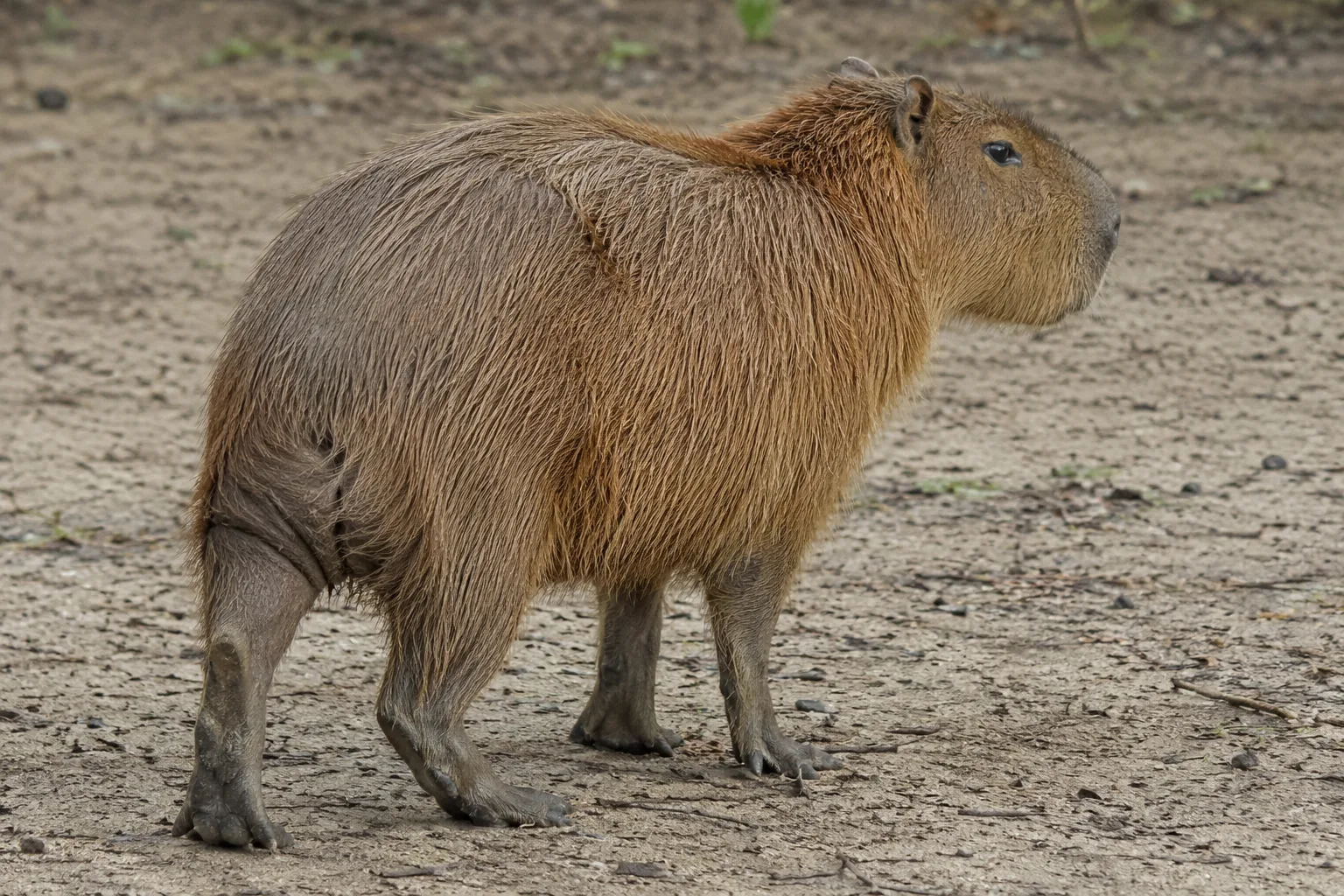
Animal Diversity Web describes capybaras as semi-aquatic, group-living grazers. That is not an apartment pet description. It is not even an ordinary backyard description unless the backyard is being run with zoo-like seriousness.
The cost side is where good intentions usually run out of road. A capybara is the world’s largest rodent, with adults often in the 35 to 66 kilogram range, so the enclosure, fencing, and water feature are closer to small-livestock infrastructure than to a hutch. Because they are intensely social herd animals, keeping a single capybara alone is a welfare problem in itself, which means you are usually budgeting for two animals, not one. They also cannot make their own vitamin C, the same as guinea pigs, so the diet has to be managed deliberately rather than topped up with whatever forage is nearby. As hindgut fermenters they re-ingest their soft morning feces to pull nutrients out of their food, their teeth grow continuously and wear against a high-fiber diet, and an exotic vet who will actually see them is not a given in every town. None of that is a one-time purchase. It is a standing obligation for the eight to ten or more years a capybara can live in captivity.
My honest take: for the overwhelming majority of households asking this question, the answer that protects both you and the animal is not “find the right permit.” It is “admire them somewhere that already does this properly, and don’t start the paperwork at all.”

The Mexico Verification Checklist
Current as of June 2026: this is a starting point, not legal advice. Recheck SEMARNAT, PROFEPA, animal-health import rules, and local code in writing before acting near the scheduled November 2026 publish date.
Before buying, importing, registering, breeding, or displaying a capybara in Mexico, collect written answers.
| Who to contact | What to ask |
|---|---|
| SEMARNAT | Which authorization or registration applies to Hydrochoerus hydrochaeris as an exotic companion animal? |
| PROFEPA | What legal-origin documentation should a buyer verify before possession? |
| Seller or breeder | Can you prove legal origin, authorization, individual identification, and health records? |
| Animal health/import authority | What import, quarantine, veterinary, or customs documents are required? |
| Local municipality | Do local animal, zoning, nuisance, or enclosure rules restrict possession? |
| Exotic veterinarian | Will you treat capybaras and advise on habitat and diet? |
For broader context, read where capybaras are legal around the world, then read do capybaras make good pets. In Mexico, the right first question is not “where can I buy one?” It is “can this exact animal be documented, authorized, housed, and cared for without harming the species or breaking the law?”
This guide is general information, not legal advice. It reflects what was on the books as of June 2026, and rules, procedures, and enforcement priorities can change. Treat every point here as a permit question until the relevant agency confirms it in writing, because local code can still say no even when the federal layer looks clear. Before buying, importing, registering, breeding, or displaying a capybara, confirm the current requirements with SEMARNAT and PROFEPA, check with your animal-health and customs authorities and your local municipality, and run the plan past a Mexican attorney who handles wildlife matters.