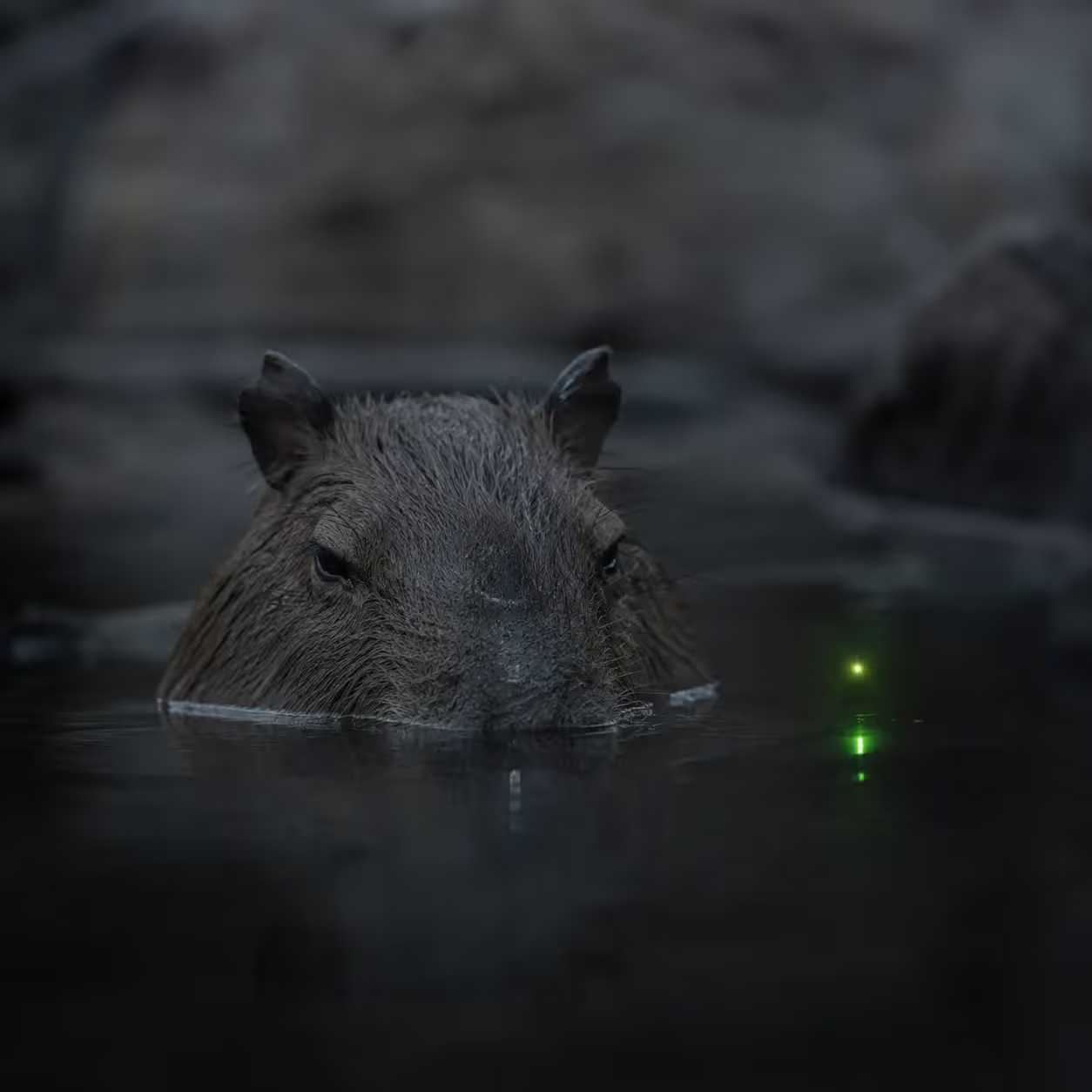

Short answer: capybaras can jump, but not much. Most jumps clear only about a foot and a half to two feet — roughly 40 to 60 centimeters. A young, playful, or genuinely motivated capybara can push closer to a meter, but a full-grown adult usually looks at the idea of jumping and decides against it.
This surprises people, because the capybara silhouette does not suggest athleticism. It suggests a footstool that occasionally blinks. But “can it jump” and “does it bother” are two different questions, and the honest answer to both is “a little.”
How High Can a Capybara Jump?
Reported figures vary, partly because most capybaras have no reason to demonstrate. The reliable range is modest: a typical hop clears well under two feet. The bigger the capybara, the less vertical you should expect — weight works against them.
The internet, of course, has clips of capybaras appearing to spring dramatically. Some are young animals in play, some are startled adults doing a one-time panic move, and some are just camera angles being generous. A capybara is not a deer. Its ceiling is “clears a low obstacle,” not “clears a hedge.”
Why Capybaras Don’t Jump High
This is a body-plan problem, not a fitness problem. Capybaras are the world’s largest rodent, and adults weigh somewhere between 77 and 145 pounds. That mass sits on a barrel-shaped torso with short legs and slightly webbed feet.
That build is not an accident. It is optimized for two things capybaras do constantly: grazing and swimming. The San Diego Zoo describes them as semi-aquatic animals that spend much of their time in and around water, and Animal Diversity Web notes the same water-first lifestyle. Short legs and a low center of gravity are excellent for wading, standing in a pond for hours, and moving through soft wetland ground. They are terrible for launching a heavy body straight up.
So a capybara’s failure to jump is really a success at being a capybara. It is very good at the things it actually does. Vertical leaps are simply not on the list.
When Capybaras Actually Jump
You will see real jumping in a few situations. Young capybaras jump and hop during play, the same way most young mammals test their bodies. A startled adult may make a single quick jump as part of bolting. And a capybara that badly wants to get somewhere — toward food, water, or its group — can produce more spring than its shape suggests, briefly.
But here is the key behavioral fact: a capybara’s real escape plan is not up, it is out, and specifically into water. When threatened, capybaras head for the nearest pond or river and can stay submerged for several minutes. Given the choice between hurdling something and swimming away from it, a capybara picks water every time. Jumping is the backup to the backup.
What This Means for Fencing
This is the one place jump height genuinely matters, and it is mostly a warning for anyone who thinks a capybara is a low-maintenance backyard animal. (It is not — but that is a different guide.)
There is a published number for this, and it is higher than the one that circulates. The AZA Capybara Care Manual says a barrier of approximately 1.8 m (6 ft) should suffice — and it gives the reason in exactly the terms this page has been making: capybaras are not capable of climbing or jumping high or long distances.
The un-topped finding is the one worth sitting with. A roof is the standard answer for an animal that climbs or leaps; the manual says a capybara exhibit does not need one. That is a professional body writing down, in enclosure terms, that this animal does not go over things.
Which is why height is the part people get right and the base is the part they get wrong. A determined capybara tests a fence by pushing on it, digging under it, or finding a gap — not by clearing it. Water complicates it further, since an animal that can swim to a low edge has a shortcut that has nothing to do with jumping. The jump is rarely the weak point.
"About a metre" turns up a lot in pet-keeping advice, and it is 80 cm short of what the care manual actually specifies. If you are building to a number, build to 1.8 m and spend the rest of the attention on the ground line.
For zoos and sanctuaries, this is routine enclosure design — the enclosure setup guide has the full specification including pool size and mesh gauge. For a private owner, it is one more line item in a very long list of reasons capybaras are hard to keep responsibly.
The Loaf Shape Is Specialized, Not Lazy
Capybaras can jump — roughly a foot and a half to two feet, a little more if they are young or highly motivated, a little less if they are a heavy adult who has rejected the premise. Their body is built for water and grazing, not for height, so a healthy capybara mostly declines to jump at all.
If you take one fact from this: a capybara’s instinct when it wants out is to head for water, not to go over the top. The loaf shape is not lazy. It is specialized. Jumping just was never the specialty.