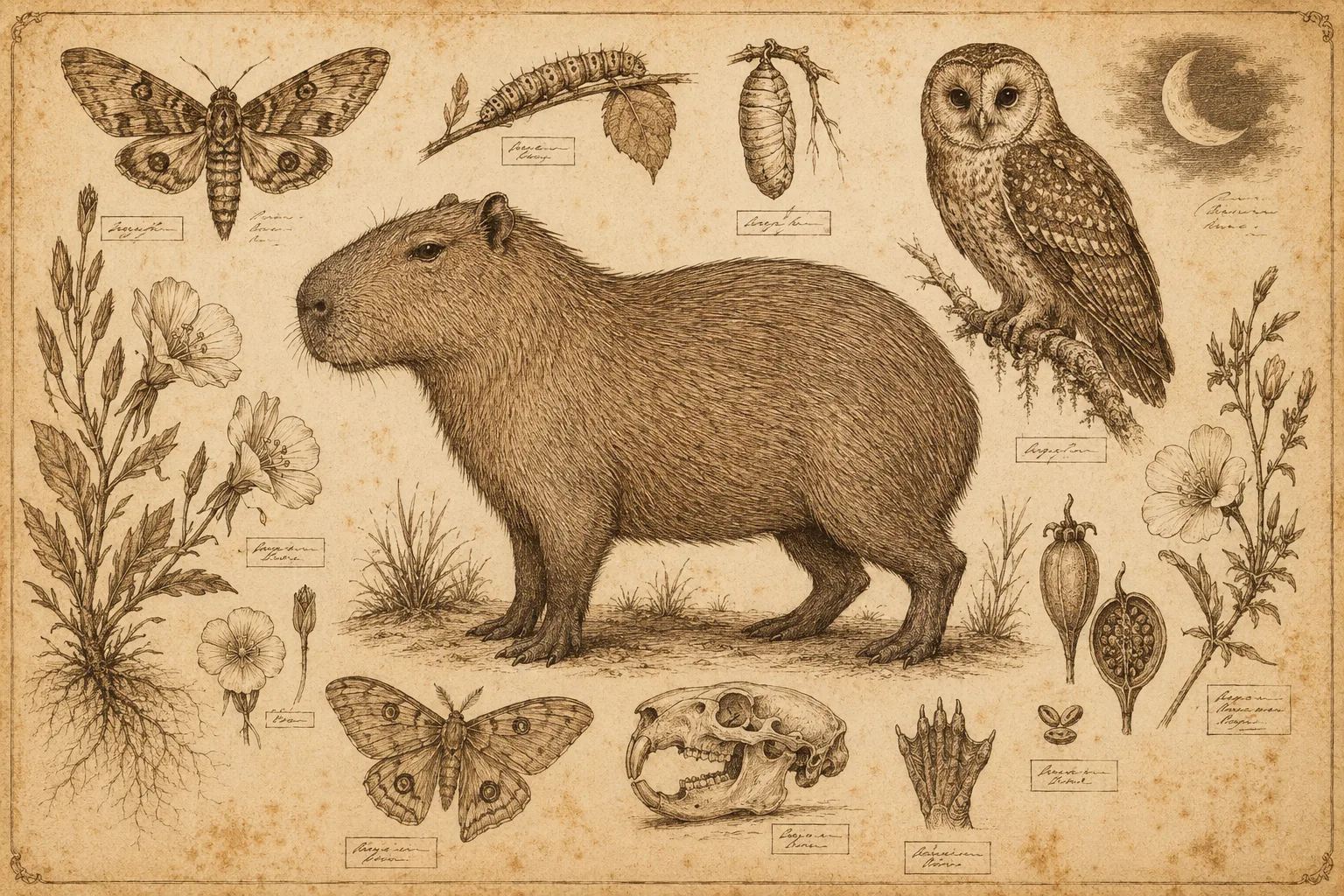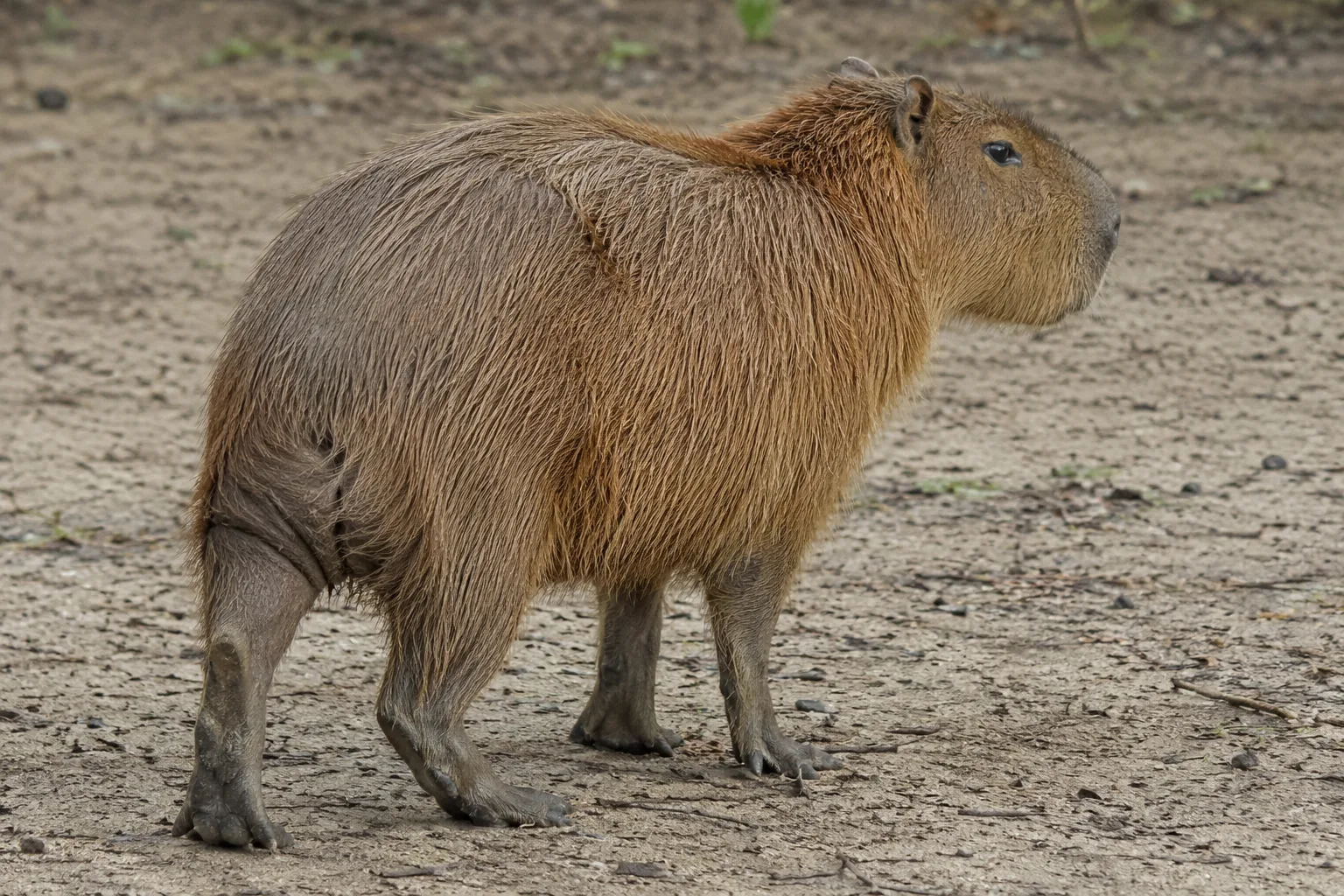

The first time you see a capybara in real life, your brain usually needs a second. Online, they look like oversized potatoes with excellent emotional regulation. In person, they are more like a wetland coffee table that learned to chew grass and judge your choices quietly.
So how big are capybaras, really?
Adult capybaras are not “large guinea pigs” in any useful household sense. They are the world’s largest living rodents, and a full-grown one can overlap with big family dogs, outweigh a North American beaver, and make a toddler comparison feel weirdly practical.
This guide is for the person who has seen one peaceful loaf on the internet and thought, “Could I pick that up?”
No. Please sit down. The loaf has mass.
The Quick Answer
A typical adult capybara is about 3.2 to 4.2 feet long, around 20 to 24 inches tall at the shoulder, and commonly listed around 77 to 145 pounds by Animal Diversity Web and San Diego Zoo Wildlife Alliance’s fact sheet. San Diego Zoo’s public animal page gives a broader range of 60 to 174 pounds, depending on sex.
In normal human language: a capybara is roughly Labrador-sized in length, often heavier than a golden retriever, and much bulkier than a beaver.
The important part is not only weight. It is shape. Capybaras are barrel-bodied, low-slung, muscular, and built for grazing near water. They do not have the tall silhouette of a dog, so photos can trick you. The body is dense. The vibe is calm. The scale is rude.
Adult capybara size, translated from zoo-sheet language
| Measurement | Typical Range | What It Means In Real Life |
|---|---|---|
| Body length | About 3.2 to 4.2 ft (100 to 130 cm) | About the length of a large dog from nose to rump, minus the wagging sales department. |
| Shoulder height | About 1.6 to 2 ft (50 to 60 cm) | Low enough to look approachable, tall enough to make your shins reconsider their hobbies. |
| Adult weight | About 35 to 66 kg (77 to 145 lb), with some sources listing up to 79 kg (174 lb) | Large-dog territory, sometimes bigger. This is not lap-pet math. |
| Birth weight | About 2 to 3 lb (1 to 1.5 kg) | They arrive surprisingly substantial, like nature pre-installed the loaf setting. |
| Sex differences | Females are often reported as slightly larger | If you are guessing from a photo, do not. The capybara does not care about your spreadsheet. |
Why Photos Make Capybaras Look Smaller
Capybaras photograph like calm celebrities. They sit low, tuck their legs, and compress into a tidy brown oval. Put one next to grass, mud, or water, and the background gives you almost no scale.
Then the internet crops the image. Congratulations, your brain is now comparing a 100-pound semi-aquatic rodent to a couch cushion.
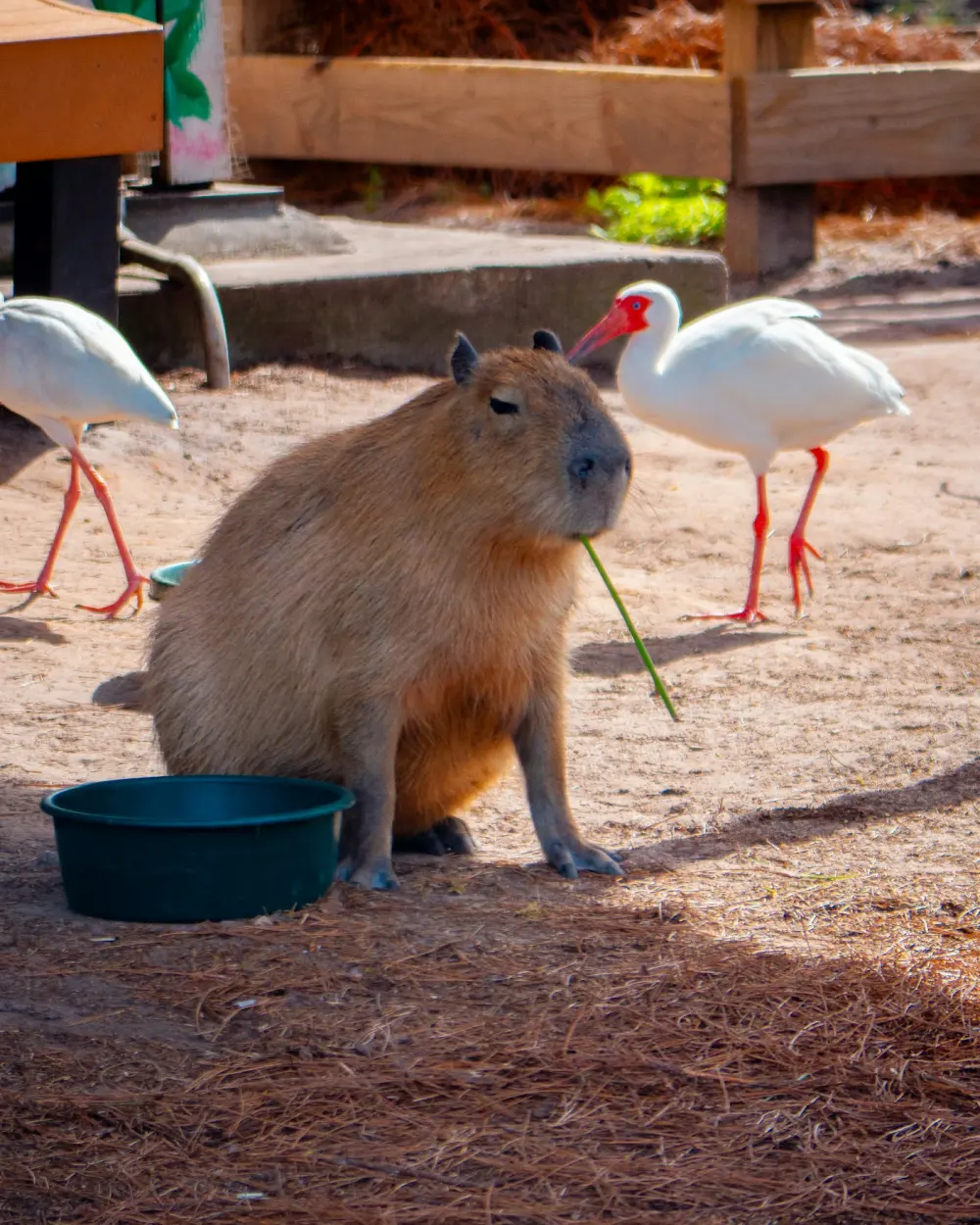
Animal Diversity Web describes capybaras as barrel-shaped, sturdy, and tailless. That barrel shape is the whole prank. A capybara can look short compared with a German shepherd, but it may still outweigh many dogs because its mass is packed close to the ground.
The capybara is not tall-big. It is dense-big.
Capybara Vs Dogs: Think Big Retriever, Not Small Terrier
For U.S. readers, dog comparisons work because most of us have stood beside a Labrador, golden retriever, German shepherd, or beagle at some point. A capybara belongs in the large-dog conversation, with one caveat: it is shaped like a furry ottoman with webbed feet.
The American Kennel Club’s breed weight chart lists Labrador retrievers around 55 to 80 pounds, golden retrievers around 55 to 75 pounds, and German shepherd dogs around 50 to 90 pounds. A capybara can sit right on top of those ranges and keep going.
So if someone says, “Capybaras are basically giant guinea pigs,” the honest answer is: sure, and a refrigerator is basically a lunchbox with confidence. (If you want the actual side-by-side with guinea pigs, nutria, and beavers, the homework is done.)
A healthy adult capybara can weigh as much as one large dog or two medium dogs. It also has a different center of gravity, a different gait, and a social life that involves water, grazing, and opinions about personal space.
Capybara Vs Beaver: The Rodent Heavyweight Match Nobody Asked For
Beavers are big. North American beavers are the largest rodents in North America, and Smithsonian’s National Zoo lists them at about 35 to 65 pounds, with rare heavy individuals reaching much higher.
But capybaras are bigger.
Smithsonian explicitly calls beavers the second largest rodents in the world, with South America’s capybaras being the heaviest. Britannica also identifies the capybara as the largest living rodent, growing up to about 4.3 feet long and 174 pounds.

The beaver has the engineering degree. The capybara has the weight class.
If rodents had a weigh-in, the capybara would arrive late, chew calmly, and still win.
Capybara Vs Toddlers: Useful, But Please Be Normal About It
Toddler comparisons are funny because they work, and also because nobody asked a two-year-old to be part of rodent journalism. Yet here we are.
The CDC explains that growth charts are percentile tools, not diagnostic instruments by themselves. That is important. Children vary. A lot. We are using toddler size only as a rough mental yardstick, not as health advice or playground accounting.
Using common U.S. growth-chart context, many 2-year-olds are somewhere around the mid-20s to low-30s in pounds. A typical adult capybara at 77 to 145 pounds can therefore weigh about three to five toddler-sized units, depending on the capybara and the child.
This is the part where the capybara stares into the middle distance, tired of being converted into toddlers for SEO.
Capybara size comparison, against the familiar animals people actually picture:
| Comparison | Approximate Adult Weight | Capybara Takeaway |
|---|---|---|
| Adult capybara | 77 to 145 lb commonly cited; up to 174 lb in some zoo references | The baseline. Biggest living rodent, full stop. |
| Labrador retriever | 55 to 80 lb (AKC) | Many capybaras outweigh Labs, though Labs stand taller and advertise more enthusiasm. |
| Golden retriever | 55 to 75 lb (AKC) | A capybara is often heavier, with less tail energy and more swamp furniture energy. |
| German shepherd dog | 50 to 90 lb (AKC) | Large capybaras can exceed the typical range; shepherds look taller because legs are a thing. |
| North American beaver | 35 to 65 lb (Smithsonian) | Capybaras are usually much heavier; beavers remain better at civil engineering. |
| 2-year-old child | Often roughly mid-20s to low-30s lb, depending on sex and percentile | One adult capybara can weigh several toddlers. This sentence is science-adjacent and cursed. |
| Guinea pig | Usually a few pounds | The family resemblance is real, but the scale jump is absurd. |
Why Capybaras Got So Huge
Capybaras are semi-aquatic herbivores. Their bodies make more sense when you stop imagining a pet and start imagining a wetland specialist.
San Diego Zoo Wildlife Alliance notes that capybaras live near rivers, ponds, marshes, and standing water, with slightly webbed feet and eyes, ears, and nostrils positioned high on the head. Animal Diversity Web notes that they spend the hottest part of the day in water and are strong swimmers.
That lifestyle rewards a low, sturdy body. Big adults can graze efficiently, move through water, and live in social groups where being a sturdy unit is helpful. They are not oversized by accident. They are built for a niche.

The size is part of the habitat story. Big body, social group, water nearby, grasses everywhere, predators worth taking seriously. That is the capybara recipe.
Can You Pick Up A Capybara?
Could a very strong person physically move a capybara? Maybe, in the same boring sense that a very strong person can make many bad decisions.
Should you pick up a capybara? No.
Capybaras are large wild animals with strong legs, serious teeth, and a nervous system that does not owe you a cuddle scene. Even young capybaras should only be handled by trained caregivers when necessary. A full adult is not a prop. It is a 77-to-145-pound animal with boundaries.
If you want a capybara photo, use distance and a zoom lens. Do not become the scale object.
What This Means For U.S. Capybara Fans
Most people in the United States will see capybaras in zoos, wildlife parks, sanctuaries, or carefully managed animal encounters. The size matters because it changes the etiquette.
Do not think “petting zoo rabbit.”
Think “large semi-aquatic mammal under professional care.”
That means barriers matter. Staff instructions matter. Space matters. If a capybara is resting, eating, moving away, or near young, your job is to admire from a sane distance and not audition for a warning sign.
The bigger the animal, the more expensive human silliness becomes. Capybaras are calm, but calm does not remove physics.
Bottom Line
Capybaras are bigger than the memes make them look. They are large-dog weight, beaver-beating rodent weight, and several-toddlers-in-a-trench-coat weight if you insist on making the comparison weird.
The clean answer: an adult capybara is about 3 to 4 feet long and often 77 to 145 pounds.
The better answer: a capybara is a heavy, social, semi-aquatic wetland animal that looks peaceful because it is built to conserve energy, stay near water, and not participate in nonsense.
Respect the size. Enjoy the loaf. Let physics keep its dignity.